The most common writing mistakes in holiday greetings are using apostrophes incorrectly, pluralizing family names incorrectly, and misusing punctuation or capitalization in greetings and sign-offs. For example, “Season’s greetings” needs an apostrophe, while a plural family name like “The Smiths” does not.
This quick guide breaks down the most frequent holiday greeting grammar mistakes with clear rules and examples you can follow confidently.
’Tis the season to send holiday greetings to one and all.
You’ve already chosen a beautiful card design now comes the part many people overthink: what to write inside so it sounds polished, warm, and intentional.
If you’re planning seasonal campaigns or personal mailings, pairing the right message with the right timing matters just as much as design. (If you’re mapping out the year ahead, this 2026 Print Campaigns marketing calendar is a helpful reference.)
The Most Common Holiday Card Grammar Mistakes
Before diving in, here’s a quick snapshot of the errors people make most often on holiday cards:
- Using apostrophes to pluralize last names
- Writing “Seasons greetings” instead of “Season’s greetings”
- Forgetting commas in holiday card sign-offs
- Misusing RSVP on holiday party invitations
These mistakes are common and easy to avoid once you know what to look for.
Where Do Apostrophes Go in Holiday Greetings?
Rule: Apostrophes are used for contractions and possession, not to make words plural.
Classic holiday phrases are familiar, but small punctuation errors can change their meaning.
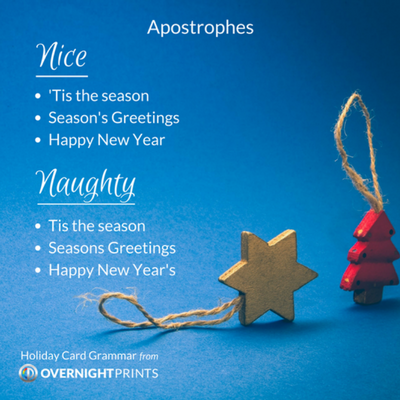
CORRECT:
- ‘Tis the season
- Season’s greetings
- Happy New Year
- New Year’s Eve
- New Year’s Day
INCORRECT:
- Tis the season
- Seasons greetings
- Seasons’ greetings
- Happy New Year’s
- New Years
Should Holiday Greetings Be Capitalized?
Rule: Holiday names are capitalized, but words like merry and happy are lowercase unless they start a sentence.
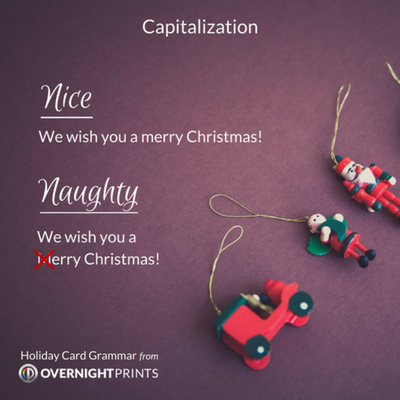
Correct:
-
Wishing you and yours a happy Kwanzaa
-
Happy Hanukkah to you and your family
Incorrect:
-
We wish you a Merry Christmas
If you’re designing cards for customers or clients, consistent capitalization helps your brand feel polished and professional, especially on printed holiday greeting cards.
Do You Need a Comma Before Signing a Holiday Card?
Rule: Closing phrases should be followed by a comma before the signature.
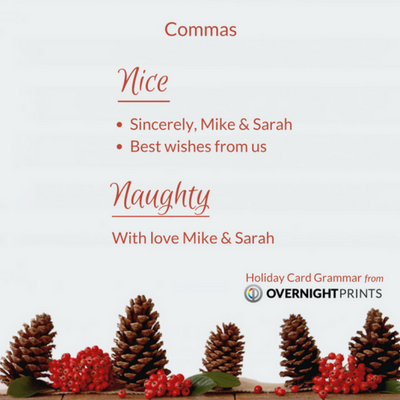
Correct:
Incorrect:
An easy alternative is to rephrase the closing and skip the comma entirely:
Correct:
How Do Apostrophes Work for Holiday Party Invitations?
Rule: When two people co-host an event, the apostrophe comes after the second name.
Feel free to send your holiday greeting card as the invitation itself. If you’re co-hosting the event, consider the compound possession rule for placing an apostrophe.
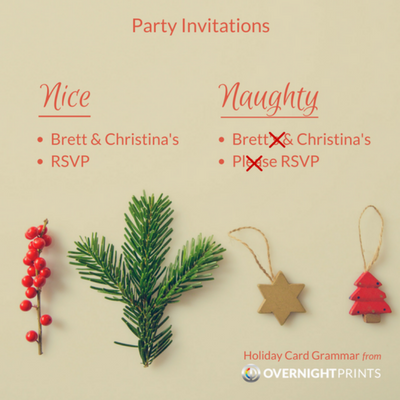
Correct:
Brett & Christina’s
Incorrect:
Brett’s & Christina’s
When asking guests to respond, remember that RSVP stands for the French phrase répondez s’il vous plaît, meaning “please respond.”
Correct:
RSVP
Incorrect:
Please RSVP (this literally means “please respond please”)
If you’re creating formal invites, keep wording simple and clean, whether you’re sending custom invitations or folded cards.
How Do You Make Last Names Plural on Holiday Cards?
Rule: To make a family name plural, add s or es, never an apostrophe unless you’re showing possession.
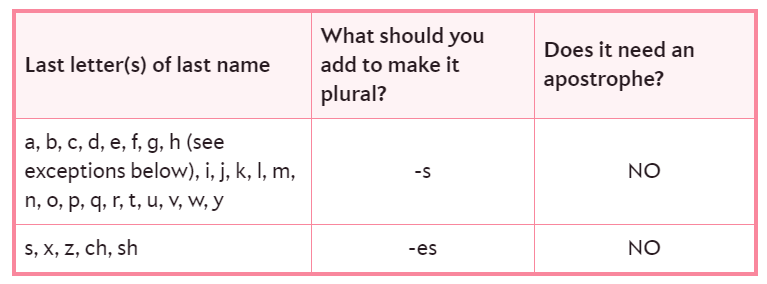
Correct:
- The Leahys
- The Ramirezes
Incorrect:
- The Leahies
- The Ramirezs
If you’re unsure, adding family is always safe.
Correct:
The Jones family
Incorrect:
- The Joneses family
- The Jones’ family
Holiday Card Grammar FAQs
Is “Happy Holidays” grammatically correct?
Yes. “Happy Holidays” is grammatically correct and is commonly used as a seasonal greeting when referring to the holiday season or multiple celebrations.
Should “Happy Holidays” be capitalized?
It depends on how the phrase is used. As a standalone greeting, card headline, or title, “Happy Holidays” is commonly capitalized. Within a sentence, lowercase may be appropriate, as in: “We wish you happy holidays and a wonderful new year.”
Is it “Season’s Greetings” or “Seasons Greetings”?
The standard form is “Season’s Greetings.” The apostrophe in “Season’s” indicates that the greetings are associated with the season.
Does “Season’s Greetings” need an apostrophe?
Yes. Write “Season’s Greetings,” with an apostrophe before the s in “Season’s.” Writing “Seasons Greetings” without an apostrophe is not the standard form.
Do you put a comma after “Love” on a card?
Yes. When “Love” is used as a closing before a name or signature, it is normally followed by a comma.
Example:
Love,
The Smith Family
The same pattern applies to closings such as “Best wishes,” “Warmly,” and “Sincerely.”
Do you put a comma after “From” on a card?
Not always. If “from” is part of a phrase such as “With love from the Smith family,” no comma is needed. On a card signed simply “From the Smith family,” a comma may be used depending on the layout and style, but rewriting the closing as a complete phrase can often look more natural.
How do you pluralize a last name on a holiday card?
Usually, add s or es to make a family name plural. Do not add an apostrophe simply to make a last name plural.
For example:
- Smith → The Smiths
- Jones → The Joneses
- Bush → The Bushes
- Martinez → The Martinezes
If the plural form feels awkward, “The [Last Name] Family” is a simple alternative.
Does a family last name need an apostrophe on a holiday card?
Not when you’re simply referring to the whole family. For example, “Happy Holidays from the Smiths” does not need an apostrophe. Apostrophes are used to show possession, not to make a last name plural.
Should “Merry Christmas” be capitalized?
Christmas is always capitalized because it is the name of a holiday. On a card, headline, or standalone greeting, “Merry Christmas” is normally capitalized. Within a sentence, “merry” may be lowercase, as in: “We wish you a merry Christmas.”
Should “Happy New Year” be capitalized?
As a standalone greeting or card headline, “Happy New Year” is commonly capitalized. In a regular sentence, capitalization depends on how the phrase is being used, but New Year’s Eve and New Year’s Day are capitalized as holiday names.
How do you punctuate “‘Tis the season”?
The traditional spelling is “’Tis the season.” The apostrophe comes before “Tis” because ’tis is a contraction of “it is,” and the apostrophe represents the omitted letter.
What are the most common holiday card grammar mistakes?
Some of the most common holiday card grammar mistakes include using apostrophes to make last names plural, writing “Seasons Greetings” instead of “Season’s Greetings,” forgetting punctuation in card closings, and using inconsistent capitalization in holiday greetings. Proofreading these details before printing can help your holiday cards look polished and professional.
A Quick Printing Tip
Before sending your cards to print, it’s worth doing one final grammar check, especially for customer-facing or corporate mailings. Clean copy paired with quality materials (like choosing the right stock — explained in this guide to paper types) makes a noticeable difference in how your message is received.
If you’re preparing seasonal outreach, you may also find these helpful:
- The Complete Guide to Holiday Greeting Card Printing
- Corporate Holiday Cards: Why You Should Order in September
- Holiday Print Prep: Get Ahead Before the Rush
Design custom holiday greeting cards and seasonal print materials with Overnight Prints — so your message feels thoughtful, professional, and mistake-free.