Choosing the paper, size, images, and layout may get most of the attention when planning a booklet, but there is another decision that can significantly change the finished product:
How will the pages be bound together?
Binding affects how a booklet looks, feels, opens, holds up during use, and even how you should prepare the design.
Two methods you will frequently encounter are saddle stitch binding and perfect binding.
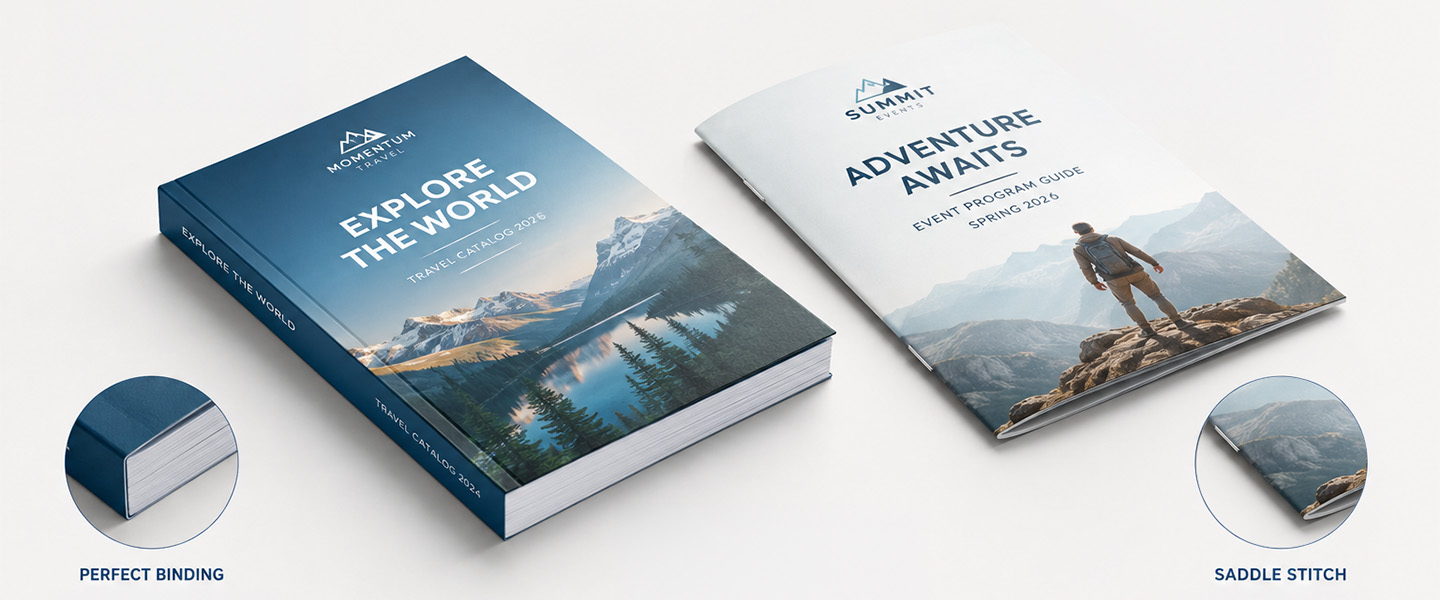
Saddle-stitched booklets use folded sheets secured through the center fold with staples. Perfect-bound publications use adhesive to attach pages to a flat spine, creating an appearance closer to a paperback book.
Neither method is automatically better.
A short event program has very different requirements from a 150-page product catalog. The right binding depends on your page count, budget, intended use, distribution method, and the impression you want the finished publication to create.
Here is how saddle stitch and perfect binding compare.
Key Takeaways
- Saddle stitching uses staples through the folded spine, while perfect binding uses adhesive to attach pages to a flat spine.
- Saddle stitching is generally better suited to shorter publications, while perfect binding is commonly used for longer, thicker projects.
- Page count is one of the most important factors when choosing a binding method.
- Saddle stitching generally provides a simpler and more economical format, while perfect binding creates a more book-like appearance.
- Your project’s purpose, budget, distribution method, page count, and desired presentation should all influence the final decision.
- Overnight Prints currently produces saddle-stitched booklets in page counts from 8 to 64 pages.
What Is Saddle Stitch Binding?
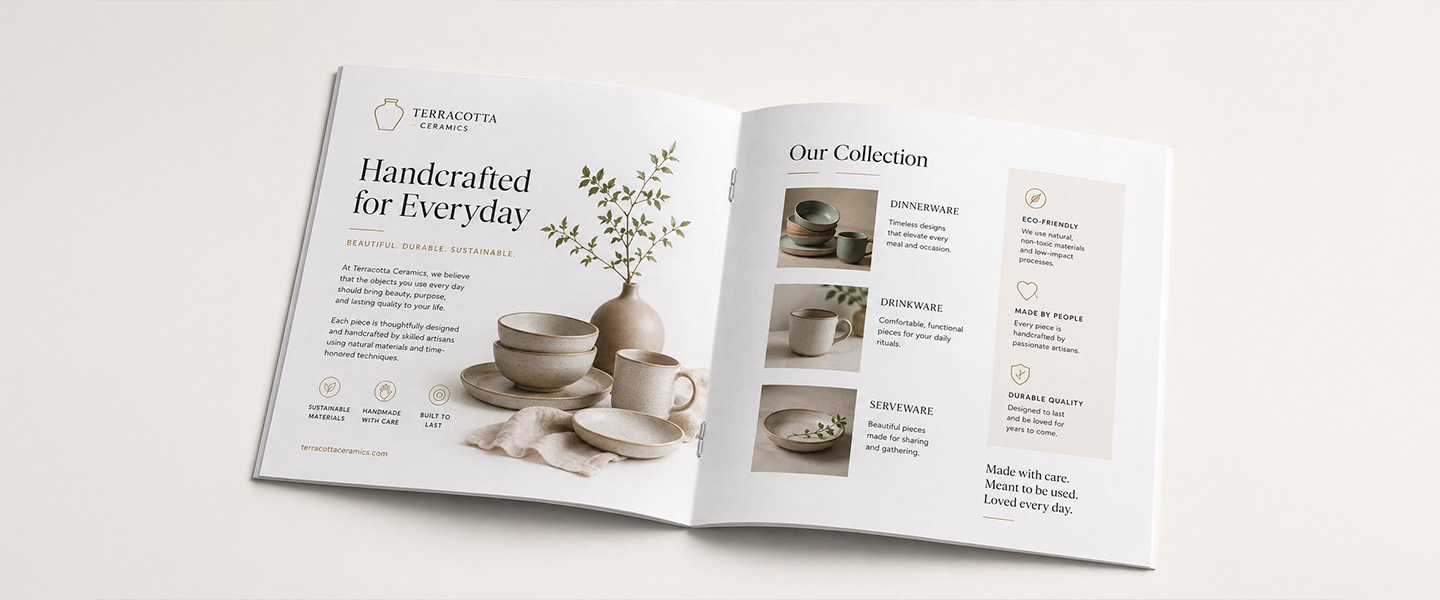
Saddle stitching is one of the most common methods used to bind shorter booklets.
Printed sheets are arranged, folded in half, nested inside one another, and secured through the center fold. Two staples are commonly used along the spine.
Despite the word “stitch,” the binding typically uses metal staples rather than thread.
The result is a lightweight booklet without a flat, square spine.
Because the pages are created from folded sheets, saddle-stitched publications normally need page counts that work with this construction. In common booklet layouts, pages are added in multiples of four.
For example:
- 8 pages
- 12 pages
- 16 pages
- 20 pages
- 24 pages
and so on.
As page counts increase, the thickness of the nested sheets also increases. This can create creep, where inner sheets extend slightly farther outward than outer sheets before trimming. Proper booklet setup accounts for this during production.
When Is Saddle Stitching a Good Choice?
Saddle stitching works particularly well for shorter projects that need to remain lightweight and easy to distribute.
Common examples include:
- event programs,
- product brochures,
- instruction guides,
- small catalogs,
- marketing booklets,
- training materials,
- company profiles,
- short publications,
- and promotional guides.
If your content needs more room than a traditional Brochure but does not require a large publication, a saddle-stitched Booklet can provide a practical middle ground.
What Is Perfect Binding?
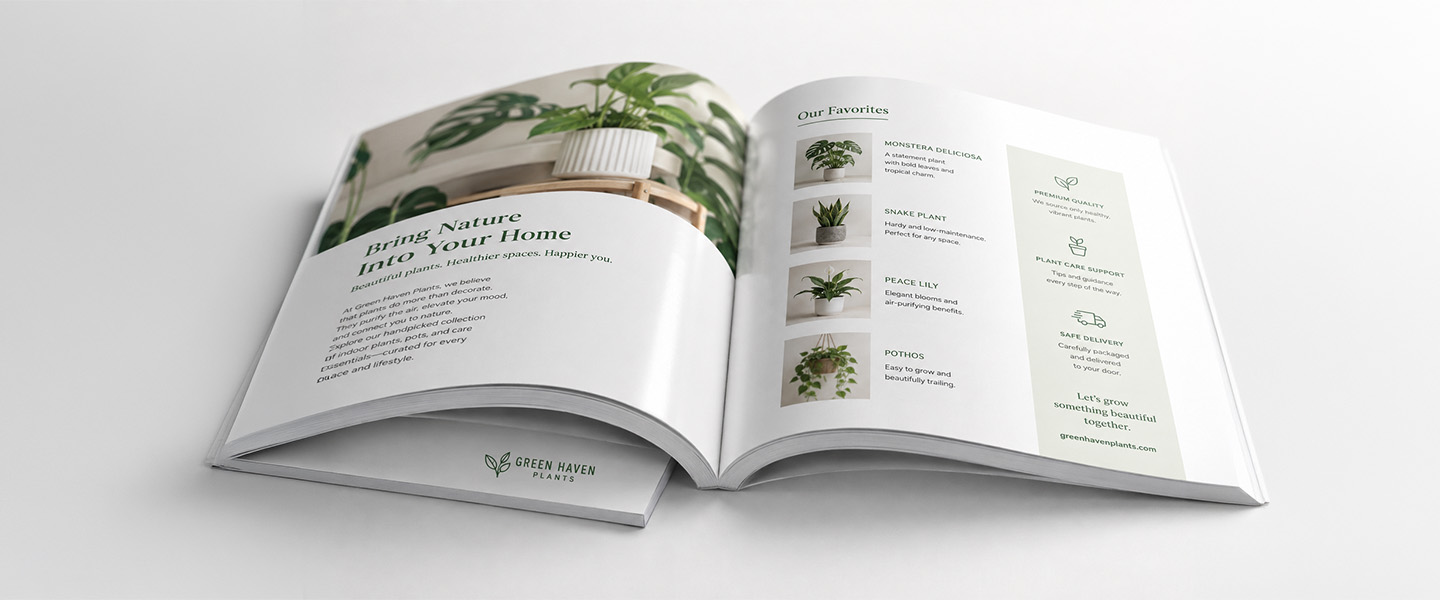
Perfect binding creates the flat, squared spine commonly associated with paperback books, magazines, catalogs, and larger reports.
Instead of nesting folded sheets and stapling them through the center, pages or signatures are gathered together and attached to a cover using adhesive along the spine.
The result is a more substantial, book-like publication.
One of the biggest visual differences is the spine.
A sufficiently thick perfect-bound publication can provide space for information such as:
- a publication title,
- company name,
- issue number,
- or branding.
This can be useful when publications are stored upright on shelves or displayed alongside other materials.
Perfect binding generally becomes practical with larger page counts because the publication needs enough thickness for the adhesive-bound spine.
Exact minimum and maximum page requirements vary by printer, paper stock, page dimensions, and production method, so specifications should always be confirmed before designing the publication.
When Is Perfect Binding a Good Choice?
Perfect binding is commonly considered for larger publications such as:
- large product catalogs,
- annual reports,
- company publications,
- detailed product guides,
- magazines,
- portfolios,
- manuals,
- and longer booklets.
It is particularly useful when the finished piece needs a more substantial, book-like presentation.
Important: Overnight Prints currently specializes in saddle-stitched booklets and does not offer perfect binding. If you’re planning to order your booklet through Overnight Prints, the available saddle-stitched format supports projects from 8 to 64 pages.
Saddle Stitch vs. Perfect Binding: What’s the Difference?
The easiest way to understand the two binding styles is to compare how they are constructed and used.
| Feature | Saddle Stitch | Perfect Binding |
| Binding Method | Staples through the center fold | Adhesive along a flat spine |
| Appearance | Clean, lightweight and professional | Polished and book-like |
| Page Count | Best suited to shorter projects | Better suited to longer publications |
| Spine | No flat printable spine | Printable spine when sufficiently thick |
| Opening | Opens relatively wide | Spine can limit how fully pages open |
| Weight | Generally lighter | Generally heavier |
| Cost | Usually more economical | Typically higher |
| Best For | Programs, marketing booklets, short catalogs | Large catalogs, reports, magazines, longer publications |
The main decision often comes down to a simple question:
How much content does your publication actually need?
If your content fits comfortably into a shorter booklet, saddle stitching can provide everything you need without adding unnecessary complexity.
If your publication contains significantly more pages and needs to resemble a paperback book, perfect binding may make more sense.
Why Your Booklet Binding Choice Matters
Binding is not simply the final production step.
It affects several parts of the project.
Presentation
A saddle-stitched booklet feels lightweight and approachable.
A perfect-bound publication feels more like a traditional book.
Neither presentation is inherently more professional. The right one depends on the project.
Durability
Both methods can create durable printed pieces when properly produced, but they behave differently.
Saddle stitching mechanically secures folded sheets through the spine. Perfect binding relies on adhesive and the construction of the spine.
How often the publication will be handled should therefore be considered when choosing a format.
User Experience
Think about how readers will physically interact with your publication.
Will they quickly flip through an event program?
Will they reference an instruction guide while completing a task?
Will they keep a catalog for several months?
Will the publication sit on a shelf?
The answers can influence which binding format makes the most sense.
Page Count
Page count is one of the biggest practical limitations.
Saddle-stitched booklets become increasingly bulky as more folded sheets are nested together. Perfect binding becomes more practical once a publication has enough pages to form a usable spine.
Budget
Saddle stitching is generally the more economical production method because its construction is relatively straightforward.
Perfect binding usually involves additional production processes and materials, which can increase the cost.
Brand Perception
Binding also contributes to how the finished publication feels.
A short, beautifully designed saddle-stitched booklet can look highly professional.
A substantial perfect-bound report can create an authoritative, permanent feel.
The important thing is matching the format to the message.
How to Choose the Right Binding for Your Project
Before choosing a binding style, evaluate the project as a whole rather than focusing on appearance alone.
Consider Your Page Count
Start here.
Saddle stitching is designed around folded sheets, which is why page counts generally need to work in multiples of four.
Adobe’s booklet preparation guidance notes that saddle-stitched documents need page counts divisible by four; otherwise, blank pages may need to be added during imposition.
Overnight Prints currently offers saddle-stitched Booklets ranging from 8 to 64 pages.
Perfect binding is generally more appropriate once a publication becomes too large or thick for practical saddle stitching.
Always confirm the printer’s specifications before finalizing your page count.
Consider Your Budget
For shorter publications, saddle stitching is generally the more cost-conscious choice.
That can make it particularly attractive when printing:
- promotional materials,
- event programs,
- conference handouts,
- marketing campaigns,
- or larger quantities.
Perfect binding can cost more, but the additional expense may make sense when the project specifically needs the appearance and construction of a book.
Do not pay for a more complicated binding method simply because it sounds more premium.
Pay for the format your project actually needs.
For more information about the factors that affect booklet costs, see How Much Does Booklet Printing Cost?.
Think About the Final Appearance
Ask what you want someone to think when they pick up the publication.
Saddle stitch tends to feel:
- lightweight,
- accessible,
- simple,
- and practical.
Perfect binding tends to feel:
- substantial,
- formal,
- book-like,
- and permanent.
A marketing booklet does not necessarily benefit from looking like a book.
Likewise, a large annual publication may feel more appropriate with a defined spine.
Consider How the Booklet Will Be Used
A booklet handed out during a one-day conference has different requirements from a catalog customers may keep for six months.
For short-term materials, saddle stitching often provides an effective balance of presentation and cost.
For longer reference materials, page count and long-term handling may make another binding style more appropriate.
Before deciding how many pages you need, read What Should a Booklet Include? for a page-by-page approach to organizing business booklet content.
Think About Distribution
How will the publication reach the reader?
If you’re handing out hundreds of pieces at a trade show, weight and cost matter.
If you’re mailing the publication, dimensions and weight can influence shipping or mailing expenses.
If you’re placing it inside a Presentation Folder, the finished thickness matters.
If customers will pick it up from a display, the cover and overall presentation become particularly important.
Design for the way the booklet will actually be distributed, not simply how it looks on a computer screen.
Which Binding Is Best for Different Types of Projects?
There are no universal rules, but these recommendations provide a useful starting point.
| Project | Recommended Binding | Why |
| Event Program | Saddle Stitch | Lightweight, easy to distribute and appropriate for shorter content |
| Small Product Catalog | Saddle Stitch | Provides multiple pages without unnecessary bulk |
| Large Product Catalog | Perfect Binding | Better suited to substantial page counts and book-like presentation |
| Company Report | Perfect Binding | Creates a more permanent publication when the report is long enough |
| Instruction Manual | Depends | Page count, frequency of use and required opening behavior matter |
| Marketing Booklet | Usually Saddle Stitch | Practical for concise branded storytelling and promotional content |
| Magazine | Depends | Shorter issues may use saddle stitch; larger publications may use perfect binding |
| Company Profile | Saddle Stitch | Professional presentation without requiring a large page count |
| Annual Publication | Often Perfect Binding | Useful for larger documents intended to be kept |
| Conference Guide | Saddle Stitch | Lightweight and convenient for attendees |
The content should ultimately determine the format.
Do not expand a 16-page booklet into a 60-page publication just to justify a particular binding style.
And do not compress a detailed 100-page publication simply to force it into a format designed for shorter projects.
Common Booklet Binding Mistakes to Avoid
Choosing the Binding Method Too Late
Binding affects layout, margins, page count, and document setup.
It should be considered before the design is finished, not immediately before printing.
Ignoring Page-Count Requirements
This is particularly important with saddle stitching.
Because sheets are folded to create multiple pages, the final page count needs to work with the binding method.
Planning your content structure early prevents awkward blank pages or last-minute additions.
Forgetting About Margins and the Binding Area
Content placed too close to the fold or spine can become difficult to read or appear visually cramped.
Your layout should account for how the publication will be physically assembled.
Ignoring Creep
As folded sheets are nested together in a saddle-stitched booklet, inner pages can extend outward farther than outer pages.
This is known as creep.
Professional booklet preparation compensates for it so that content remains correctly positioned after trimming.
Choosing Based Only on Price
The cheapest option is not automatically the best option.
At the same time, the most expensive binding method is not automatically better.
Compare cost with the actual purpose of the publication.
Paying for a Premium Format You Don’t Need
A short marketing booklet does not necessarily need a book-style spine.
If saddle stitching already gives the project the appearance, durability, and functionality it needs, additional complexity may offer little practical benefit.
Forgetting About Distribution
A thick publication may look impressive but become more expensive or inconvenient to ship in large quantities.
Think about storage, transportation, mailing, display, and hand distribution before finalizing the format.
Design Your Booklet Around the Binding
Once you’ve chosen your binding, your design needs to support it.
For saddle-stitched booklets, pay particular attention to:
- page counts,
- safe zones,
- bleed,
- margins,
- center spreads,
- and content close to the fold.
Overnight Prints recommends designing and uploading booklet files as individual pages rather than two-page spreads.
This is also where content planning becomes important.
A booklet should not simply be a collection of unrelated pages. Each page should move the reader naturally toward the next part of the message.
For help organizing that journey, see What Should a Booklet Include?.
And if you’re still deciding whether you need a booklet at all, Booklets vs. Brochures: Which Should You Use? can help you compare the two formats.
Why Choose Overnight Prints for Booklet Printing?
Overnight Prints offers professional Booklet Printing for businesses that need a structured multi-page format for catalogs, event programs, training manuals, company profiles, and marketing materials.
Current booklet options include:
- saddle-stitch binding,
- 8 to 64 pages,
- popular 5.5″ × 8.5″ and 8.5″ × 11″ sizes,
- full-color printing,
- premium paper options,
- online design and file-upload tools,
- and multiple shipping options.
Overnight Prints specializes in saddle-stitched booklets rather than perfect binding, making its booklet offering particularly suited to shorter and medium-length business publications.
If that format matches your project’s page count and purpose, you can explore the available Booklet Printing options before preparing your final artwork.
Frequently Asked Questions
What is the difference between saddle stitch and perfect binding?
Saddle stitching folds sheets together and secures them through the center fold with staples. Perfect binding attaches pages or signatures to a flat spine using adhesive. Saddle stitching is commonly used for shorter publications, while perfect binding is typically associated with longer, more book-like publications.
Is saddle stitch cheaper than perfect binding?
Generally, yes. Saddle stitching is usually a simpler and more economical binding process, particularly for shorter publications. Actual pricing depends on the printer, quantity, page count, size, paper, and other specifications.
How many pages can a saddle-stitched booklet have?
The practical maximum varies by printer, paper stock, and booklet dimensions. Overnight Prints currently offers saddle-stitched booklets from 8 to 64 pages.
What is the minimum page count for perfect binding?
There is no universal minimum because the required thickness depends on the printer, paper stock, page size, and binding equipment. Perfect binding needs enough thickness to create a functional adhesive-bound spine, so always check the printer’s specifications.
Which booklet binding is more durable?
Both can provide durable results when properly produced. Perfect binding creates a substantial book-like structure, while saddle stitching mechanically secures pages through the fold. The better option depends on page count, materials, construction, and how the publication will be handled.
Can saddle-stitched booklets lay flat?
Saddle-stitched booklets can generally open wider and flatter than many perfect-bound publications because there is no glued flat spine restricting the center fold. How flat they sit also depends on page count and paper thickness.
Can you print on the spine of a perfect-bound booklet?
Yes, provided the finished publication has enough spine width to accommodate readable text or graphics. Exact requirements depend on the printer and final spine thickness.
Which binding is best for a product catalog?
For a shorter product catalog, saddle stitching can provide an economical and professional format. Larger catalogs with substantially higher page counts may be better suited to perfect binding.
Conclusion
Saddle stitch and perfect binding solve different printing problems.
Saddle stitching works particularly well for shorter, lightweight, and cost-conscious publications such as event programs, marketing booklets, small catalogs, company profiles, and instructional materials.
Perfect binding is generally better suited to larger publications that need a flat spine and more book-like presentation.
The right decision ultimately depends on four things:
page count, purpose, budget, and desired appearance.
Start with your content rather than the binding.
Determine how much information readers actually need, how they will use the publication, and how it will be distributed. From there, choosing the appropriate format becomes much easier.
For projects between 8 and 64 pages that fit a saddle-stitched format, explore custom Booklet Printing from Overnight Prints to compare available sizes, paper options, and printing specifications.
Resources
- PRINTING United Alliance – Printing Industry Glossary – Industry terminology and definitions for binding, printing, paper, and commercial print production.
- Adobe InDesign – Booklet Printing Settings – Guidance covering margins, bleed, signatures, spacing, and booklet imposition.
- AIGA – The Professional Association for Design – Professional resources related to graphic design and visual communication.