
A quick “thank you” can mean more when someone takes the time to write it down.
Employee appreciation cards give managers, business owners, and teams a simple way to recognize the people behind the work—whether someone delivered a great project, helped a teammate, reached a milestone, or simply deserves recognition for consistently doing a good job.
But then comes the difficult part:
What should you actually write in an employee appreciation card?
A good message doesn’t have to be long. In fact, a few specific and sincere sentences are usually more meaningful than a paragraph filled with generic praise.
In this guide, you’ll find employee appreciation message examples for different situations, occasions when it makes sense to send a card, and tips for creating recognition that feels personal rather than routine.
What Is an Employee Appreciation Card?

An employee appreciation card is a physical or digital card used to recognize an employee’s contribution, effort, achievement, milestone, or positive impact.
Businesses can use them for formal recognition occasions, but they don’t have to be reserved for major achievements.
You might send one after:
- Completing an important project
- Receiving positive customer feedback
- Reaching a work anniversary
- Helping another team
- Handling a difficult situation well
- Achieving a sales or performance goal
- Taking initiative
- Supporting a new employee
- Going above expectations
- Consistently doing great work
Employee recognition matters beyond a single annual celebration. Gallup recommends making recognition an ongoing part of the employee experience rather than treating it as a once-a-year event. Gallup’s employee recognition guidance
That makes appreciation cards particularly useful because they’re simple enough to use throughout the year.
When Should You Send an Employee Appreciation Card?
There’s no single correct date.
Some cards are tied to specific occasions, while others are more meaningful precisely because the employee wasn’t expecting one.
Here are several opportunities to consider.
Employee Appreciation Day
Employee Appreciation Day is an obvious opportunity to recognize your team.
Companies can give everyone a card with a personalized note rather than sending the same generic message to the entire organization.
If you’re preparing recognition for the occasion, you can also explore our Employee Appreciation Day card templates and ideas for additional inspiration.
Work Anniversaries
A work anniversary is an opportunity to recognize more than the number of years someone has been with the company.
Mention something they’ve contributed during that time.
Instead of:
Happy five-year anniversary!
Try:
Happy five-year anniversary, Maya! Thank you for the energy and care you’ve brought to our customer team. You’ve helped make some of our busiest seasons feel much more manageable.
The second message tells the employee why they’re appreciated.
After a Major Project
Don’t wait until the end of the year to recognize something someone accomplished months ago.
If an employee successfully launches a project, solves an important problem, or gets the team through a demanding deadline, recognize the contribution while it’s still fresh.
For example:
Thank you for everything you put into the website launch. Your attention to detail during the final week made a huge difference, and we really appreciate the extra effort.
After Positive Customer Feedback
If a customer specifically praises an employee, share the recognition.
You could write:
A customer mentioned how helpful and patient you were while solving their issue. Thank you for representing our team so well and taking such good care of our customers.
This connects the appreciation directly to something the employee did.
After Someone Helps the Team
Not every valuable contribution appears on a performance dashboard.
Maybe someone trained a new coworker, stepped in during a busy week, shared expertise, or helped solve another department’s problem.
Those are excellent moments for recognition.
Promotions and New Responsibilities
A promotion is both an achievement and the beginning of something new.
An appreciation card can recognize what led to the opportunity while expressing confidence about what’s next.
At the End of the Year
Year-end cards can thank employees for their contributions throughout the year.
If you’re planning employee recognition alongside customer and business holiday communications, our holiday marketing timeline can help organize print planning ahead of the busy season.
For No Special Reason
Some of the best recognition isn’t connected to a calendar.
A card that simply says:
I’ve noticed the way you’ve been helping everyone on the team lately. Thank you.
can feel more genuine than recognition employees know is scheduled every year.
What Should You Write in an Employee Appreciation Card?
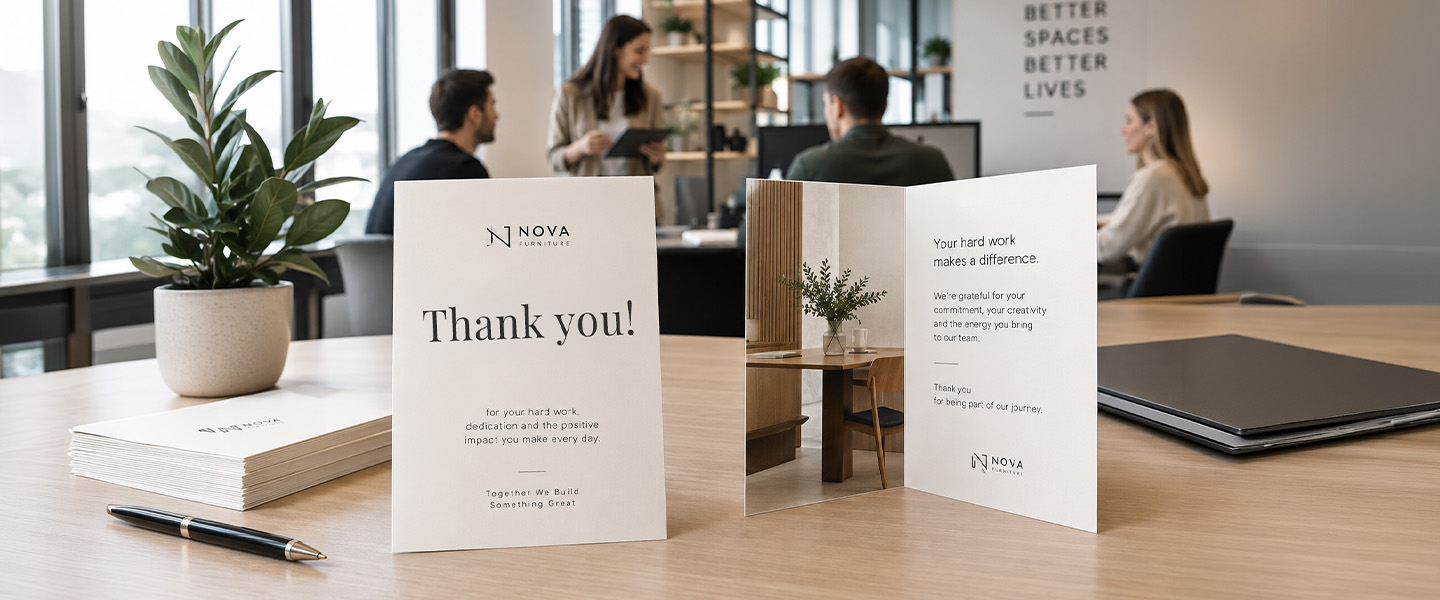
A strong employee appreciation message usually has three simple parts:
- Say what you’re recognizing.
- Explain why it mattered.
- Thank the person.
For example:
Great job on yesterday’s presentation. You made a complicated topic easy for the client to understand, and your preparation really showed. Thank you for representing the team so well.
Notice that the message doesn’t rely on words like amazing, awesome, or incredible.
It’s effective because it’s specific.
Recognition research from Gallup and Workhuman has similarly emphasized that effective recognition should be authentic, personalized, and connected to what the employee contributed. Gallup and Workhuman employee recognition research
Employee Appreciation Card Messages for Great Work
You don’t need an elaborate message when recognizing everyday performance.
Try:
Thank you for the consistently great work you bring to the team. Your reliability makes a real difference, and it’s appreciated.
Or:
Your work on this project was excellent. Thank you for being so thoughtful and thorough from beginning to end.
Or:
Thank you for always bringing such care to your work. It doesn’t go unnoticed.
Or:
You’ve done an outstanding job this month. Thank you for your focus, consistency, and everything you contribute to the team.
Make it better
Instead of simply writing:
Great job!
add the reason:
Great job on the client presentation. You anticipated their questions and made the entire meeting run smoothly.
Specific recognition feels more personal because the employee knows you’re paying attention.
Employee Appreciation Messages for Going Above and Beyond

When someone makes an extra effort, name it.
For example:
Thank you for stepping in when the team needed extra help this week. Your willingness to take on more made a difficult deadline much easier for everyone.
Or:
I really appreciate the extra effort you put into getting this project across the finish line. Thank you for being someone the team can count on.
Or:
You went well beyond what was expected on this project, and it made a noticeable difference. Thank you for everything you put into it.
Avoid making “going above and beyond” synonymous with consistently working late or sacrificing personal time. Recognition should celebrate meaningful contributions without suggesting that overwork is the standard for being appreciated.
Employee Appreciation Messages for Teamwork
Some employees make the people around them better.
Recognize that contribution too.
Try:
Thank you for always being willing to share what you know and help your teammates. You make this a stronger team.
Or:
Your support made a huge difference during a busy week. Thank you for jumping in and helping everyone stay on track.
Or:
We appreciate the way you bring people together and make collaboration easier. Thank you for being such a supportive teammate.
Or:
Thank you for making time to help our new team members get settled. Your patience and willingness to share your knowledge have made their transition much easier.
Employee Appreciation Messages for Leadership
Recognition shouldn’t only flow from managers to employees.
Leaders, supervisors, mentors, and team leads can also be thanked for the way they support their teams.
For example:
Thank you for always making time to answer questions and help us find solutions. Your support makes a real difference to the team.
Or:
I appreciate the trust and encouragement you give us to take ownership of our work. Thank you for being such a supportive leader.
Or:
Thank you for keeping the team focused and calm during a challenging project. Your leadership helped us get through it successfully.
Employee Appreciation Messages for Work Anniversaries
A work anniversary message should acknowledge both the milestone and the person’s contribution.
One-year anniversary
Happy first work anniversary! Thank you for everything you’ve brought to the team this year. We’re glad you’re here and excited to see what’s ahead.
Five-year anniversary
Five years already! Thank you for the knowledge, commitment, and energy you’ve brought to the team over the years. You’ve made a lasting impact here.
Long-term employee
Thank you for all the years you’ve dedicated to our team. Your experience, consistency, and willingness to support others have helped shape the company in ways that are deeply appreciated.
Whenever possible, personalize anniversary messages with a specific achievement, memory, or contribution from the employee’s time at the company.
Employee Appreciation Messages After a Difficult Project
Recognition can be especially meaningful after a demanding period.
Try:
That was a challenging project, and I really appreciate how you stayed focused and solution-oriented throughout it. Thank you for helping us get to the finish line.
Or:
Thank you for the patience and persistence you brought to this project. There were plenty of unexpected challenges, and your contribution helped us work through them.
Or:
We couldn’t have completed this project without your expertise and attention to detail. Thank you for everything you contributed.
Short Employee Appreciation Messages
Sometimes you only have room for a sentence or two.
That’s fine.
A short message can still feel personal:
- Thank you for everything you bring to our team.
- Your hard work and consistency are truly appreciated.
- Thank you for always being someone we can count on.
- Your contribution made a real difference. Thank you.
- We appreciate the care you bring to your work every day.
- Thank you for helping make this team stronger.
- Your effort hasn’t gone unnoticed. Thank you.
- We’re grateful to have you on the team.
- Thank you for taking the initiative and making it happen.
- Your work made this project better. Thank you.
The key is to choose a message that actually fits the person and situation.
What Should You Avoid Writing in an Employee Appreciation Card?
Recognition can lose its impact when the message feels copied, exaggerated, or disconnected from what the employee actually did.
Avoid these common mistakes.
Making every card identical
If 20 employees receive exactly the same message, the gesture can feel more like a campaign than genuine recognition.
The cards themselves can share the same branded design, but try to personalize the handwritten or individual message.
Being too vague
Thanks for everything!
isn’t wrong.
But:
Thank you for taking the lead on training our two new team members this month.
is much more meaningful.
Turning appreciation into feedback
An appreciation card isn’t the place for:
Great job this quarter! Next quarter, we’d like to see you improve…
Keep recognition and constructive performance feedback separate.
Comparing employees
Avoid messages such as:
You’re one of the only people who always gets this right.
Even when intended as praise, it comes at someone else’s expense.
Focus on the recipient.
Overdoing corporate language
You don’t need to write:
Your unwavering commitment to operational excellence continues to exemplify our organizational values.
unless that’s genuinely how people at your company speak.
Something like:
Thank you for being so dependable. We really appreciate having you on the team.
usually feels much more human.
Should Employee Appreciation Cards Be Handwritten?
They don’t have to be completely handwritten, but adding a handwritten element can make a printed card feel much more personal.
One practical approach is to use professionally printed notecards or greeting cards with company branding on the outside and leave space inside for managers to write individual messages.
This gives the company a consistent presentation without making every employee receive the exact same note.
For a larger organization, you could also print a general message inside and have the employee’s direct manager add a short handwritten note.
How to Design Employee Appreciation Cards
The message is the most important part, but the design can reinforce the gesture.
Keep the card relatively simple.
Consider including:
- Company logo
- Brand colors
- A short appreciation headline
- Plenty of space for a personal message
- Employee recognition theme
- Subtle company graphics or illustrations
A front cover could simply say:
You Make a Difference
or:
Thank You for Everything You Do
The inside then provides enough blank space for a manager to explain why.
This is one situation where leaving empty space is actually part of the design.
Should You Include Your Company Logo?
Yes, if the card is part of an official employee-recognition program.
Branding helps connect the recognition to the organization, but it shouldn’t dominate the card.
A giant company logo with a tiny area for the employee’s message can make the card feel promotional.
Keep the focus on the person being recognized.
Can Small Businesses Use Employee Appreciation Cards?
Absolutely.
Employee recognition isn’t limited to companies with large HR departments or formal recognition programs.
In fact, small businesses may have an advantage: owners and managers often know their employees’ individual contributions closely enough to make recognition highly specific.
A restaurant owner could thank an employee for handling a particularly busy weekend.
A small agency could recognize someone after a successful client launch.
A local retailer could thank an employee mentioned in a positive customer review.
The card doesn’t need to be elaborate.
It needs to show that someone noticed.
Create an Employee Recognition Habit
Employee appreciation cards work best when they’re not treated as a once-a-year obligation.
Keep a small supply of cards available so managers can recognize contributions when they happen.
You could create simple triggers:
Customer compliments an employee → Send a card
Major project completed → Recognize key contributors
Work anniversary → Send a personalized note
Employee helps another department → Say thank you
Team reaches an important milestone → Recognize the people behind it
This makes recognition part of everyday management rather than another annual HR task.
Organizations can also establish broader recognition practices. The U.S. Office of Personnel Management notes that effective employee recognition can include both formal and informal approaches and that timely recognition can reinforce valued behaviors and contributions. U.S. Office of Personnel Management recognition guidance
A Simple Formula for Writing Your Own Message
If you’re staring at a blank card and don’t know where to begin, use this formula:
Thank them + identify the contribution + explain the impact.
For example:
Thank you for taking the time to help train our new team members. Your patience and knowledge made their first few weeks much easier.
Or:
Thank you for catching the issue before launch. Your attention to detail saved the team a lot of extra work.
Or:
Thank you for the way you handled that customer situation. Your patience helped turn a difficult conversation into a positive outcome.
You don’t need to sound like a professional greeting-card writer.
You just need to sound like you noticed.
Frequently Asked Questions About Employee Appreciation Cards
What do you write in an employee appreciation card?
Start by identifying exactly what the employee did, explain why it mattered, and thank them. For example: “Thank you for taking the lead on the client presentation. Your preparation made the meeting run smoothly, and we really appreciate the extra effort.”
Specific messages usually feel more meaningful than general phrases such as “great job.”
When should you send employee appreciation cards?
Employee appreciation cards can be sent after achievements, successful projects, positive customer feedback, work anniversaries, promotions, acts of teamwork, or Employee Appreciation Day. You can also send one simply to recognize someone’s consistent contribution.
Recognition doesn’t need to wait for a special occasion.
How long should an employee appreciation message be?
Usually, two to four sincere sentences are enough. The quality and specificity of the message matter more than its length.
Should a manager sign an employee appreciation card?
When possible, yes. A signature or short handwritten note from the employee’s direct manager can make the recognition feel more personal.
For significant achievements, senior leaders or teammates may also add their own messages.
Should employee appreciation cards be personalized?
Yes. You can use the same card design across the company while personalizing the message for each employee. Mentioning a specific achievement, behavior, or contribution makes the recognition more credible.
Is an employee appreciation card enough on its own?
It depends on the situation. A card can be an appropriate way to recognize everyday contributions, milestones, and acts of teamwork, but it shouldn’t replace appropriate compensation, promotions, bonuses, time off, or other forms of recognition when those are warranted.
What is a good short employee appreciation message?
A simple example is:
“Thank you for everything you bring to our team. Your consistency and willingness to help others make a real difference, and we appreciate you.”
Make Employee Appreciation Personal
The best employee appreciation cards aren’t necessarily the ones with the longest messages or most elaborate designs.
They’re the ones that make someone think:
They noticed what I did.
Start with the contribution. Explain why it mattered. Then say thank you.
Whether you’re recognizing a major achievement, celebrating an anniversary, or acknowledging the person who quietly makes everyone’s job easier, a few thoughtful sentences can turn a simple card into meaningful recognition.
For businesses creating their own employee recognition materials, Overnight Prints can help turn your branded card design into a printed piece your managers can personalize for the people behind the work.