Planning a 2026 wedding begins long before invitations are mailed.
Before guests RSVP.
Before menus are finalized.
Before seating charts are drafted.
It begins with the announcement.
Engagement announcements and Save-the-Dates are not simply formalities; they are the first tangible moment when your wedding becomes real in the hands of your guests, setting expectations about tone, formality, and scale while quietly establishing the visual identity that will carry through the entire event.
If you are planning Save-the-Date printing or engagement announcements for 2026, timing and format matter more than most couples realize.
This guide outlines when to order, what to print, and how to structure your wedding printing packages so nothing feels rushed or forgotten.
When Should Engagement Announcements Be Sent in 2026?
Engagement announcements are typically sent within one to three months after the proposal, depending on how quickly the couple wishes to share the news and whether formal wedding planning has already begun.
For couples announcing early in 2026, the engagement announcement serves as a joyful declaration of the milestone itself, often including a professional photograph, the engagement date, and a simple message about the upcoming celebration.
Couples announcing early often choose printed Engagement Announcements that highlight photography and minimal design, creating a keepsake that feels more intentional than a digital post.
If wedding dates are already secured, some couples combine engagement announcements with Save-the-Dates, although traditionally they remain separate pieces.
The key distinction is purpose: engagement announcements celebrate the proposal, while Save-the-Dates reserve the calendar.
How Far in Advance Should You Send Save-the-Dates?
Most couples should send Save-the-Dates 6–12 months before their wedding. Local weddings may only require 6–8 months of notice, while destination, holiday weekend, and international weddings generally benefit from 10–12 months or more.
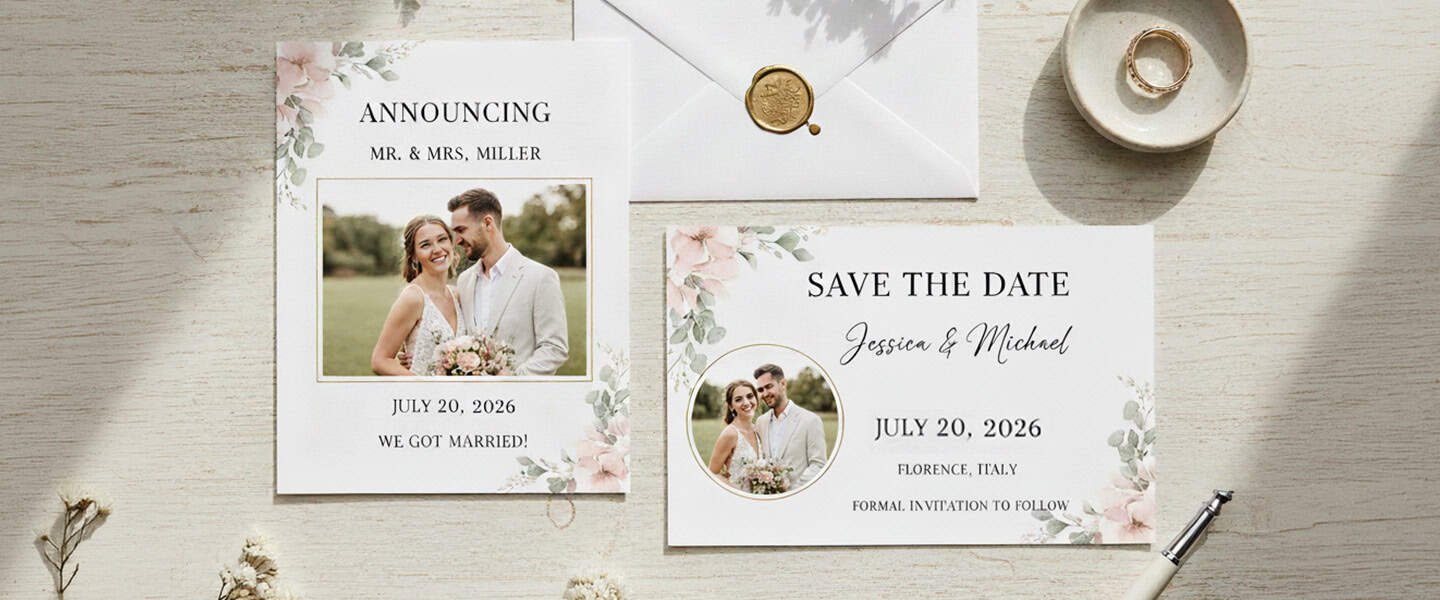
Save-the-Dates for a 2026 wedding should typically be mailed 9 to 12 months before the wedding date, particularly if the guest list includes out-of-town attendees or if the wedding falls during peak travel seasons.
Destination weddings require even earlier distribution, often 12 months in advance, to give guests sufficient time to arrange accommodations and travel.
This means couples planning a summer 2026 wedding should finalize Save-the-Date printing by late summer or early fall 2025.
Because printing timelines can extend during busy seasons, it is wise to finalize design selections at least four to six weeks before mailing, allowing time for proofing, revisions, and delivery.
Planning ahead prevents rushed decisions and unnecessary premium fees.
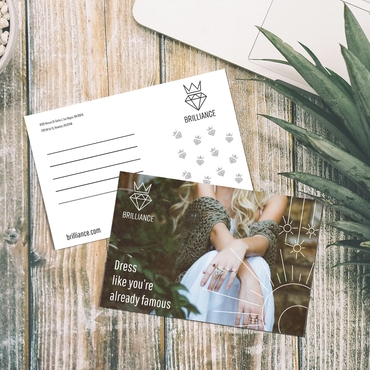
Many couples prefer postcard-style Save-the-Dates because they are easy to mail and cost-efficient without compromising presentation. High-quality Postcards offer a clean format that still feels substantial in hand.
Save-the-Date Timeline by Wedding Type
Not every wedding follows the same timeline. The ideal mailing date depends on your guest list and event location.
| Wedding Type | When to Send Save-the-Dates |
|---|---|
| Local Wedding | 6–8 months before |
| Large Wedding | 8–10 months before |
| Destination Wedding | 10–12 months before |
| Holiday Weekend Wedding | 10–12 months before |
| International Wedding | 12+ months before |
The more travel planning your guests need to do, the earlier you should send your Save-the-Dates.
This extra planning window often improves attendance and helps guests secure lower travel costs.
Engagement Announcements vs. Save-the-Dates: What’s the Difference?
Although often confused, engagement announcements and Save-the-Dates serve distinct roles within a wedding communication strategy.
Engagement announcements share personal news with a broader audience, which may include friends and family who are not on the wedding guest list.
Save-the-Dates, by contrast, are sent exclusively to invited guests and contain essential information such as the wedding date, location (city and state at minimum), and sometimes a wedding website link.
Understanding this difference helps couples determine whether they need both pieces or whether one will suffice.
In more traditional settings, engagement announcements are mailed shortly after the proposal, while Save-the-Dates follow once venue and date details are confirmed.
Engagement Announcement Ideas for 2026
If you’re sending a dedicated engagement announcement, consider formats that feel personal and memorable.
Popular options include:
Photo Announcements
A favorite engagement photo paired with a simple announcement message.
Story-Based Announcements
A short note sharing how the proposal happened.
Destination Reveal Cards
Perfect for couples planning weddings in another city or country.
Minimalist Announcement Cards
Clean typography with the engagement date and names.
Multi-Photo Layouts
Several engagement photos arranged in a collage-style design.
The best engagement announcements balance personality with simplicity and focus on celebrating the milestone rather than sharing excessive details.
Choosing the Right Format for 2026
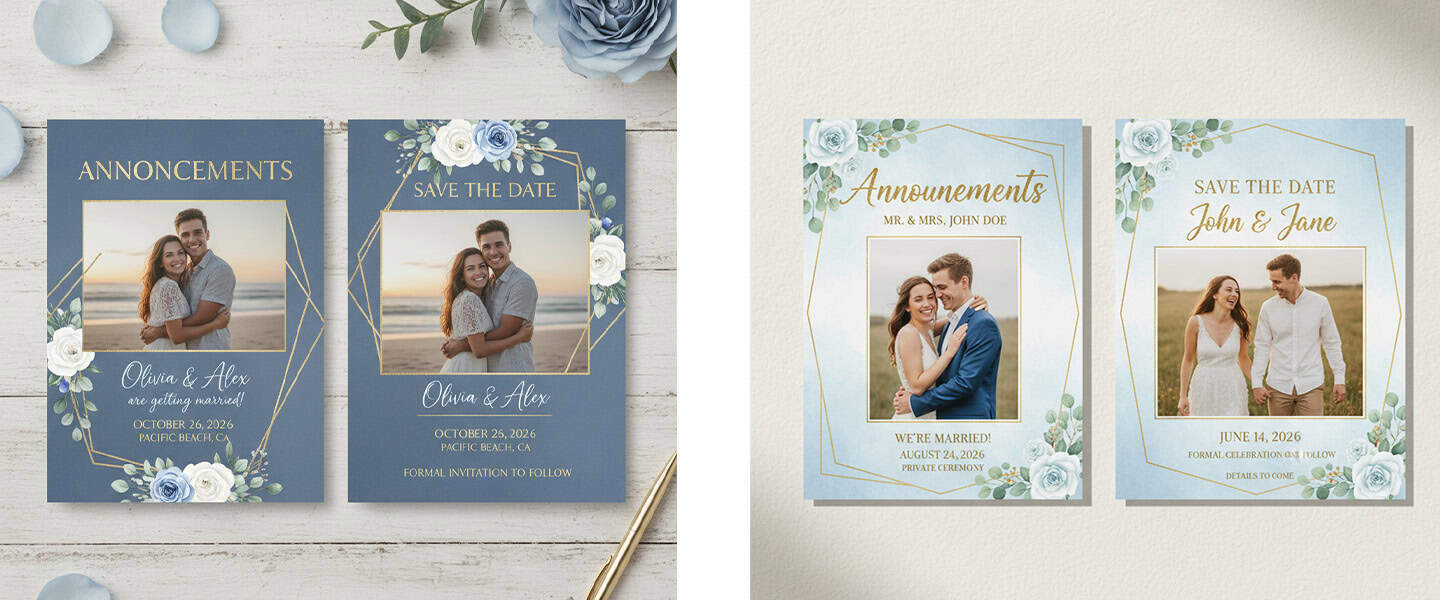
Wedding aesthetics continue to evolve, and 2026 trends reflect a strong return to intentional simplicity paired with premium materials.
Postcard-style Save-the-Dates remain popular because they are efficient to mail and cost-effective without sacrificing visual impact, especially when printed on substantial cardstock.
Couples seeking a more traditional format often choose card-and-envelope combinations within their Invitations collection, allowing them to coordinate paper weight, finish, and envelope liners from the beginning.
Engagement announcements, meanwhile, frequently incorporate photography and minimalist layouts, ensuring that the message feels celebratory rather than overly structured.
For couples exploring various print formats beyond wedding stationery, our Ultimate Glossary of Print Terms provides helpful explanations of finishes and paper options that can influence the final presentation.
Save-the-Date Design Trends for 2026
Save-the-Date designs in 2026 are leaning toward clean, personal styles that introduce the look and feel of the wedding without overwhelming guests with details. From engagement photography to custom illustrations, couples can choose a design that reflects their celebration while keeping the wedding date front and center.
Minimalist Typography
Simple typography, generous white space, and carefully selected fonts create an elegant, modern look. Minimalist Save-the-Dates work especially well for formal and contemporary weddings and can easily coordinate with the invitation suite later.
Full-Photo Save-the-Dates
Engagement photography can become the main design element, with the couple’s names, wedding date, and location placed around or over the image. This style creates a personal announcement while keeping the wording simple.
Soft and Neutral Color Palettes
Neutral shades and softer color combinations can give Save-the-Dates a timeless appearance. Couples can also introduce one accent color that carries through invitations, menus, signage, and other wedding stationery.
Handwritten and Script Accents
Script fonts and handwritten details add a personal touch without requiring an elaborate design. They can be paired with clean typography to highlight names, dates, or short phrases while maintaining readability.
Monogram-Based Designs
Custom monograms featuring the couple’s initials can establish a visual identity that continues throughout the wedding. The same monogram can later appear on invitations, RSVP cards, menus, programs, and other printed pieces.
Venue Illustrations
Illustrations of the ceremony venue, reception location, city skyline, or destination can make a Save-the-Date feel more distinctive. This approach is particularly fitting for destination weddings or celebrations held at recognizable locations.
Modern Postcard Layouts
Postcard-style Save-the-Dates offer a simple, mail-friendly format with plenty of space for essential details. Couples can use the front for photography or artwork and the back for the wedding date, location, website, and mailing information.
Coordinated Wedding Stationery
Rather than treating the Save-the-Date as a standalone piece, couples can use it to introduce design elements that will appear throughout their wedding stationery. Consistent typography, colors, illustrations, and paper choices can create a cohesive look from the first announcement through the wedding day.
Whatever style you choose, the most effective Save-the-Date designs keep the essential information easy to find. Names, wedding date, and location should remain clear, while photography, typography, colors, and illustrations help establish the personality of the celebration.
Print Trends for 2026: Designs, Colors & Finishes
How to Budget for Engagement Announcements and Save-the-Dates
Search volume for phrases like “cheap wedding invitations” reveals a common concern: balancing cost with elegance.
The same principle applies to engagement announcements and Save-the-Date printing.
The most effective budgeting strategy is to decide early where quality matters most.
Many couples choose to invest in higher-quality paper stock for Save-the-Dates, since they represent the first official wedding communication, while keeping engagement announcements simpler and more cost-conscious.
Ordering quantities carefully also protects your budget. Because Save-the-Dates are sent per household rather than per guest, the total required count is often lower than couples initially assume.
Adding a modest buffer of 10 to 15 extra pieces ensures that last-minute guest additions do not require costly reprints.
Wedding Printing Packages: Why Coordination Matters
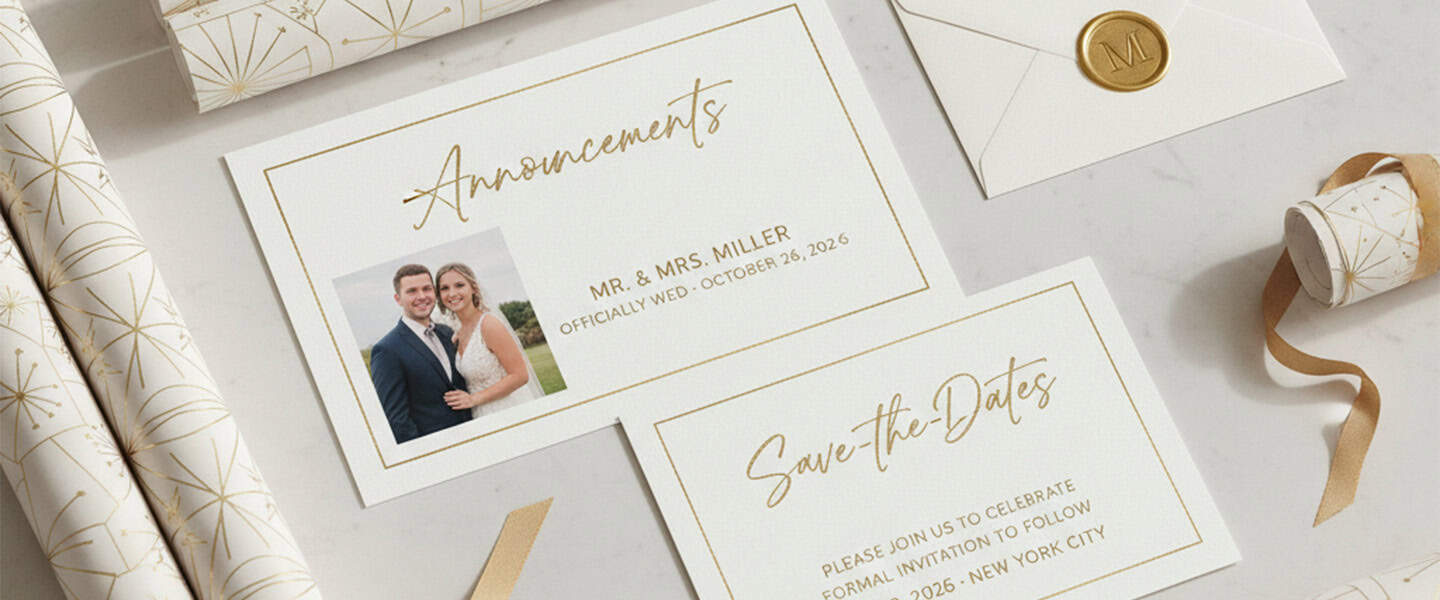
Rather than designing each piece separately, many couples benefit from selecting coordinated wedding printing packages that include engagement announcements, Save-the-Dates, invitations, and matching inserts.
This approach ensures visual continuity across typography, color palettes, and layout elements, creating a cohesive story from the first announcement through the final RSVP.
It also simplifies the ordering process and reduces the risk of mismatched finishes or inconsistent paper weights.
Couples who value seamless presentation often appreciate how structured print planning eliminates unnecessary stress later in the wedding timeline.
Paper and Finish Trends for 2026
Texture and weight are gaining more importance than decorative embellishment.
While foil and embossing remain available, many 2026 couples are favoring clean design paired with tactile paper quality, allowing the material itself to elevate the experience.
Soft-touch finishes, uncoated heavyweight stock, and subtle matte coatings are increasingly preferred over overly glossy surfaces.
Color palettes are trending toward muted neutrals accented by a single bold tone, creating invitations that feel timeless rather than overly thematic.
For a deeper look at evolving aesthetics, Print Trends for 2026: Designs, Colors & Finishes explores how material and color choices influence perception.
Simple Save-the-Date Wording Examples
Most Save-the-Dates require only a few pieces of information.
Traditional
Save the Date
Emma Johnson & Michael Carter
June 12, 2027
Charleston, South Carolina
Formal invitation to follow.
Modern
We’re getting married!
June 12, 2027
Save the date.
Invitation coming soon.
Destination Wedding
Save the Date
Join us in Mexico City
June 12, 2027
Travel details coming soon.
Keeping the wording simple allows the design and photography to take center stage.
Printed vs. Digital Save-the-Dates
Choosing between printed and digital Save-the-Dates depends on your wedding style, budget, timeline, and how you want guests to receive the announcement. Printed cards offer a more traditional, tangible experience, while digital options prioritize speed and convenience.
| Printed Save-the-Dates | Digital Save-the-Dates | |
| Presentation | More formal and tangible | More casual and convenient |
| Delivery | Requires printing and mailing | Delivered immediately |
| Cost | Includes printing and postage | Usually lower |
| Keepsake Value | High; guests can display or save them | Limited |
| Design Experience | Physical paper, finish, texture, and print quality | Screen-based design |
| Personalization | Can feature photos, custom artwork, paper, and finishes | Easy to customize digitally |
| Best For | Traditional, formal, or keepsake-focused weddings | Casual weddings or shorter planning timelines |
Pros and Cons of Printed Save-the-Dates
Printed Save-the-Dates provide a physical reminder of the wedding and can help establish the style of the celebration through paper, photography, colors, and finishes. They can also become keepsakes for the couple and their guests. However, they require additional time for printing, addressing, postage, and mailing.
Pros and Cons of Digital Save-the-Dates
Digital Save-the-Dates can be delivered quickly and generally cost less because there are no printing or postage expenses. They can be useful for couples working with a shorter timeline. However, they lack the tactile experience of printed stationery and may be easier for guests to overlook among emails or messages.
Ultimately, both formats can communicate the essential wedding details effectively. Couples looking for a more traditional and memorable presentation may prefer printed Save-the-Dates, while those prioritizing speed, convenience, and lower costs may choose digital.
Why Early Planning Protects Design Flexibility
Printing early does more than secure delivery timelines; it preserves creative choice.
When couples wait until the final months before mailing, they often face limited stock availability or expedited shipping costs, which may restrict customization options.
Ordering engagement announcements and Save-the-Dates well in advance ensures access to premium paper selections and allows ample time for proof adjustments, particularly if photography or custom typography is involved.
The earlier the timeline begins, the smoother the experience becomes.
Coordinating With Invitations
Although Save-the-Dates precede invitations, the two should align visually.
Even if the final invitation suite evolves, maintaining consistent typography or color direction creates a seamless guest experience.
Couples who plan their Save-the-Date printing alongside preliminary invitation design often find the transition between pieces effortless, reducing the likelihood of redesigning elements mid-process.
If you are preparing for the full invitation phase, our guide on Wedding Invitations 2026: When to Order, What to Print & How to Budget provides detailed insight into coordinating timelines and costs.
Frequently Asked Questions About Save-the-Dates
How far in advance should you send Save-the-Dates?
Most couples should send Save-the-Dates 6–12 months before the wedding. For weddings that require significant travel or take place during busy holiday periods, sending them earlier gives guests more time to make arrangements.
When should you send Save-the-Dates for a 2026 wedding?
For a 2026 wedding, count backward from your wedding date to determine when to mail your Save-the-Dates. A local wedding may require 6–8 months of notice, while larger, destination, or holiday weekend weddings may benefit from 10–12 months or more.
When should you order Save-the-Dates?
Ideally, order your Save-the-Dates at least 4–6 weeks before you plan to mail them. This provides time for printing, shipping, addressing, and any necessary corrections without rushing the process.
When should you send Save-the-Dates for a destination wedding?
Destination wedding Save-the-Dates should generally be sent 10–12 months before the wedding. For international destinations or celebrations requiring extensive travel planning, sending them 12 months or more in advance can be helpful.
How many Save-the-Dates should I order?
Start by counting the number of households on your guest list rather than the total number of individual guests. Then consider ordering an additional 10–15% for last-minute additions, addressing mistakes, replacements, and keepsakes.
Do you send one Save-the-Date per guest or per household?
Save-the-Dates are typically sent one per household, provided everyone at that address is invited. Adult guests living separately should receive their own Save-the-Date, even if they are members of the same family.
What information should a Save-the-Date include?
A Save-the-Date should include the couple’s names, wedding date, and wedding location, usually the city and state or destination. You can also include your wedding website and a short phrase such as “Formal invitation to follow.”
Should Save-the-Dates match wedding invitations?
They don’t have to match exactly, but using similar colors, typography, illustrations, or overall style can create a more cohesive wedding stationery suite. Your Save-the-Date can introduce the visual direction that later appears on invitations and other printed pieces.
What are the Save-the-Date trends for 2026?
Popular Save-the-Date design trends for 2026 include minimalist typography, full-photo cards, soft neutral colors, handwritten accents, custom monograms, venue illustrations, and modern postcard layouts. Coordinated designs that can carry through the rest of the wedding stationery are also a practical choice.
Are paper or digital Save-the-Dates better?
It depends on your wedding and priorities. Printed Save-the-Dates provide a more tangible and traditional experience and can double as keepsakes, while digital Save-the-Dates offer faster delivery and may reduce costs. Formal weddings often favor printed cards, while digital options can work well for casual celebrations or shorter planning timelines.
Do you need both engagement announcements and Save-the-Dates?
Not necessarily. Engagement announcements celebrate and share the news of your engagement, while Save-the-Dates are sent to invited guests to reserve the wedding date. Couples can use both, but a Save-the-Date alone may be sufficient once the wedding date and location are confirmed.
How long before the wedding should invitations be sent after Save-the-Dates?
Wedding invitations are typically mailed 6–8 weeks before the wedding, even when Save-the-Dates were sent several months earlier. Destination weddings may require invitations to be sent earlier so guests have enough time to finalize travel and accommodations.
Final Thoughts: Announce With Intention
Engagement announcements and Save-the-Dates are more than calendar reminders.
They introduce your celebration to the world.
They set expectations about tone, scale, and style.
They begin the story long before the ceremony.
For couples planning weddings in 2026, the smartest approach is deliberate timing, thoughtful material selection, and coordinated printing decisions that support the full wedding timeline.
When handled early and intentionally, these first pieces of stationery do more than inform, they create anticipation.