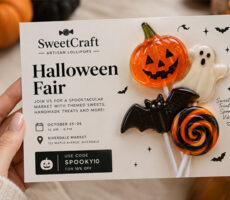
Holiday marketing rarely feels late when you’re planning it.
Then suddenly it’s November.
Your promotion still needs approval. The postcard hasn’t been designed. Someone realizes the holiday cards need updated addresses. The packaging stickers aren’t ready. And the sale you’re promoting starts next week.
The easiest way to avoid that rush is to work backward from one question:
When does the customer need to receive or see the printed piece?
For many small businesses, holiday print planning should begin in September or early October, while customer-facing campaigns often begin appearing from October through December.
But not everything needs to be printed at the same time.
A Black Friday postcard, holiday greeting card, December event poster, and branded packaging sticker all have different deadlines.
Here’s a practical timeline for deciding what to prepare—and when.
The Holiday Marketing Timeline at a Glance
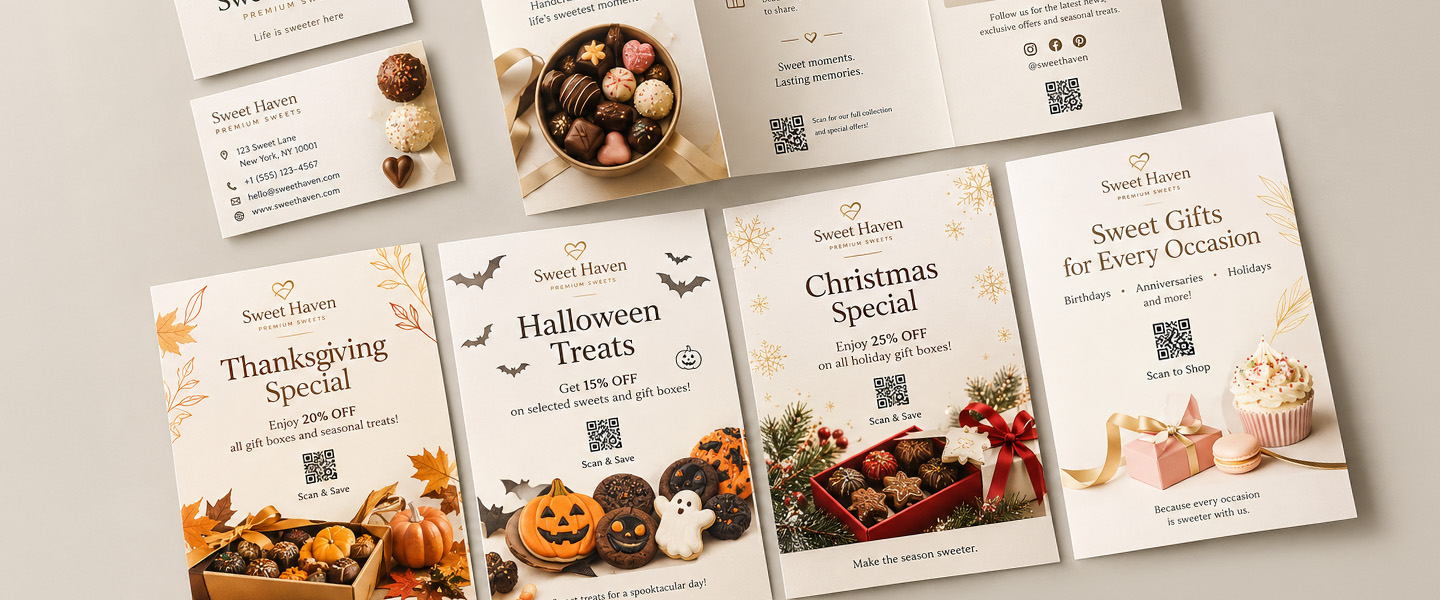
If you’re planning for the November–December holiday season, this is a useful starting point:
| When | What to Do |
| September | Plan campaigns, budget, offers, quantities, audiences and creative |
| Early October | Design core holiday materials and prepare mailing lists |
| Late October | Print early promotions, packaging materials and November campaigns |
| Early November | Launch Thanksgiving, Black Friday and Small Business Saturday materials |
| Mid-November | Finalize and print December promotions and holiday cards |
| Late November | Send December direct mail and distribute holiday materials |
| Early December | Focus on in-store, local and last-minute promotions |
| Mid/Late December | Shift toward thank-you, year-end and New Year messaging |
This isn’t a universal deadline calendar.
A restaurant promoting a December holiday menu has different needs from an ecommerce business preparing thousands of packages or a real estate agent mailing cards to past clients.
Use the timeline as a framework, then adjust it around your actual campaign.
September: Build the Holiday Plan
September might feel early for holiday marketing.
For planning, it isn’t.
Starting early also gives you more flexibility with design, production, and distribution. This holiday printing guide explains why early preparation can make seasonal campaigns easier to manage.
This is when you want to decide what you’re actually doing before anyone starts designing.
Ask:
- Which holidays or shopping moments matter to our business?
- Are we running Black Friday or Cyber Monday promotions?
- Are we participating in Small Business Saturday?
- Are we mailing customers?
- Do we need holiday packaging?
- Are we sending customer or employee cards?
- Are there December events to promote?
- What needs to be printed?
- How many pieces will we need?
- Who needs to approve the artwork?
You don’t necessarily need finished designs in September.
You need decisions.
Create One Holiday Campaign Calendar
Put every major date in one place.
That could include:
October
- Early holiday-shopping campaign
- Halloween, if relevant to your business
November
- Thanksgiving
- Black Friday
- Small Business Saturday
- Cyber Monday
- Giving Tuesday
December
- Holiday promotions
- Christmas
- Hanukkah and other relevant seasonal observances
- Shipping/order cutoffs
- Customer appreciation
- Year-end messaging
January
- New Year promotions
- Thank-you campaigns
- New-year business messaging
Not every business needs to market around every date.
A better strategy is usually to choose the occasions that genuinely connect with your customers.
Decide What Needs to Be Printed
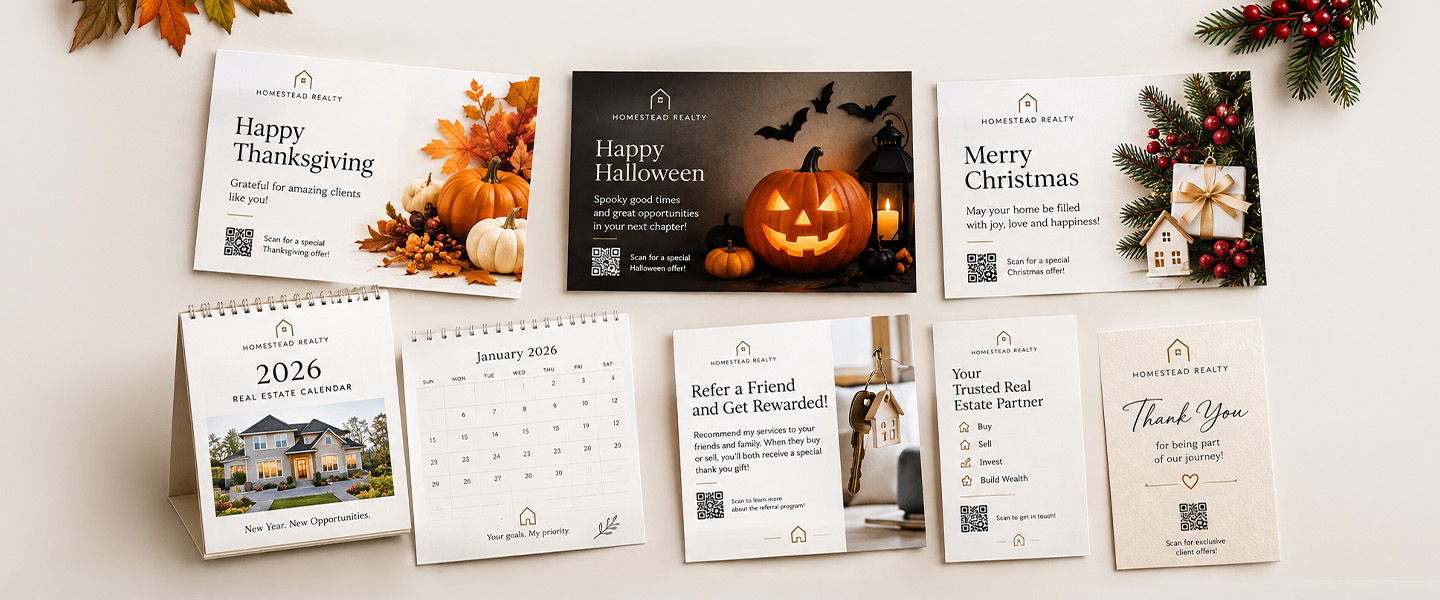
Once you know the campaigns, translate them into physical materials.
For example:
Retail Store
Holiday campaign might need:
- Window posters
- Promotional flyers
- Postcards
- Packaging stickers
- Gift inserts
Restaurant
Holiday campaign might need:
- Seasonal menus
- Table promotions
- Flyers
- Takeout inserts
- Gift card promotions
Real Estate Agent
Holiday campaign might need:
- Client holiday cards
- Postcards
- Calendars
- Referral materials
Ecommerce Brand
Holiday campaign might need:
- Packaging stickers
- Custom tissue paper
- Thank-you inserts
- Promotional postcards
- Return-customer offers
This gives you a print inventory before deadlines begin approaching.
Early October: Start Designing the Core Materials
By early October, move from planning to production.
Start with materials you’ll use throughout the season rather than one-day promotions.
For example:
- General holiday packaging
- Thank-you materials
- Seasonal branding
- Holiday cards
- November direct mail
- Reusable promotional materials
If you’re creating several pieces, establish a simple visual system.
You might choose:
One seasonal color palette
One headline style
One illustration or photography direction
One promotional theme
Then adapt it across different products.
This makes a postcard, sticker, flyer, and card feel like parts of the same campaign without making every design identical.
Prepare Your Mailing List Early
If you’re sending postcards or greeting cards, don’t wait until the artwork is finished to think about recipients.
Review your list.
Look for:
- Duplicate contacts
- Incomplete addresses
- Former customers
- Incorrect ZIP Codes
- Customers who should be segmented differently
- People who shouldn’t receive the mailing
If you’re planning geographically targeted local advertising rather than using an existing customer list, USPS offers Every Door Direct Mail (EDDM), which allows businesses to select delivery routes and filter areas using factors including age, household size, and income. (USPS)
Getting the audience ready while the creative is being developed saves time later.
Late October: Print Materials You’ll Need in November
By late October, your earliest holiday materials should start moving from design into print.
Prioritize anything connected to November.
That could include:
- Thanksgiving promotions
- Black Friday materials
- Small Business Saturday promotions
- November events
- Early holiday-shopping campaigns
- Packaging supplies you’ll begin using in November
This is also a good time to order materials you’ll need in larger quantities throughout the season.
Think Beyond One Promotion
Suppose a boutique has three upcoming campaigns:
November 1–20: Early holiday shopping
Black Friday weekend: Special promotion
December: Gift-shopping campaign
It may not make sense to put all three offers on one flyer.
Instead, decide which materials can stay evergreen and which need campaign-specific information.
For example:
Reusable: branded packaging stickers
Reusable: holiday tissue paper
November-specific: Black Friday postcard
December-specific: gift promotion flyer
This prevents you from being stuck with 500 Black Friday flyers on December 1.
Early November: Black Friday and Small Business Saturday
By early November, Black Friday campaigns should no longer be sitting in the brainstorming stage.
If you’re still deciding what the campaign should include, these Black Friday print marketing ideas can help you plan postcards, signage, flyers, and other promotional materials.
Your printed materials should either be ready or in production, depending on when and how they’ll be distributed.
Possible materials include:
- Postcards
- Flyers
- Posters
- Window signage
- Package inserts
- Promotional stickers
For local businesses, custom postcards can be used to put the offer directly in front of a defined customer or geographic audience.
For in-store campaigns, custom posters and flyers can reinforce the same promotion where customers are already shopping.
Example: Local Boutique
Instead of waiting until Thanksgiving week, the business could prepare:
Postcard
Black Friday Starts Early
Shop November 20–28
Save 20% on selected gifts.
Visit us at [location]
Store poster
BLACK FRIDAY
20% Off Selected Gifts
Through November 28
Package sticker
A little holiday happiness inside.
One campaign, three different jobs.
Mid-November: Get December Materials Ready
While customers are thinking about Thanksgiving and Black Friday, your business should already be thinking about December.
This is when I’d prioritize:
- December postcards
- Holiday greeting cards
- Customer appreciation materials
- December event promotions
- Holiday packaging
- Year-end materials
Don’t wait until December 1 to begin designing something customers need to receive in early December.
When Should Businesses Order Holiday Cards?
If you’re sending custom greeting cards, start earlier than the day you intend to mail them.
Your timeline needs to account for more than printing.
Think:
Design
↓
Internal approval
↓
Printing
↓
Delivery to your business
↓
Writing/signing cards
↓
Addressing/preparing mail
↓
Postal delivery
A company sending 20 cards may need very little preparation time after printing.
A company sending 1,000 personalized cards has a completely different project.
The more manual work required after printing, the earlier you should order.
Late November: December Direct Mail Should Be Moving
If you want a holiday promotion in customers’ hands during December, don’t treat the mailing date as the same thing as the campaign date.
Mail needs time to travel.
And during a time-sensitive campaign, delays of even a few days can reduce the useful life of the offer.
If you’re sending promotional direct mail, build additional time into the schedule for:
- Printing
- Preparing the mailing
- Postal processing
- Delivery
- Customer response
USPS publishes current mailing and service information businesses can use when planning campaigns, and exact timing depends on the mail service and destination. (USPS)
USPS business mailing resources
For campaigns tied to Christmas delivery, check the current year’s USPS recommended send-by dates rather than relying on dates from a previous holiday season.
USPS’s 2025 guidance, for example, recommended different send-by dates depending on whether customers used Ground Advantage, First-Class Mail, Priority Mail, or Priority Mail Express. Those dates should not be assumed to be identical every year. (USPS)
Give Customers Time to Respond
There’s another deadline businesses sometimes forget:
Your customer needs time too.
Imagine your postcard says:
Order Holiday Gifts by December 10
If the postcard arrives December 9, the campaign hasn’t given the customer much opportunity to act.
Instead, work backward:
Customer deadline: December 10
↓
Desired arrival: Late November / early December
↓
Mailing
↓
Printing
↓
Artwork approval
↓
Design
Your internal deadline may need to be weeks before the date customers see on the postcard.
Early December: Shift Toward Immediate and Local Action
Once December begins, your campaign strategy may need to change.
Long-lead marketing becomes less practical as important dates approach.
This is where local and in-store materials become especially useful.
Think:
- Posters
- Flyers
- Counter cards
- Packaging inserts
- Stickers
- Local promotions
The call to action can also become more immediate.
Earlier in the season:
Start Your Holiday Shopping
Closer to the holiday:
Still Looking for a Gift?
or:
Pick Up a Last-Minute Gift Today
The product hasn’t changed.
The customer’s urgency has.
Update Your Messaging as the Season Progresses
Don’t run the exact same message from October through December.
Consider moving through stages.
Stage 1: Inspiration
Find Something They’ll Love
Stage 2: Promotion
Holiday Sale Starts Friday
Stage 3: Urgency
Last Weekend to Shop
Stage 4: Convenience
Still Need a Gift? Visit Us Today
Stage 5: Appreciation
Thank You for Shopping With Us This Year
This creates a campaign that evolves with the customer’s mindset.
Mid-to-Late December: Stop Selling the Holiday After It’s Over
Time-sensitive print has one obvious disadvantage:
You can’t edit it after it’s printed.
That’s why quantities matter.
If you’re ordering materials containing:
BLACK FRIDAY
or:
ORDER BY DECEMBER 15
or:
CHRISTMAS SALE
be conservative about how many you’ll realistically distribute.
For materials you want to keep using, choose more evergreen language.
Instead of:
Christmas Packaging
you might create:
A Little Something Special for You
Instead of:
Christmas Thank You
consider:
Thank You for Supporting Our Small Business
Those materials may remain usable beyond one specific date.
Don’t Forget the Week After the Holidays
The holiday campaign doesn’t necessarily end December 25.
Late December and early January can support:
- Customer thank-you campaigns
- New Year promotions
- Loyalty offers
- Clearance events
- Appointment reminders
- Referral campaigns
- New-year business updates
A customer appreciation card might say:
Thanks for Being Part of Our Year
We appreciate every visit, order and recommendation. Here’s to what’s next.
This gives you a natural transition from holiday promotion to customer retention.
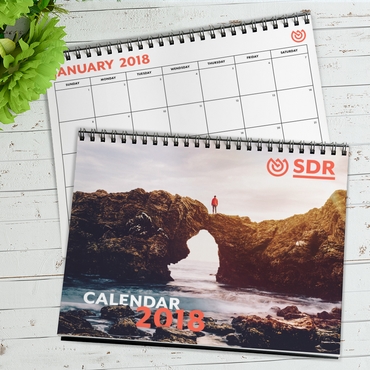
For businesses that want something customers can keep throughout the following year, custom calendars can also turn year-end gifting into longer-term brand visibility.
What Should You Print for Holiday Marketing?
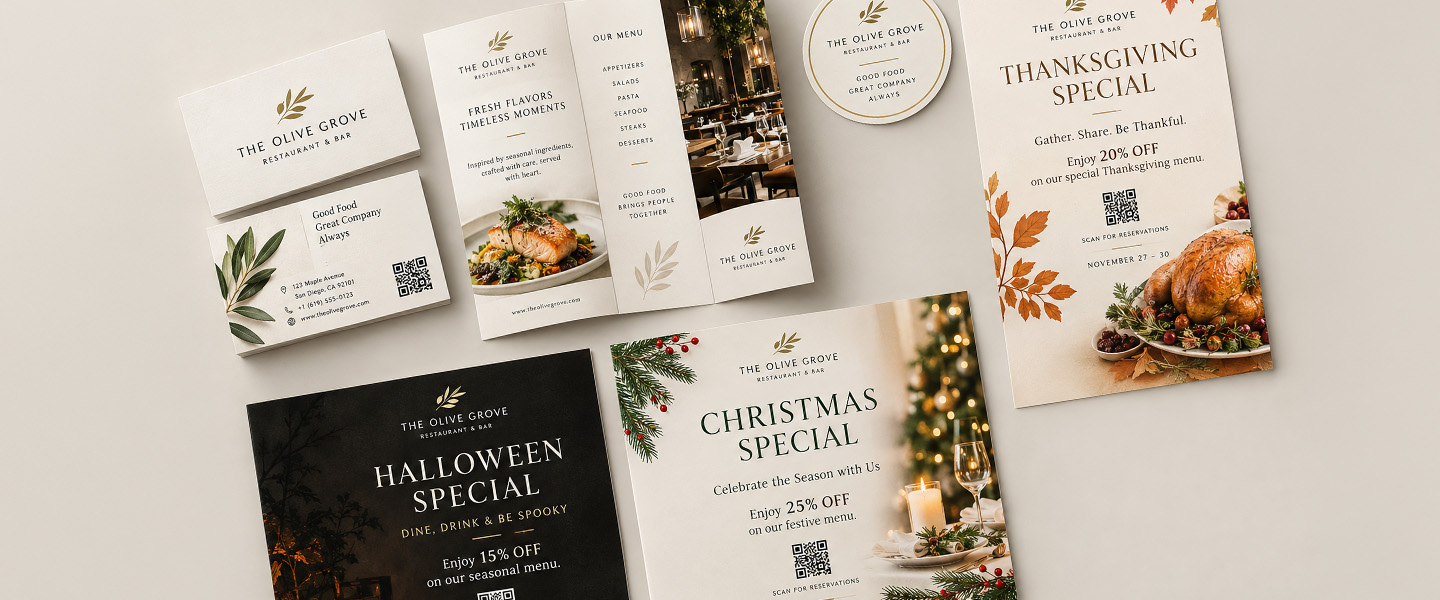
There’s no universal holiday-printing checklist.
Choose materials based on how customers interact with your business.
| Business Goal | Print Product to Consider |
| Reach local households | Postcards |
| Promote an in-store sale | Posters / Flyers |
| Thank customers | Greeting Cards / Notecards |
| Brand shipped orders | Stickers / Tissue Paper |
| Promote an event | Flyers / Posters |
| Encourage repeat purchases | Postcard inserts |
| Give customers something useful | Calendars |
| Present several products/services | Brochures |
The point isn’t to order everything.
A restaurant probably doesn’t need the same holiday print mix as an ecommerce candle company.
Choose the materials that support the actual customer journey.
Holiday Printing Timeline Example: Local Retail Store
Here’s what this might look like in practice.
September
The store decides:
- Black Friday offer
- December gift campaign
- Customer thank-you campaign
- Packaging theme
October
The team designs:
- Black Friday postcards
- Store posters
- Packaging stickers
- December promotional materials
Mailing list is cleaned and finalized.
Late October / Early November
Black Friday materials are printed.
Packaging stickers arrive and begin being used.
Mid-November
December postcards and holiday cards are finalized and printed.
Late November
December promotional mail begins moving.
Holiday signage replaces Black Friday signage after the promotion ends.
December
The store shifts toward:
- Gift messaging
- Last-minute shopping
- Local availability
- Customer appreciation
Late December
Promotional messaging transitions to:
- Thank you
- New Year
- Loyalty/return visits
That’s a much smoother process than trying to design every campaign the week before it happens.
Holiday Printing Timeline Example: Ecommerce Business
An ecommerce business has different priorities.
Its biggest concern may be packaging volume rather than store signage.
September
Estimate holiday order volume and decide whether packaging will change.
October
Order:
- Custom stickers
- Custom tissue paper
- Thank-you inserts
- Promotional postcards
This gives the business time to prepare inventory before order volume increases.
November
Begin using holiday packaging.
Black Friday/Cyber Monday orders can include an insert encouraging customers to return in December.
December
Change the insert:
Instead of:
Come Back for Holiday Shopping
use:
Thanks for Shopping With Us
or promote a January return offer.
Build Extra Time Into Your Holiday Print Schedule
One of the safest things a small business can do is avoid planning around the absolute latest possible date.
A holiday printing timeline can include several stages:
- Copywriting
- Design
- Internal review
- Proofreading
- Final artwork preparation
- Printing
- Shipping/delivery
- Mailing or distribution
If one stage takes longer than expected, every deadline after it moves.
Build a buffer—especially for campaigns with fixed dates.
A postcard arriving three days later than expected may be inconvenient.
A postcard promoting an event that already happened is useless.
Check Your Print Files Before Ordering
Holiday deadlines can make people rush through proofing.
That’s exactly when mistakes happen.
Before submitting artwork, verify:
- Dates
- Prices
- Promotional codes
- Expiration dates
- Addresses
- Phone numbers
- Website URLs
- QR codes
- Event times
- Product names
- Spelling
- Bleed
- Safe zones
- Image resolution
One extra proofread is much faster than discovering an incorrect date after the order arrives.
A Simple Holiday Print Planning Formula
If you only remember one thing from this guide, use this:
Start with the date customers need the material.
Then work backward.
For example:
December 5: Customer should receive postcard
← Allow mailing time
← Prepare mailing
← Receive printed postcards
← Allow production and delivery
← Approve final artwork
← Proofread
← Design
← Write the offer
That gives you your real deadline.
Not December 5.
The internal deadline may be several weeks earlier.
The exact amount of time depends on the product, quantity, production option, shipping method, mailing method, destination, and how much preparation your team needs.
Frequently Asked Questions About Holiday Marketing Timelines
When should small businesses start planning holiday marketing?
For November and December campaigns, September or early October is a practical time to begin planning. Businesses with large mailing lists, extensive packaging requirements, multiple locations, or complicated approval processes may benefit from starting even earlier.
Planning doesn’t mean launching holiday advertising in September. It means deciding what you’ll need before production deadlines become urgent.
When should I start printing holiday marketing materials?
Start with the date the material needs to reach customers and work backward through distribution or mailing, delivery from the printer, production, proofing, and design.
Materials needed in November should generally be finalized earlier than materials intended only for late December.
When should businesses order holiday cards?
Allow enough time for printing, delivery to your business, signing or personalization, addressing, mailing, and postal delivery.
A company mailing hundreds of handwritten cards should start considerably earlier than a business sending a small number.
When should holiday postcards be mailed?
It depends on the campaign, mail service, destination, and date customers need to receive them. Build the schedule around arrival, not simply the mailing date, and check current USPS service information before launching a time-sensitive campaign.
Is September too early to plan holiday marketing?
No. September is a useful month for planning offers, audiences, budgets, quantities, packaging, and creative direction for November and December.
You don’t necessarily need to start showing customers holiday promotions that early.
Is October too early to print holiday materials?
Not necessarily. October can be a good time to print evergreen holiday packaging, November promotions, customer cards, and other materials you know you’ll need.
Time-sensitive December materials can be printed later if the schedule allows.
What holiday marketing materials should a small business print?
Common options include postcards, greeting cards, flyers, posters, stickers, custom tissue paper, calendars, notecards, and brochures. The right combination depends on whether your goal is customer acquisition, in-store promotion, ecommerce packaging, events, retention, or appreciation.
How far in advance should I print Black Friday materials?
Work backward from when customers need to see the promotion. Printed pieces that need to be mailed require more lead time than posters being placed inside your own store. Ideally, Black Friday materials should be approved and moving toward production before the week of the event.
Should I print all my holiday materials at once?
Not necessarily. Evergreen packaging and general holiday materials can be ordered earlier, while highly time-sensitive promotions may be better ordered separately.
Splitting materials by campaign can also prevent you from being left with unusable pieces after a promotion ends.
How can I avoid ordering too many holiday print materials?
Separate evergreen materials from date-specific materials.
Order more cautiously when the design contains a specific date, event, discount, or holiday. More general branded materials may remain useful throughout the season or even into the new year.
Start With the Deadline, Not the Design
Holiday printing becomes much easier when you stop treating everything as one December project.
September is for planning.
October is for designing and preparing.
November is when many campaigns launch and December materials should already be moving.
December shifts toward immediate promotions, appreciation, and year-end messaging.
But the most important date isn’t on a generic marketing calendar.
It’s the day your customer needs to see your message.
Work backward from there, build in time for design, proofing, printing, delivery, and distribution, and give yourself a buffer for anything that doesn’t go exactly according to plan.
When you’re ready to prepare your holiday campaign, Overnight Prints offers postcards, greeting cards, stickers, flyers, posters, calendars, and other printed materials for small-business marketing.