A wedding invitation suite typically includes the main invitation, an RSVP method, and any additional cards guests need for details such as the venue, accommodations, transportation, reception, or wedding website.
But not every wedding needs a six-piece stationery set.
For some couples, the perfect suite is:
Invitation + RSVP information.
For others, it’s:
Invitation + RSVP card + details card + reception card + multiple envelopes.
The right wedding invitation suite depends on one simple question:
What information do your guests need in order to attend your wedding without confusion?
Start there.
Then build the suite around it.
First, What Is a Wedding Invitation Suite?

A wedding invitation suite is a coordinated collection of stationery sent to guests with the formal wedding invitation.
The invitation is the centerpiece.
The other pieces support it.
Depending on the wedding, a suite may contain:
Main invitation
The essential who, what, when, and where.
RSVP card
A way for guests to confirm whether they’re attending.
Details card
Additional information that doesn’t belong on the main invitation.
Reception card
Reception information when it needs to be communicated separately.
Accommodation card
Hotel or lodging information.
Directions or map card
Helpful when guests need additional guidance to reach the venue.
Wedding website card
A simple way to direct guests to more detailed or changing information online.
Inner and outer envelopes
Used in some traditional invitation formats.
You don’t need every item on that list.
Think of the suite as a system:
The invitation announces.
The inserts explain.
The RSVP collects a response.
The envelope brings everything together.
Start With the Main Invitation
If you removed every insert from the envelope, the main invitation should still communicate the most important facts.
Guests should be able to understand:
Who is getting married?
When is the wedding?
Where is it happening?
A traditional invitation may also include the names of the hosts and formal request language.
A more contemporary invitation might simplify the wording considerably.
For example:
Together with their families
Emma Carter & James Bennett
invite you to celebrate their wedding
Saturday, the seventeenth of October
two thousand twenty-six
at four o’clock in the afternoon
The Garden House
Charleston, South Carolina
Or a less formal celebration might use:
We’re getting married!
Emma & James
October 17, 2026 · 4 PM
The Garden House
Charleston, SC
Dinner & dancing to follow
The exact wording depends on the tone of the wedding.
What matters most is that the essential information isn’t buried.
What Doesn’t Need to Go on the Main Invitation?
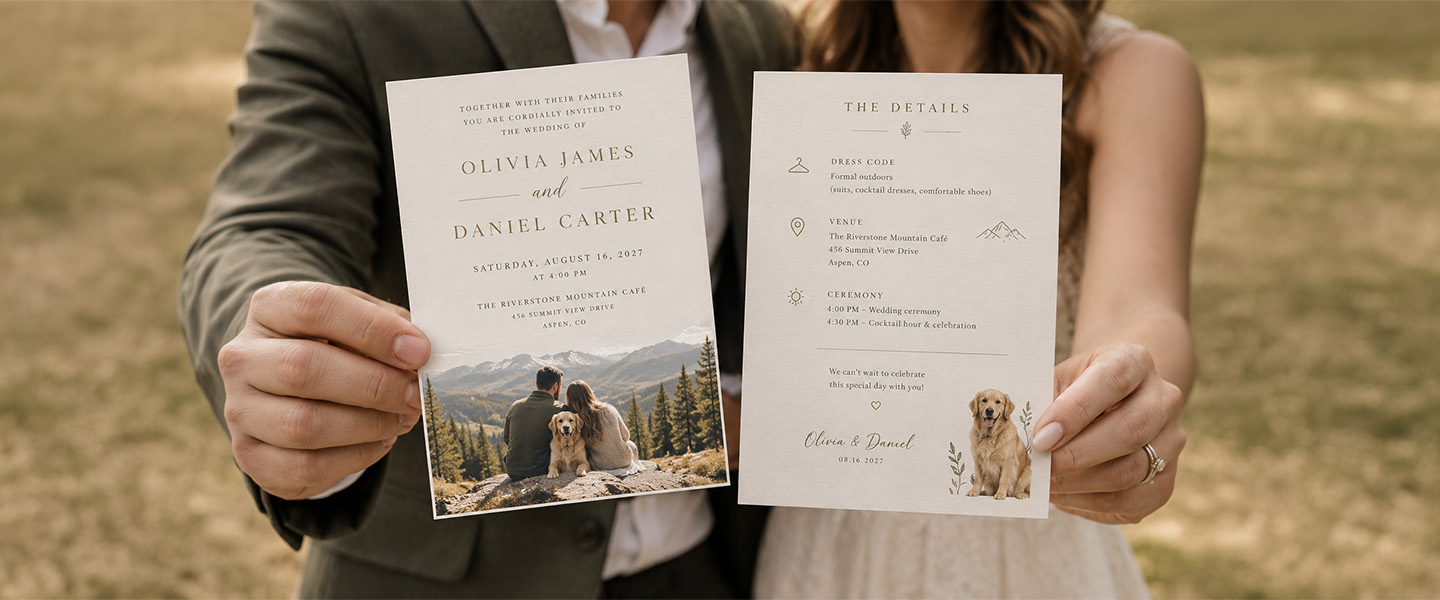
This is where invitation suites become useful.
Your main invitation doesn’t need to explain:
Hotel blocks.
Shuttle schedules.
Parking instructions.
Dress code details.
Weekend events.
Registry information.
A five-step RSVP process.
Directions from the airport.
Trying to fit everything onto one invitation usually makes the design harder to read.
Instead, move supporting information onto an enclosure card or wedding website.
That allows the invitation itself to remain focused.
Now Decide How Guests Will RSVP
The next piece isn’t necessarily another printed card.
It’s a decision.
How do you want guests to respond?
You have a few options.
Printed RSVP Card
A traditional response card might say:
Kindly reply by September 12
M ______________________
☐ Joyfully accepts
☐ Regretfully declines
Number attending: ______
A return envelope can be included so guests can mail the response back.
Online RSVP
You can instead direct guests to the wedding website:
Please RSVP by September 12
ourweddingwebsite.com
or:
Scan to RSVP
[QR CODE]
This reduces the number of pieces in the suite and allows responses to be managed digitally.
Both
Some couples may want to offer both a traditional card and an online option, particularly when their guest list includes people with different preferences.
Whichever method you choose, make the deadline obvious.
Guests shouldn’t have to search for it.
The Details Card: Your Invitation’s Best Friend
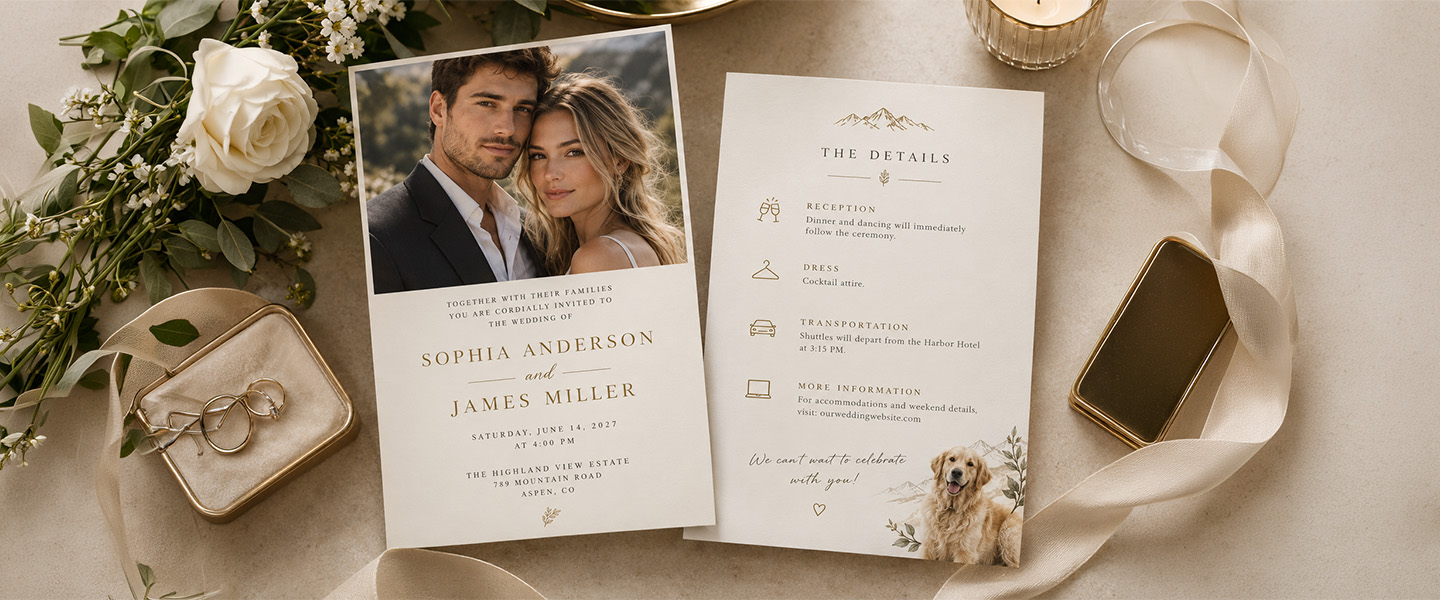
If there’s one insert that solves a lot of invitation problems, it’s the details card.
Instead of creating a separate card for every small piece of information, you can combine several items onto one well-organized card.
For example:
DETAILS
Reception
Dinner and dancing will immediately follow the ceremony.
Dress
Cocktail attire.
Transportation
Shuttles will depart from the Harbor Hotel at 3:15 PM.
More Information
For accommodations and weekend details, visit:
ourweddingwebsite.com
That’s much cleaner than squeezing all of that underneath the venue address on the main invitation.
Do You Need a Separate Reception Card?
Sometimes.
If the ceremony and reception are at the same location and one immediately follows the other, you may only need a short line on the invitation:
Reception to follow
or:
Dinner and dancing to follow
A separate reception card becomes more useful when:
- The reception is at a different venue
- There is a significant gap between events
- Reception information is detailed
- Only certain guests are invited to a particular event
- The reception requires separate directions
For example:
RECEPTION
Please join us for dinner and dancing at
The Charleston Room
150 King Street
Charleston, South Carolina
Cocktails at 6:00 PM
Dinner at 7:00 PM
Now the information has enough room to breathe.
What About Hotel Information?
If many guests are traveling, accommodation information becomes much more important.
An accommodation insert can include:
ACCOMMODATIONS
A room block has been reserved at:
The Harbor Hotel
120 Waterfront Drive
Reserve by September 1 using code:
CARTERBENNETT
For reservations:
ourweddingwebsite.com/stay
You can also place this information on the wedding website and use the printed card simply to direct guests there.
That can be especially useful if hotel availability, booking links, or travel information may change.
Do You Need a Directions Card?
Not automatically.
Guests today often navigate using their phones.
But directions can still be useful when:
- The venue is difficult to find
- GPS directions are unreliable
- Parking is in a separate location
- Guests need to enter through a particular gate
- The ceremony is on a large property
- Transportation is being coordinated
Instead of printing turn-by-turn directions that most guests won’t use, consider whether a simple map or short instruction would be more useful.
For example:
PARKING
Complimentary parking is available at the north entrance on Willow Road.
or:
GETTING THERE
The ceremony will take place in the Garden Pavilion. From the main entrance, follow signs toward the lake.
Give guests the information they actually need.
The Wedding Website Can Carry the Details Your Paper Doesn’t Need To
One of the easiest ways to keep a wedding invitation suite from becoming overcrowded is to let print and digital information work together.
The invitation suite can provide the essentials.
The wedding website can handle the details.
A website might include:
- Full schedule
- Hotel links
- Transportation
- Directions
- Registry
- Dress code guidance
- FAQs
- Local recommendations
- RSVP form
- Updates
Then your enclosure card can simply say:
WEEKEND DETAILS
For accommodations, transportation, local recommendations, and our complete weekend schedule, please visit:
ourweddingwebsite.com
or scan:
[QR CODE]
This gives guests one place to find information without turning the invitation envelope into a small instruction manual.
So, What Does Your Wedding Invitation Suite Actually Need?
Here’s a simpler way to decide.
A Simple Wedding
You may only need:
Main invitation
RSVP instructions
That’s enough if the ceremony and reception are straightforward and guests don’t need much additional information.
A Wedding With Additional Details
Consider:
Main invitation
RSVP
Details card
Use the details card for transportation, dress code, reception information, or the wedding website.
A Destination Wedding
You may need:
Main invitation
RSVP
Travel/accommodation card
Details card or wedding website card
Guests traveling significant distances usually need more planning information.
A Multi-Day Wedding
Your suite may include:
Main invitation
RSVP
Weekend itinerary
Accommodation information
Wedding website
If you’re hosting a welcome party, ceremony, reception, brunch, and other activities, organization becomes especially important.
Essential vs. Optional Wedding Invitation Pieces
| Invitation Piece | Do You Need It? | Purpose |
| Main invitation | Essential | Announces the wedding and gives core details |
| RSVP method | Essential | Lets guests respond |
| Details card | As needed | Holds additional practical information |
| Reception card | As needed | Gives separate reception information |
| Accommodation card | Useful for traveling guests | Provides hotel information |
| Directions/map card | Useful for difficult locations | Helps guests reach the venue |
| Wedding website card | Optional but useful | Sends guests to expanded online information |
| Inner envelope | Optional/traditional | Can identify specifically invited guests |
| Outer envelope | Usually needed when mailing | Protects and addresses the suite |
The goal isn’t to build the biggest suite.
It’s to create the clearest one.
How Should All the Cards Look Together?
A wedding invitation suite doesn’t require every piece to look identical.
It should feel coordinated.
You can create that connection through:
- Typography
- Color palette
- Paper
- Illustration style
- Monogram
- Borders
- Floral elements
- Line art
- Layout
- Printing style
For example, your invitation might feature a floral illustration across the top.
The RSVP card doesn’t need the entire illustration again.
It might use one small flower in the corner.
The details card could use the same typography and border.
The pieces relate without becoming repetitive.
Choose One Visual Element to Lead the Suite
Before adding multiple decorative ideas, decide what defines the design.
Maybe it’s:
Typography
A classic serif paired with a simple script.
Color
Deep green with warm neutral paper.
Illustration
A drawing of the venue.
Pattern
A subtle botanical border.
Monogram
The couple’s initials used across the pieces.
Once you have that visual anchor, the remaining design decisions become easier.
If you’re still choosing typography, our guide to serif vs. sans serif fonts for print explains how the two styles differ and how readability should influence the decision.
Don’t Make Every Card the Same Size
Different sizes can make a suite easier to organize.
Imagine opening an envelope and seeing:
Main invitation — largest
Details card — medium
RSVP card — smaller
The hierarchy is immediately visible.
You don’t have to read everything to understand which piece is most important.
That said, the sizes should still fit comfortably inside the envelope and work together as a set.
Before finalizing anything, stack the pieces at their intended sizes.
What looks balanced individually may feel awkward when assembled.
Think About How the Suite Will Be Opened
Designing each card separately is only half the job.
Put them together.
Which piece is visible first?
Does the invitation clearly feel like the main piece?
Are smaller cards getting lost?
Is the suite too thick?
Is an important piece hidden behind another?
Does the orientation change unnecessarily from card to card?
This is one of those moments when viewing the design only on a computer screen isn’t enough.
Create a physical mockup.
Even plain printer paper cut to size can tell you a lot about how the final suite will feel.
What Order Do Wedding Invitation Inserts Go In?
A practical approach is to start with the main invitation as the largest piece and place smaller enclosure cards with it in a logical order.
For example:
Main invitation
↓
Details or reception card
↓
Accommodation card
↓
RSVP card
The exact arrangement can vary based on the sizes and design of your pieces.
What’s more important is that the suite feels organized when the guest opens it.
If one insert contains especially important instructions—such as an RSVP deadline—make sure it isn’t visually lost among decorative extras.
Don’t Forget the Envelope
The envelope is the first part of the invitation suite your guests actually see.
That makes it part of the experience.
At minimum, make sure:
- Recipient names are correct
- Address is correct
- Return address is included where appropriate
- The suite fits without being forced
- Postage is sufficient for the finished piece
The number of inserts, paper thickness, dimensions, and other physical characteristics can affect the final mailing.
Before mailing the full batch, it’s smart to assemble one complete invitation exactly as a guest will receive it and verify the postage requirements for that finished piece.
The United States Postal Service provides current guidance for mailing letters, including size, shape, and postage considerations.
How Much Information Is Too Much?
Here’s a useful test.
Look at every piece of information in the suite and ask:
Does the guest need this before arriving at the wedding?
If yes, keep it somewhere accessible.
Then ask:
Does it need to be printed?
That’s different.
The venue address?
Probably.
The RSVP deadline?
Yes.
A detailed list of your ten favorite restaurants near the hotel?
The wedding website may be better.
A three-day schedule guests need while traveling?
A printed itinerary could be useful.
Registry details?
Those can live online.
Use the printed suite for information that benefits from being physically present.
Use the website for information that is lengthy, likely to change, or easier to interact with digitally.
A Sample Wedding Invitation Suite
Let’s put everything together.
Imagine Emma and James are getting married on October 17, 2026.
Many guests are traveling, the ceremony and reception are at different locations, and transportation is provided.
Their suite could look like this:
MAIN INVITATION
Together with their families
Emma Carter
&
James Bennett
invite you to celebrate their marriage
Saturday, October 17, 2026
at four o’clock in the afternoon
The Garden House
Charleston, South Carolina
DETAILS CARD
CELEBRATE WITH US
Cocktails, dinner, and dancing will follow at
The Charleston Room
150 King Street
Shuttle transportation will be provided between the Harbor Hotel, ceremony, and reception.
Cocktail attire.
RSVP CARD
Kindly reply by September 12
☐ Joyfully accepts
☐ Regretfully declines
Please RSVP at:
ourweddingwebsite.com/rsvp
WEBSITE / ACCOMMODATION CARD
PLAN YOUR WEEKEND
A room block is available at The Harbor Hotel.
For reservations, transportation, weekend events, and local recommendations:
ourweddingwebsite.com
Four pieces.
Each one has a clear job.
Nothing needs to carry the entire wedding.
What About Save-the-Dates?
Save-the-dates usually come before the formal wedding invitation suite.
Their job is different.
A save-the-date tells guests:
Keep this date available.
The invitation suite later tells them:
Here’s exactly when, where, and how the celebration will happen.
Save-the-dates are particularly helpful when guests need significant advance notice for travel or accommodations.
If you’re planning your mailing timeline, our guide to when to send Save-the-Dates covers timing, ordering, and printed vs. digital options.
Before You Order: Read the Suite Like a Guest
You know your wedding plans.
Your guests don’t.
That’s why couples can accidentally overlook missing information—the answer feels obvious because they’ve been planning the event for months.
Ask someone who isn’t involved in the planning to review the suite.
Then see whether they can answer:
What date is the wedding?
What time should I arrive?
Where is the ceremony?
Where is the reception?
How do I RSVP?
When is the RSVP deadline?
What should I wear, if a dress code is specified?
Where do I find travel information?
What website should I visit?
If they can’t answer something important, the information may need to be clearer.
Then Proofread the Details That Can’t Be Wrong
Typography can be changed.
Colors can be adjusted.
But before printing, give special attention to information that could create real confusion:
Names
Date
Day of the week
Ceremony time
Venue name
Street address
City and state
RSVP deadline
Website
QR code
Hotel information
Transportation times
Read everything more than once.
Ask someone else to read it too.
And type the website address into a browser rather than assuming it’s correct.
If you’re using a QR code, scan it from a printed test.
Prepare the Artwork for Printing
Once the wording and design are final, make sure the files are actually ready for production.
That includes checking:
- Final dimensions
- Bleed
- Safe area
- Image resolution
- Color settings
- Fonts
- Spelling
- Alignment
- Front and back orientation
Our guide to how to prepare files for printing explains these requirements in more detail.
And if you’re building the suite yourself, the principles in our layout design guide can help you create hierarchy and consistency across multiple cards.
Your Invitation Suite Doesn’t Need More Pieces. It Needs the Right Pieces.
It’s easy to see elaborate wedding stationery online and think:
Do we need all of that?
Maybe.
Maybe not.
Start with the essentials:
Who.
When.
Where.
How to respond.
Then think like your guests.
If they need additional information to attend comfortably, give it to them through the appropriate enclosure or your wedding website.
If they don’t need it, you don’t need to add another card simply to make the suite feel complete.
A beautiful wedding invitation suite isn’t defined by how many pieces are inside the envelope.
It’s one where every piece feels intentional—and your guests know exactly what they need to do next.
Wedding Invitation Suite FAQs
What is included in a wedding invitation suite?
A wedding invitation suite generally centers on the main invitation and an RSVP method. Depending on the wedding, it can also include a details card, reception card, accommodation information, directions or a map, a wedding website card, and envelopes.
What is the difference between a wedding invitation and an invitation suite?
The wedding invitation is the primary card announcing the wedding and its essential details. An invitation suite includes the invitation plus the additional stationery or inserts sent with it.
Do I need a details card with my wedding invitation?
Not necessarily. A details card is useful when guests need information that would overcrowd the main invitation, such as transportation, accommodations, reception details, dress code, or a wedding website.
What should go on a wedding invitation details card?
A details card can include reception information, dress code, transportation, parking, accommodations, wedding website information, or other practical details guests need before the event.
Do I need an RSVP card if guests RSVP online?
No. If all responses are being collected online, you can provide the RSVP website or QR code instead of including a traditional mail-back response card.
Should the wedding website be on the invitation?
It can be included on a separate details or website card so the main invitation stays uncluttered. The website can then provide expanded information about accommodations, transportation, schedules, FAQs, and other wedding details.
Do you need a separate reception card?
Not always. If the reception immediately follows the ceremony at the same venue, a short phrase such as “Reception to follow” may be enough. A separate card can be useful when the reception is at another location or requires additional information.
What size should wedding invitation inserts be?
There is no single required size. Inserts are often smaller than the main invitation so guests can visually distinguish the primary invitation from supporting information. Make sure all pieces fit comfortably inside the selected envelope.
Should all wedding invitation cards match?
They should feel coordinated, but they don’t have to be identical. Repeating typography, colors, illustrations, paper choices, or other visual elements can make separate pieces feel like part of the same suite.
How do I know how much postage my wedding invitation needs?
Postage depends on characteristics of the fully assembled mailpiece, including its size, weight, shape, and thickness. Assemble a complete invitation with all inserts and envelopes, then check current postal requirements before mailing the full batch.