Standard envelope sizes range from small announcement envelopes to larger business and catalog formats, with the popular #10 business envelope measuring 4 1/8 × 9 1/2 inches and the A7 invitation envelope measuring 5 1/4 × 7 1/4 inches.
Choosing an envelope sounds simple until you’re faced with #10, A2, A6, A7, booklet, catalog, and dozens of other options.
The right size depends primarily on what you’re putting inside.
A business letter needs a different envelope than a wedding invitation. A greeting card needs enough clearance to slide in comfortably. Larger documents may need to stay flat instead of being folded.
And if you’re mailing the envelope, dimensions can also affect how USPS classifies your mailpiece and how much postage you pay.
This guide breaks down common envelope sizes, their dimensions, and when to use each one.
Standard Envelope Sizes at a Glance
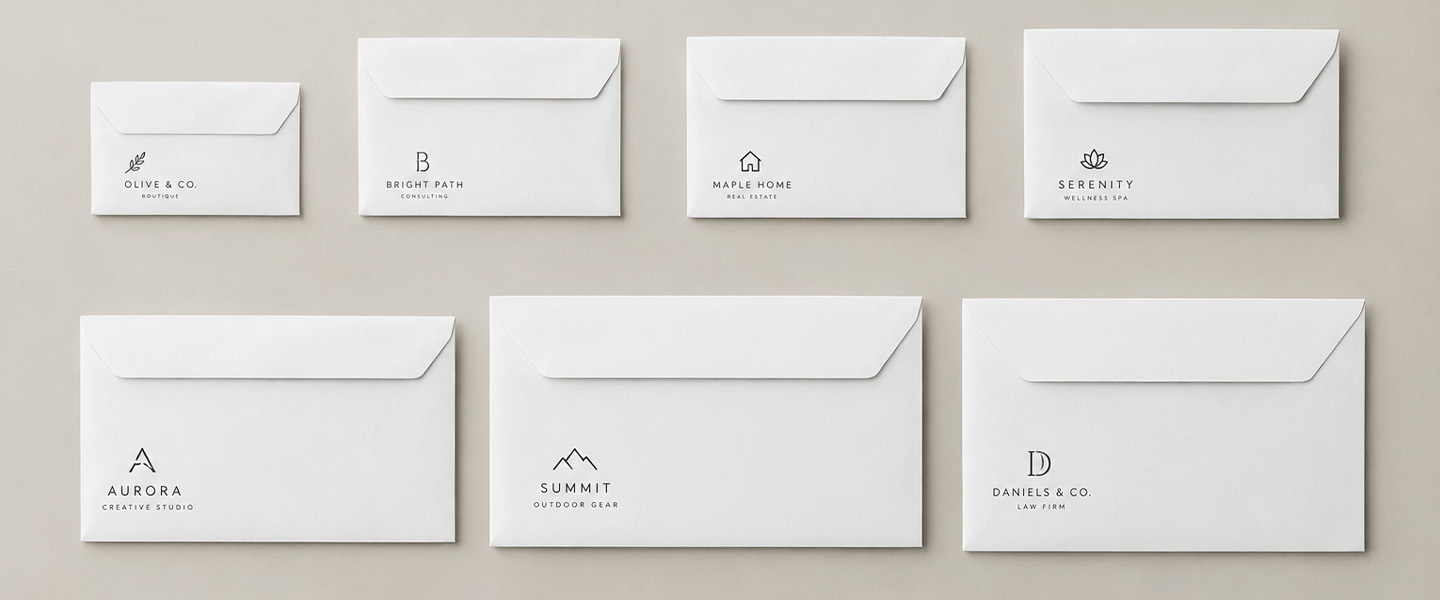
Here’s a quick envelope size chart for some of the most commonly used formats in the U.S.
| Envelope | Dimensions | Common Uses |
| #6 1/4 | 3 1/2 × 6 in. | Small documents, checks |
| #9 | 3 7/8 × 8 7/8 in. | Reply and return envelopes |
| #10 | 4 1/8 × 9 1/2 in. | Business letters, invoices, statements |
| #12 | 4 3/4 × 11 in. | Larger business documents |
| A1 | 3 5/8 × 5 1/8 in. | Small cards, RSVP cards |
| A2 | 4 3/8 × 5 3/4 in. | Notes, invitations, cards |
| A4 | 4 1/4 × 6 1/4 in. | Invitations, announcements |
| A6 | 4 3/4 × 6 1/2 in. | Invitations, greeting cards |
| A7 | 5 1/4 × 7 1/4 in. | Invitations, greeting cards, announcements |
| A8 | 5 1/2 × 8 1/8 in. | Larger invitations and cards |
| A9 | 5 3/4 × 8 3/4 in. | Invitations, announcements |
| A10 | 6 × 9 1/2 in. | Large cards and announcements |
These are common industry dimensions; available formats can vary by envelope manufacturer.
What Is the Standard Envelope Size?
The #10 envelope, measuring 4 1/8 × 9 1/2 inches, is the standard envelope commonly used for business correspondence in the United States.
It’s the envelope you probably picture when you think about receiving:
- Business letters
- Invoices
- Statements
- Notices
- Contracts
- Office correspondence
A standard 8.5 × 11-inch sheet of paper can be folded into thirds to fit inside.
That makes the #10 particularly practical for businesses sending standard letter-size documents without needing an oversized envelope.
If you’re creating correspondence for clients or customers, pairing an appropriately sized envelope with professionally designed letterhead can also create a more consistent presentation.
For more guidance on putting those pieces together, see our letterhead and envelopes guide.
Business Envelope Sizes
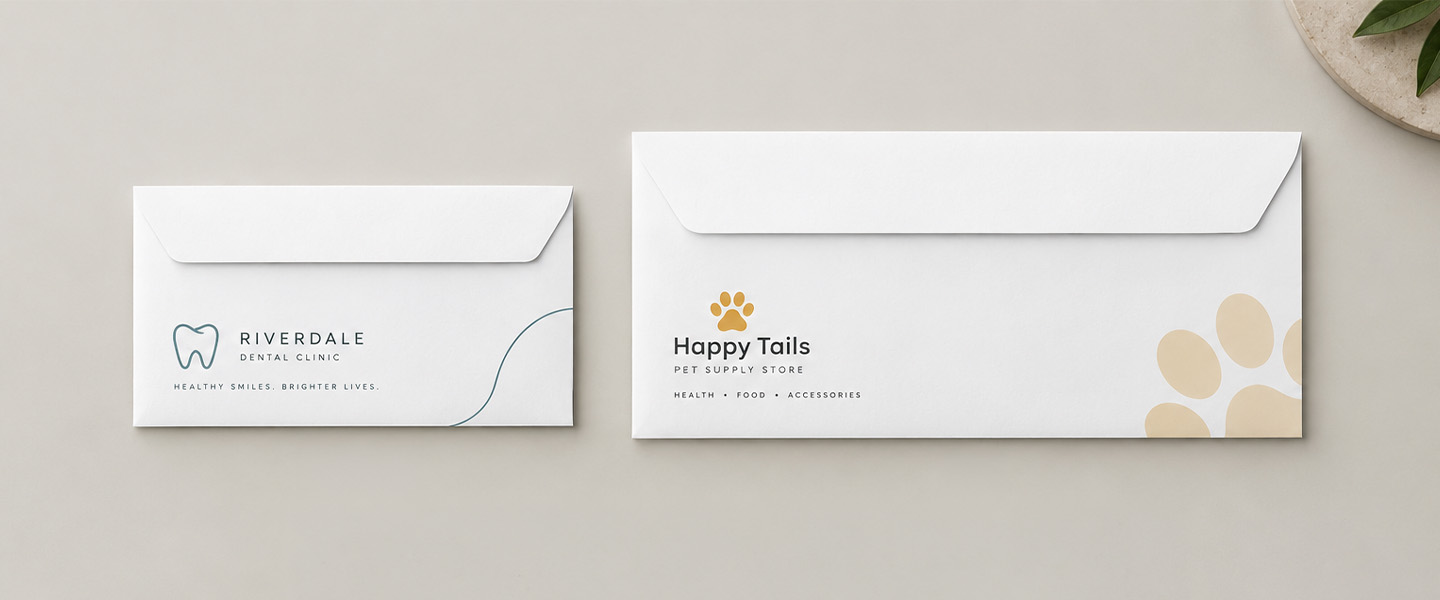
Business envelopes are generally designed around common office documents and mailing needs.
#10 Envelope — 4 1/8 × 9 1/2 Inches
The #10 is one of the most recognizable business envelope sizes.
It’s commonly used for:
- Letters
- Invoices
- Statements
- Notices
- Direct mail
- General business correspondence
A standard letter-size sheet can be tri-folded to fit inside.
#9 Envelope — 3 7/8 × 8 7/8 Inches
The #9 is slightly smaller than a #10.
One common use is as a reply envelope placed inside a larger #10 envelope.
For example, a business might send a letter in a #10 envelope and include a #9 return envelope for the recipient.
#6 1/4 Envelope — 3 1/2 × 6 Inches
This smaller format can be useful for:
- Checks
- Receipts
- Small forms
- Compact correspondence
Because space is limited, it isn’t normally the first choice for full-size business letters.
#12 Envelope — 4 3/4 × 11 Inches
The #12 provides additional room compared with the standard #10 and can accommodate larger or more substantial inserts.
Before choosing a business envelope, consider not only the document’s dimensions but also how many sheets or inserts will go inside.
Invitation and Announcement Envelope Sizes
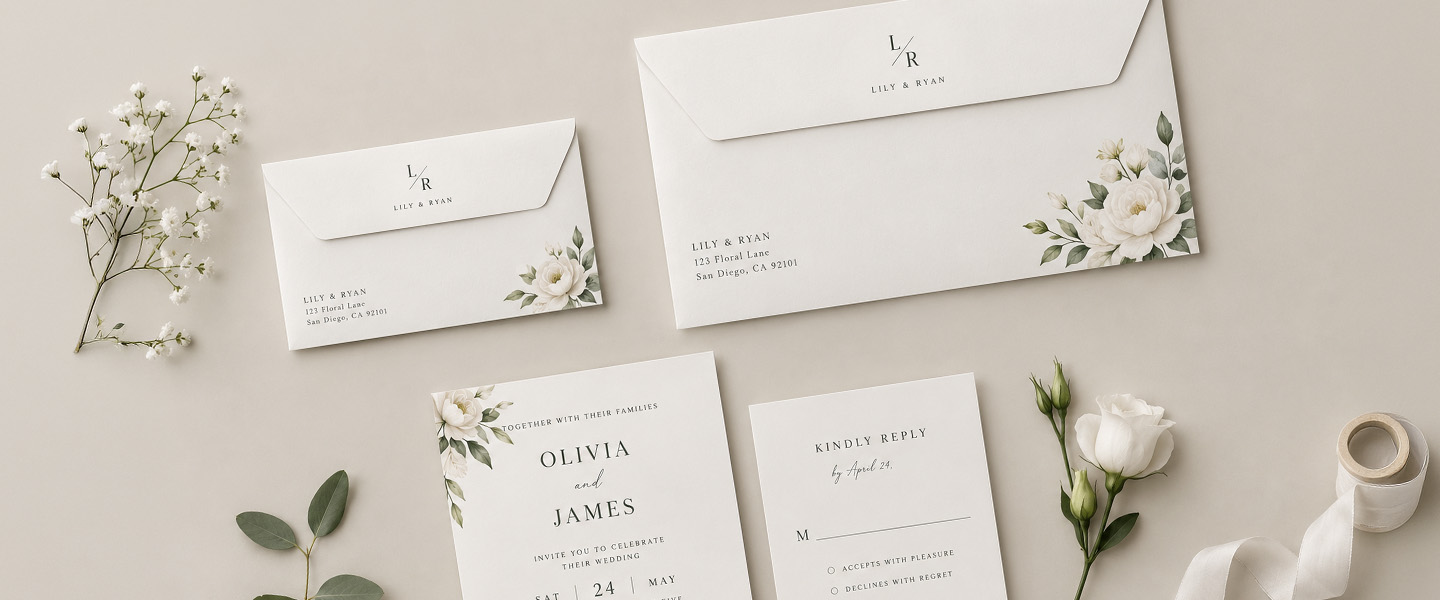
Invitation envelopes use a different sizing system.
Instead of numbers such as #9 and #10, you’ll frequently see sizes such as A2, A6, and A7.
These envelopes are commonly used for:
- Wedding invitations
- Save-the-Dates
- Greeting cards
- Party invitations
- Announcements
- Thank-you cards
- RSVP cards
A2 Envelope — 4 3/8 × 5 3/4 Inches
A2 envelopes are useful for smaller cards and invitations.
They can work well for:
- Thank-you notes
- RSVP cards
- Small invitations
- Personal correspondence
A6 Envelope — 4 3/4 × 6 1/2 Inches
The A6 offers more room while remaining compact.
It is commonly paired with invitations, announcements, and greeting cards.
A7 Envelope — 5 1/4 × 7 1/4 Inches
The A7 is one of the most common invitation envelope sizes.
It’s commonly paired with a 5 × 7-inch card, leaving enough room for the card to fit comfortably inside.
That makes it a popular option for:
- Wedding invitations
- Save-the-Dates
- Holiday cards
- Birthday invitations
- Event invitations
- Announcements
If you’re preparing wedding stationery, our 2026 Save-the-Date printing timeline explains when to order and send your cards.
A8 Envelope — 5 1/2 × 8 1/8 Inches
A8 envelopes give larger cards and invitations additional room.
They can be useful when your design needs more space than a traditional 5 × 7 card.
A9 Envelope — 5 3/4 × 8 3/4 Inches
The A9 is another larger announcement format and works well when you want a more substantial invitation or card presentation.
What Size Envelope Fits a 5 × 7 Card?
A 5 × 7-inch card typically fits an A7 envelope, which measures 5 1/4 × 7 1/4 inches.
That extra quarter inch in each direction gives the card enough clearance to slide into and out of the envelope without being an excessively loose fit.
A 5 × 7 card is commonly used for:
- Invitations
- Save-the-Dates
- Holiday cards
- Announcements
- Thank-you cards
- Event invitations
When choosing an envelope, don’t simply select one with exactly the same dimensions as your card.
The envelope needs to be slightly larger than the piece inside.
What Size Envelope Fits a 4 × 6 Card?
For a 4 × 6-inch card, you’ll need an envelope with interior dimensions slightly larger than the card itself.
Depending on the exact card and envelope construction, an A6 envelope at 4 3/4 × 6 1/2 inches is one common option.
Always check the finished dimensions of both products before ordering, particularly if you’re using thick cardstock or including multiple pieces.
How Much Larger Should an Envelope Be Than the Card?
An envelope should be slightly larger than the card or document inside so the contents can be inserted and removed without bending or damaging them.
For example:
5 × 7 card → 5 1/4 × 7 1/4 A7 envelope
The amount of clearance you’ll need also depends on:
- Paper thickness
- Number of cards or inserts
- Folded versus flat pieces
- Embellishments
- Envelope construction
A wedding invitation suite containing several cards, for example, will be thicker than a single invitation.
So don’t choose based on width and height alone.
What Size Envelope Fits an 8.5 × 11 Sheet of Paper?
That depends on whether you want to fold the paper or keep it flat.
For everyday business correspondence, an 8.5 × 11-inch sheet can be folded into thirds and placed inside a #10 envelope measuring 4 1/8 × 9 1/2 inches.
This is a common setup for business letters.
If the document shouldn’t be folded, you’ll need a larger envelope designed to accommodate letter-size paper flat.
This may be preferable for:
- Certificates
- Important documents
- Presentation materials
- Contracts
- Formal documents
- Marketing materials
The contents should determine the envelope—not the other way around.
Large Envelope Sizes
Some materials simply shouldn’t be squeezed into a standard business envelope.
Larger envelopes are useful for sending documents, booklets, catalogs, presentations, and other materials that need more room.
Common larger envelope formats include:
6 × 9 Envelopes
Useful for smaller documents, booklets, marketing materials, and pieces that don’t fit comfortably inside a standard business envelope.
9 × 12 Envelopes
A 9 × 12 envelope is commonly used when you want to place standard 8.5 × 11-inch documents inside without folding them.
This can work well for:
- Contracts
- Reports
- Certificates
- Presentation materials
- Business documents
10 × 13 Envelopes
A 10 × 13 envelope provides additional clearance for multiple sheets, folders, and thicker document sets.
When you’re mailing larger pieces, however, it’s important to distinguish between an envelope’s commercial size name and its USPS mail classification.
They’re not necessarily the same thing.
What Envelope Sizes Qualify as USPS Letter Mail?
For USPS purposes, a mailpiece generally needs to stay within specific dimensions to qualify as letter-size mail.
USPS currently defines letter-size mail as:
| Measurement | Minimum | Maximum |
| Length | 5 in. | 11 1/2 in. |
| Height | 3 1/2 in. | 6 1/8 in. |
| Thickness | 0.007 in. | 1/4 in. |
USPS also specifies that letter-size mail must be rectangular. First-Class Mail letter-size pieces have a maximum weight of 3.5 ounces.
A piece that exceeds the maximum letter dimensions can move into another mail classification, which may change the postage required.
For current requirements, always verify your finished mailpiece using the USPS letter-size standards before mailing.
What Is Considered a Large Envelope by USPS?
USPS calls large envelope-size mailpieces flats.
A flat exceeds at least one of the maximum dimensions for letter-size mail while remaining within the maximum dimensions for a flat.
USPS currently lists maximum flat dimensions of:
- 15 inches long
- 12 inches high
- 3/4 inch thick
Flats must also meet other requirements, including flexibility and shape standards.
Because size, thickness, flexibility, weight, and other characteristics can affect classification, businesses planning a large mailing should check current USPS physical standards before printing or mailing.
Do Square Envelopes Cost More to Mail?
They can.
USPS notes that unusual shapes and sizes, including square envelopes, may require additional postage because they can be more difficult for postal equipment to process.
That’s worth considering before choosing a square format purely for visual impact.
A square invitation may look distinctive, but if you’re mailing hundreds of invitations, a postage difference can add up.
Always check the current USPS requirements before committing to an unusually shaped mailpiece.
How to Choose the Right Envelope Size
Start with what’s going inside.
1. Measure Your Finished Piece
Measure the actual dimensions after printing, cutting, and folding.
If you’re mailing a 5 × 7 invitation, for example, start with those finished dimensions—not the dimensions of the original design file.
2. Decide Whether the Piece Can Be Folded
A standard business letter can usually be folded.
A certificate probably shouldn’t be.
This decision can dramatically change the envelope size you need.
3. Account for Multiple Inserts
An envelope containing one card behaves differently from one containing:
- Invitation
- RSVP card
- Details card
- Map
- Additional insert
More pieces mean more thickness.
4. Leave Enough Clearance
Don’t choose an envelope with exactly the same dimensions as its contents.
You need enough room to insert the piece comfortably.
5. Consider Mailing Requirements
If you’re mailing the piece, check its finished size, shape, thickness, and weight.
A beautiful envelope isn’t helpful if its dimensions unexpectedly change your postage costs.
6. Match the Envelope to the Purpose
Finally, think about how the recipient will experience it.
A #10 makes sense for an invoice.
An A7 feels more natural for a wedding invitation.
A larger envelope may make more sense for a document that should arrive unfolded.
Size is functional, but it’s also part of the presentation.
Envelope Size Chart: Which Size Should You Choose?
Here’s a simple reference based on what you’re sending:
| You’re Sending | Envelope to Consider |
| Standard business letter | #10 |
| Return/reply envelope | #9 |
| Small note or RSVP | A1 or A2 |
| Small invitation | A2 or A6 |
| 5 × 7 invitation/card | A7 |
| Large invitation/card | A8 or A9 |
| 8.5 × 11 letter folded in thirds | #10 |
| 8.5 × 11 document kept flat | 9 × 12 |
| Multiple full-size documents | 9 × 12 or 10 × 13 |
Use this as a starting point rather than an absolute rule. Envelope construction, paper thickness, inserts, and mailing requirements can all affect the final choice.
Match Your Envelope to the Printed Piece
The easiest way to choose an envelope is to work backward from the piece you’re sending.
Start with the final card, invitation, letter, or document size. Decide whether it will be folded. Account for any additional inserts. Then choose an envelope that provides enough clearance while still fitting the presentation you want.
For business correspondence, that might mean pairing a #10 envelope with professionally printed letterhead.
For an invitation or announcement, you may instead start by choosing your finished postcard or card dimensions and then select an envelope that fits.
And if your project is being mailed, check USPS requirements before finalizing the design. Envelope dimensions aren’t just a design decision—they can affect how your mail is processed and priced.
Frequently Asked Questions About Envelope Sizes
What is the most common envelope size?
The #10 envelope is one of the most common business envelope sizes in the United States. It measures 4 1/8 × 9 1/2 inches and fits standard 8.5 × 11-inch paper folded into thirds.
What are the dimensions of a #10 envelope?
A standard #10 envelope measures 4 1/8 × 9 1/2 inches.
What size envelope fits a 5 × 7 card?
An A7 envelope, measuring 5 1/4 × 7 1/4 inches, is commonly used for a 5 × 7-inch card.
What size envelope fits an 8.5 × 11 sheet?
A #10 envelope can hold an 8.5 × 11-inch sheet folded into thirds. If the document needs to remain flat, a larger format such as a 9 × 12 envelope is commonly used.
What size is an A7 envelope?
An A7 envelope measures 5 1/4 × 7 1/4 inches.
What size is an A6 envelope?
An A6 envelope measures 4 3/4 × 6 1/2 inches.
What size is an A2 envelope?
An A2 envelope measures 4 3/8 × 5 3/4 inches.
Are A7 and #7 envelopes the same size?
No. Envelope naming systems can be confusing, but an A7 announcement envelope and a numbered commercial envelope are not interchangeable names. Always check the actual dimensions instead of relying only on the size label.
How do I know what envelope size I need?
Measure the finished item you’re putting inside, account for folds and additional inserts, and select an envelope slightly larger than the contents. If you’re mailing it, also check USPS size, thickness, shape, and weight requirements.
Does envelope size affect postage?
Yes. Size is one factor USPS uses to classify mail. Shape, thickness, flexibility, and weight can also affect classification and postage, so check current USPS requirements for your finished mailpiece before mailing.