Posters appear almost everywhere. Retail stores use them to announce sales. Restaurants display promotions and events. Businesses place them in storefront windows. Organizations use them at conferences, offices, schools, and community spaces.
But not every poster faces the same conditions.
A poster displayed on an interior wall in a retail store has very different requirements from one placed outside where it may encounter sunlight, moisture, wind, and changing temperatures.
Even two outdoor displays can require different solutions.
A poster positioned behind a storefront window is protected from rain and wind. A poster attached directly to an outdoor structure is not.
That is why choosing between an indoor and outdoor poster involves more than simply asking whether the display is inside or outside.
You also need to consider:
- how long it will be displayed,
- whether it will be protected,
- how much sunlight it receives,
- whether moisture is possible,
- how far away people will see it,
- and how frequently it may need to be replaced.
Here is how to choose the right poster material and print format for your specific display.
Key Takeaways
- Indoor and outdoor posters face very different conditions, so the right material depends heavily on where the poster will be displayed.
- Indoor posters can prioritize color, detail, and readability, while outdoor displays require greater consideration of sunlight, moisture, wind, and temperature.
- The length of the campaign matters almost as much as the location. A one-day outdoor display has different requirements from signage expected to remain outside for months.
- Glossy surfaces can produce vibrant visuals but may create glare depending on lighting and placement.
- Traditional paper posters may work in protected outdoor or storefront locations, but direct weather exposure can require a more durable signage format.
- Viewing distance, protection, campaign duration, and budget should all be considered before choosing your print format.
What Is the Difference Between Indoor and Outdoor Posters?
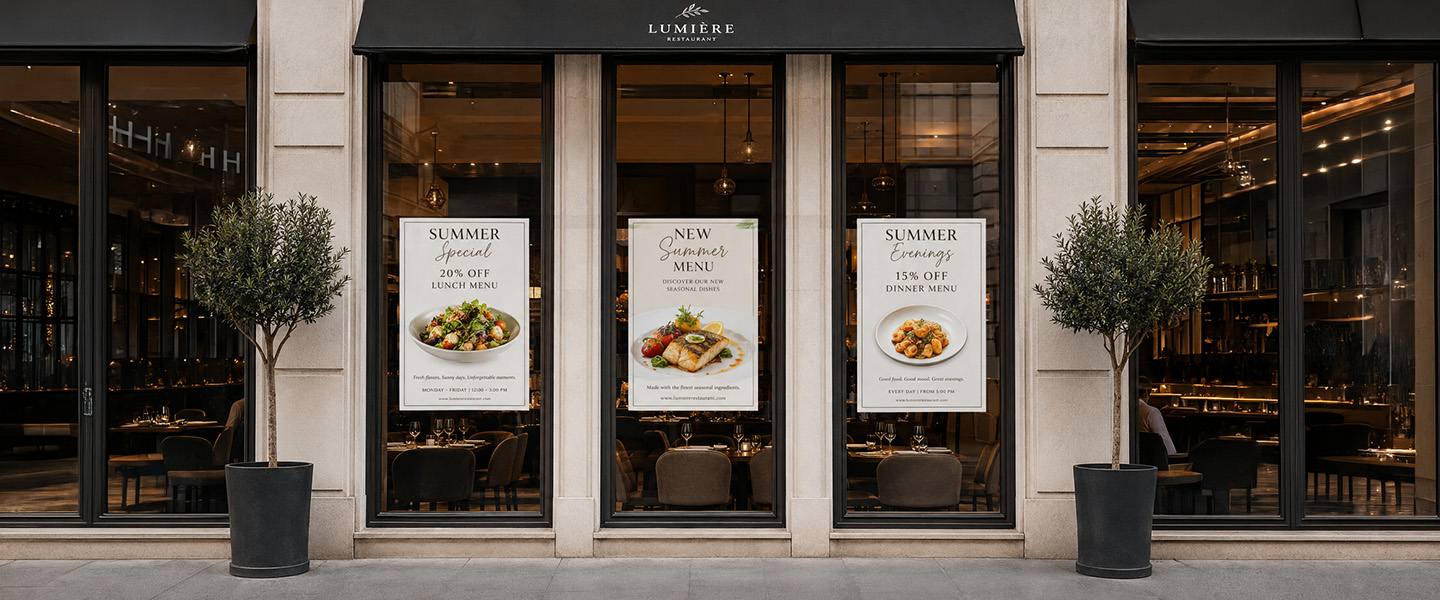
The biggest difference is the environment in which the printed piece needs to perform.
Indoor environments are generally controlled.
A poster displayed inside a store, office, restaurant, or event venue usually does not need to withstand rain, strong wind, or major temperature changes.
That allows the printing decision to focus more heavily on:
- color reproduction,
- image quality,
- readability,
- finish,
- size,
- and visual presentation.
Outdoor displays introduce additional variables.
Depending on placement, an outdoor poster may encounter:
- direct sunlight,
- rain or humidity,
- wind,
- dirt,
- temperature changes,
- and repeated exposure over time.
As a result, durability becomes a much bigger consideration.
However, location alone does not determine what you need.
Imagine two posters.
The first is displayed outdoors for three hours during a community event on a clear day.
The second needs to remain outdoors for three months.
Both are technically “outdoor posters,” but their durability requirements are completely different.
Protection matters too.
A printed poster displayed behind glass or inside a weather-protected case faces fewer environmental risks than a piece directly exposed to the elements.
The right question is therefore not simply:
Is this poster indoors or outdoors?
It is:
What conditions will this printed piece actually experience?
What Materials Work Best for Indoor Posters?
Indoor poster printing provides more flexibility because weather resistance is usually not the primary concern.
Instead, businesses can focus on visual quality and how the poster interacts with the surrounding environment.
Standard Poster Paper
Quality poster paper works well for most indoor promotional applications.
It is particularly useful for:
- retail promotions,
- indoor events,
- offices,
- restaurants,
- temporary signage,
- presentations,
- and promotional displays.
Overnight Prints’ Posters are currently printed on 100# gloss paper coated on both sides, approximately 140 GSM.
This makes them suitable for applications where vibrant full-color graphics and visual impact are important.
Available poster sizes include options such as 11″ × 17″, 16″ × 20″, 18″ × 24″, 19″ × 27″, 22″ × 28″, and 24″ × 36″, giving businesses flexibility for both smaller displays and larger promotional pieces.
Glossy Poster Paper
Glossy paper reflects more light than an uncoated or low-shine surface.
That can help:
- photographs appear vibrant,
- colors look more visually prominent,
- graphics attract attention,
- and promotional designs create stronger visual impact.
Glossy posters are particularly useful for:
- colorful retail promotions,
- photography,
- product advertising,
- event graphics,
- artwork,
- and high-impact visual displays.
However, placement matters.
Strong overhead lights or direct light hitting the poster can create reflections that make some parts of the design more difficult to see.
If your poster will be placed under bright lighting, test or consider the viewing angle before deciding where to display it.
What About Matte Poster Paper?
Matte finishes can be useful for text-heavy designs and environments where glare is a major concern because they reflect less light.
However, Overnight Prints currently lists its poster stock as 100# gloss paper rather than a matte poster option.
If a low-glare matte surface is essential to your project, check the available specifications before ordering rather than assuming every poster printer offers the same finish.
For Overnight Prints posters, careful placement can help minimize unwanted reflections from the glossy surface.
What Materials Work Best for Outdoor Posters?
Outdoor printing requires a different approach because paper alone may not provide the durability needed for direct exposure.
Before selecting a format, consider five environmental factors.
Weather Exposure
Will rain reach the poster?
Even occasional moisture can be an important concern for traditional paper-based materials.
A protected poster under an awning or behind a window has very different requirements from one installed in a completely exposed location.
Sunlight
Direct sunlight can affect printed materials over time.
The longer a display remains exposed, the more important it becomes to consider how the material and printed image will perform under those conditions.
Wind
Wind creates another challenge that indoor posters rarely face.
Large paper posters can bend, tear, or become difficult to secure when displayed in exposed locations.
The larger the format, the more important mounting and material choice become.
Temperature Changes
Outdoor displays may experience heat, cold, humidity, and rapid temperature changes.
Long-term signage should use a material and installation method appropriate for those conditions.
Campaign Duration
Duration can completely change the best choice.
For example:
A few hours: A poster may be sufficient if conditions are controlled and the display is protected.
Several days: Protection from moisture and wind becomes increasingly important.
Several weeks or months: A more durable signage format may be the better investment.
Overnight Prints’ current Poster offering uses 100# gloss paper. Because this is a paper-based poster product, it should not automatically be treated as weatherproof outdoor signage.
For direct or extended exposure to rain, wind, or other weather conditions, consider whether a more durable large-format signage solution would better fit the project.
Indoor vs. Outdoor Posters: Key Differences
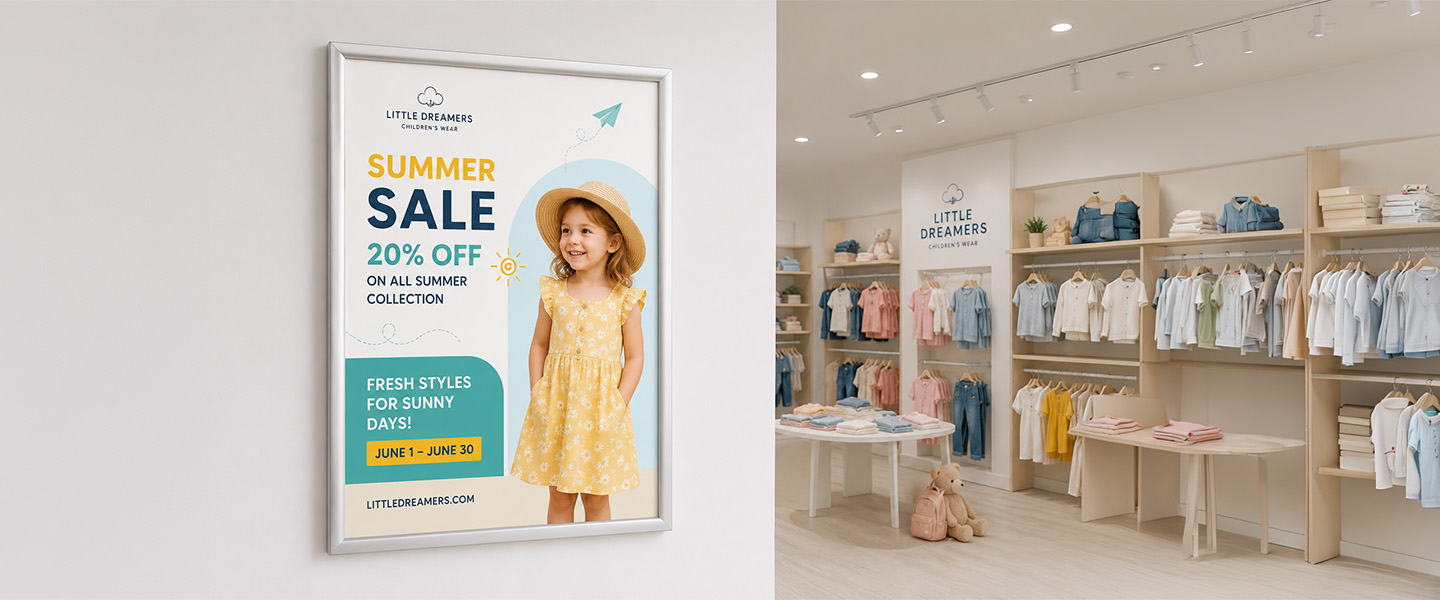
| Factor | Indoor Posters | Outdoor Posters |
| Environment | Generally controlled | Potentially exposed to weather |
| Durability Needs | Low to moderate | Moderate to high |
| Sun Exposure | Usually limited | Potentially significant |
| Moisture | Usually minimal | Possible or frequent |
| Wind | Not normally a concern | Can affect mounting and material |
| Viewing Distance | Often closer | Often farther away |
| Display Duration | Short or long term | Highly dependent on material and protection |
| Design Priority | Detail and readability | Visibility and immediate impact |
| Protection | Often unnecessary | May require windows, frames, cases, or durable materials |
| Format Choice | Paper posters often work well | Durable signage may be preferable for direct exposure |
The key difference is not simply indoor versus outdoor.
It is the amount of environmental stress the printed material needs to tolerate.
Why Poster Material Matters
Poster material affects much more than how the finished piece feels.
It can influence how the entire campaign performs.
Print Quality
Different surfaces reproduce colors, photographs, text, and fine details differently.
Glossy paper can help colorful graphics and photography appear vibrant, making it useful for promotional posters designed to attract attention.
But material should always support the design rather than compete with it.
A visually impressive surface does not help if the poster becomes difficult to read in its actual environment.
Durability
A beautiful poster has limited value if it deteriorates before the campaign ends.
That is why the expected lifespan of the display should influence the material decision from the beginning.
For short indoor campaigns, additional durability may provide little practical benefit.
For outdoor campaigns, durability can become one of the most important considerations.
Readability
Material and finish influence how light interacts with a poster.
Glossy surfaces can reflect light, while lower-shine surfaces generally produce less glare.
But readability also depends on:
- font size,
- contrast,
- viewing distance,
- lighting,
- placement,
- and the amount of information included.
A poster should be designed for its actual environment rather than evaluated only on a computer screen.
Brand Perception
Printed materials contribute to how a business presents itself.
A crisp, properly displayed poster can make a promotion feel intentional and professional.
A faded, damaged, wrinkled, or poorly mounted poster can create the opposite impression.
Material choice therefore becomes part of the presentation of the brand.
Campaign Cost
The cheapest material is not always the least expensive option over the full life of a campaign.
If a poorly suited poster needs to be reprinted several times because it cannot handle the display conditions, the total cost may eventually exceed that of choosing a more appropriate format from the beginning.
At the same time, there is little reason to pay for extreme durability when a poster will only be displayed indoors for one weekend.
Match the material investment to the campaign.
How to Choose the Right Poster for Your Display
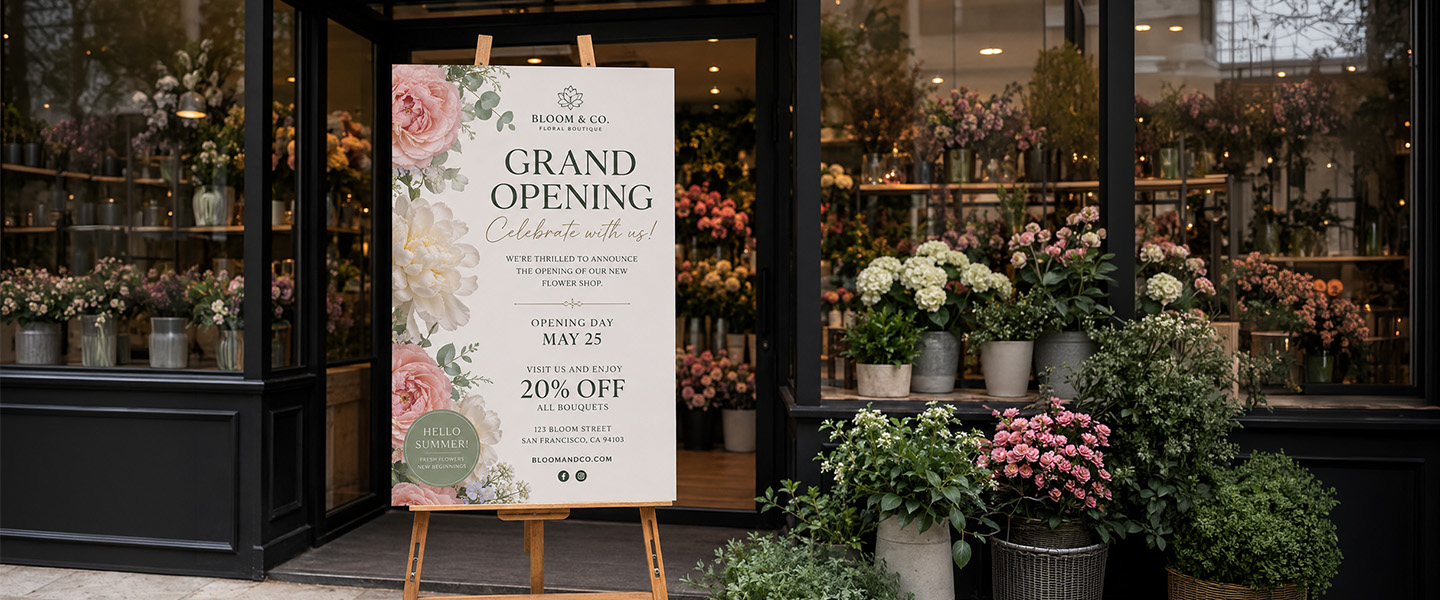
Instead of starting with paper specifications, answer a few practical questions first.
Where Will the Poster Be Displayed?
Start with the environment.
Is it:
- inside a store,
- inside an office,
- at an indoor event,
- behind a storefront window,
- under a covered outdoor area,
- or completely exposed outdoors?
The more environmental exposure the display receives, the more durability matters.
How Long Will It Be Displayed?
A poster promoting a one-day event does not need the same lifespan as permanent or semi-permanent signage.
Ask whether the campaign lasts:
- a few hours,
- several days,
- a few weeks,
- several months,
- or longer.
Do not pay for durability you do not need—but do not underestimate the conditions your poster needs to survive.
Will It Be Protected?
Protection can dramatically change what materials are practical.
A poster displayed:
- behind glass,
- inside a frame,
- in a display case,
- inside a storefront window,
- or under a covered structure
has significantly less direct exposure than an unprotected outdoor poster.
A standard printed poster may therefore work in some semi-outdoor environments when properly protected.
How Far Away Will People See It?
Viewing distance affects both poster size and design.
A restaurant promotion displayed beside the entrance may be viewed from only a few feet away.
A poster intended to attract pedestrians from across the street needs a completely different visual hierarchy.
As distance increases:
- headlines should become larger,
- messaging should become shorter,
- contrast should become stronger,
- and unnecessary detail should be removed.
For a more detailed breakdown, see What Size Poster Actually Works Best for Storefronts, Events & Promotions?.
What Is Your Budget?
Budget should be evaluated alongside lifespan.
For a short indoor campaign, an affordable paper poster may be exactly what you need.
For a demanding outdoor campaign, spending more on a suitable durable format can help reduce the risk of replacement.
The goal is not to choose the cheapest or most expensive option.
It is to choose the format that delivers the necessary performance for the expected campaign duration.
Choosing Poster Materials by Use Case
Different environments create different priorities.
| Use Case | Key Consideration | Recommended Approach |
| Retail Store | Color and visibility | High-quality indoor poster |
| Restaurant | Readability and lighting | Position poster carefully to manage glare |
| Trade Show | Visual impact | High-quality large-format poster |
| Office | Professional presentation | Clean, restrained poster design |
| Indoor Event | Short-term visibility | Standard poster |
| Storefront Window | Light and viewing direction | Consider reflections, sun exposure, and placement |
| Lobby or Reception Area | Close viewing | Prioritize print quality and detail |
| Covered Outdoor Area | Limited environmental exposure | Poster may work with appropriate protection |
| Outdoor Event | Weather and durability | Consider a more durable signage format |
| Long-Term Outdoor Display | Sun, moisture and wind | Use signage designed specifically for outdoor conditions |
There is no material that is universally “best.”
A successful choice depends on matching the print format to the environment.
When Should You Choose a Banner Instead of a Poster?
Sometimes the answer to “Which outdoor poster should I choose?” is that a poster may not be the right format at all.
Traditional posters are excellent for indoor displays, storefronts, event venues, and protected promotional spaces.
But a more durable large-format format can make more sense when the display needs to handle demanding outdoor conditions.
Consider a banner or another outdoor-oriented signage solution when you need:
Long-Term Outdoor Exposure
If the display needs to remain outdoors for weeks or months, durability becomes more important than the characteristics of traditional poster paper.
Resistance to Wind or Rain
Paper-based posters are not ideal for direct exposure to repeated rain or significant wind.
A format specifically designed for outdoor installation can provide a more practical solution.
Repeated Use
Businesses sometimes need signage that can be displayed at multiple events.
Examples include:
- annual festivals,
- trade events,
- community markets,
- sporting events,
- grand openings,
- and recurring promotions.
A reusable signage format may provide better long-term value than repeatedly printing temporary posters.
Large Outdoor Displays
Large-format outdoor advertising needs to remain visible and physically stable.
Material, installation, viewing distance, and weather exposure all become more important as the display gets larger.
The main principle is simple:
Use posters where posters work best.
If the environment requires substantially more durability than paper can reasonably provide, choose a print format designed for those conditions rather than trying to make a traditional poster perform a job it was not designed to do.
Common Poster Material Mistakes to Avoid
Using Standard Paper for an Unprotected Outdoor Display
Paper posters can work beautifully indoors and in protected locations.
Direct exposure to rain and other weather conditions is a different situation.
Evaluate environmental exposure before ordering.
Ignoring Glare
A glossy poster placed directly beneath strong lighting or opposite a bright window may become difficult to read from certain angles.
Think about the actual display location during the design process.
Forgetting About Sunlight
Storefront windows and outdoor locations can receive significant sunlight even when the poster itself is protected from rain.
Consider both exposure and campaign duration when choosing placement.
Choosing Material Without Considering Duration
A temporary event poster and a months-long outdoor campaign should not automatically use the same solution.
Start with how long the display needs to perform.
Choosing Based Only on Price
A cheaper poster that requires repeated replacement may not actually save money.
Compare the initial price with the expected lifespan.
Using the Wrong Print Product
Sometimes a poster simply is not the best product for the environment.
Recognizing that before printing can save time and money.
Forgetting About Viewing Distance
Material alone cannot make a poster effective.
If the text is too small or the design contains too much information for the intended viewing distance, even excellent printing will struggle to communicate the message.
How to Design Posters for Indoor vs. Outdoor Viewing
The environment should also influence the design itself.
For Indoor Posters
People often have more time to examine indoor displays.
That gives you more flexibility to include:
- supporting information,
- secondary messaging,
- product details,
- QR codes,
- dates and times,
- and additional branding.
Still, avoid overcrowding the layout.
For Outdoor Posters
Prioritize speed.
Someone walking or driving past the display may only see it for a few seconds.
Focus on:
- one strong headline,
- one clear visual,
- high contrast,
- large typography,
- minimal supporting text,
- and one obvious action.
The farther away the audience is, the simpler the message should become.
If you’re deciding whether a poster is the right format in the first place, read Posters vs. Flyers: Which Print Format Gets More Local Attention?.
You can also compare additional formats in Flyers vs. Posters vs. Rack Cards.
Why Choose Overnight Prints for Poster Printing?
Overnight Prints offers custom Poster Printing for business promotions, events, retail displays, presentations, artwork, and other large-format applications.
Current poster specifications include 100# gloss paper coated on both sides, full-color printing, multiple popular sizes, and online design and artwork-upload options.
Available sizes include formats ranging from 11″ × 17″ through larger options such as 24″ × 36″, allowing businesses to select a poster based on available display space and viewing distance.
For indoor and protected promotional displays, posters provide an easy way to create large, visually prominent marketing materials.
For demanding outdoor environments, evaluate weather exposure and durability requirements before deciding whether a traditional paper poster is the right format.
Frequently Asked Questions
What is the difference between indoor and outdoor posters?
Indoor posters are displayed in controlled environments and can focus primarily on print quality, readability, and visual presentation.
Outdoor posters may face sunlight, moisture, wind, dirt, and temperature changes, which means material durability and protection become more important.
What type of paper is best for posters?
The best poster paper depends on where the poster will be displayed and the visual effect you want.
Glossy paper can work particularly well for colorful graphics, photography, retail promotions, and high-impact visuals. Lower-shine surfaces can be useful when glare is a major concern.
Overnight Prints currently prints posters on 100# gloss paper coated on both sides.
Can paper posters be used outdoors?
Paper posters can sometimes be used outdoors temporarily when conditions are favorable or when the poster is protected inside a frame, window, or covered display.
Traditional paper should not automatically be considered weatherproof. For direct or extended exposure to rain, wind, or moisture, a more durable signage format may be appropriate.
How long do outdoor posters last?
There is no single lifespan for an outdoor poster.
Longevity depends on the material, printing method, amount of sunlight, moisture, wind, temperature, installation method, and whether the poster is protected.
Always choose the material based on the actual conditions and required display duration.
Is matte or glossy better for posters?
Neither is universally better.
Gloss can help colors and photography appear vibrant, while matte or lower-shine surfaces can reduce glare and work well for text-heavy displays.
The best finish depends on the design, lighting, and placement.
What poster material is best for a storefront window?
A high-quality paper poster can work well behind a storefront window because the glass provides protection from direct rain and wind.
However, consider reflections, direct sunlight, viewing distance, and how long the poster will remain displayed.
How can I protect a poster displayed outdoors?
Protection can include placing the poster behind glass, inside a weather-protected display case, under a covered structure, or using another mounting system designed to reduce exposure.
If significant weather exposure is unavoidable, consider using a print format specifically intended for outdoor conditions.
Should I use a poster or banner for an outdoor event?
It depends on the conditions.
A poster can work for a short event when displayed in a protected area. For repeated use, large outdoor displays, or situations involving wind, rain, and extended exposure, a more durable signage format such as an outdoor-appropriate banner may make more sense.
Conclusion
The best poster material depends on much more than whether the display is technically indoors or outdoors.
Think about the entire environment:
Where will it be displayed?
How long will it stay there?
Will it be protected?
How much sunlight or moisture will it encounter?
How far away will people see it?
Indoor posters generally allow you to prioritize print quality, color, detail, and readability because the environment is controlled.
Outdoor displays require greater attention to durability, protection, sunlight, wind, and moisture.
And sometimes, a traditional poster is not the right solution.
For demanding outdoor conditions or long-term displays, choosing a more durable signage format from the beginning can prevent unnecessary replacements and produce a better result.
For indoor, storefront, event, and protected promotional displays, explore custom Posters from Overnight Prints and compare available sizes to find the right format for your message and viewing distance.
Resources
- PRINTING United Alliance – Industry resources covering commercial printing, substrates, production, and print technology.
- Adobe – CMYK Process Colors – Guidance explaining CMYK process color and how commercial printing reproduces full-color artwork.
- Adobe – Color Management for Printing – Information about managing color for more consistent printed output.
- AIGA – The Professional Association for Design – Professional resources related to graphic design, visual communication, typography, and design practice.