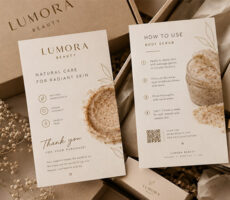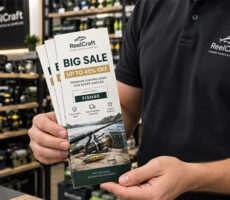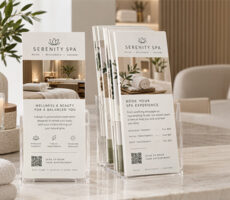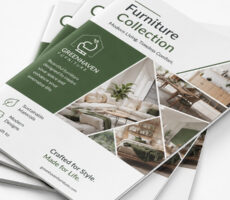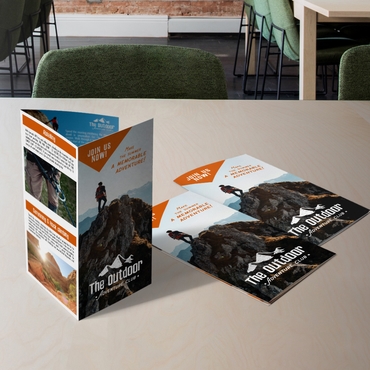
Starting a business can make it feel like you need to print everything at once: business cards, brochures, flyers, postcards, stickers, signs, stationery, packaging inserts, and more.
You probably don’t.
Most small businesses can begin with a few carefully chosen materials, then add more as their customer interactions and marketing plans become clearer.
A local contractor may need business cards, flyers, and postcards. An online shop may get more value from packaging stickers and thank-you inserts. A tourism business might prioritize brochures and rack cards instead.
The right starter kit depends on three things:
- How customers discover the business
- Where sales conversations happen
- What customers need before taking the next step
This guide will help you decide what to print first, what can wait, and which materials fit different types of small businesses.
Quick Answer: What Should a New Small Business Print?
Most small businesses should start with:
- A contact piece, such as a business card
- A sales or information piece, such as a flyer or brochure
- A promotional piece, such as a postcard
- A customer-experience piece, such as a sticker, notecard, or package insert
A physical-location business may also need posters, menus, signs, appointment cards, or other operational materials.
You don’t necessarily need every item on this list.
A better rule is:
Don’t print a product until you know what job it needs to do.
| Business Need | Print Material to Consider |
| Share contact information | Business cards |
| Explain several services | Brochures |
| Promote one offer or event | Flyers |
| Reach local households | Postcards |
| Improve packaging | Stickers and package inserts |
| Stay visible in shared locations | Rack cards |
| Attract attention inside a store | Posters |
| Provide detailed information | Booklets |
| Create a useful branded giveaway | Bookmarks |
| Thank or reconnect with customers | Notecards or greeting cards |
Start With the Customer Journey, Not the Product List
Before ordering anything, think about how someone moves from discovering your business to becoming a customer.
For example, a potential customer might:
- Meet you at a networking event
- Take your business card
- Visit your website
- Request a consultation
- Receive a brochure explaining the service
- Book an appointment
- Receive a thank-you card afterward
Another customer might:
- Receive a postcard in the mail
- Scan a QR code
- Visit a landing page
- Redeem an offer in the store
An e-commerce customer might:
- Find the business through social media
- Place an online order
- Receive a package with a branded sticker
- Find a thank-you postcard inside
- Use the postcard’s discount code to order again
The print materials are different because the customer journeys are different.
The U.S. Small Business Administration recommends developing marketing and sales strategies around how a business will attract and retain customers and how sales will happen. It also notes that marketing strategies should evolve with the business’s needs. See the SBA’s business-planning guidance.
Your printing plan should do the same.
1. Business Cards: For In-Person Connections
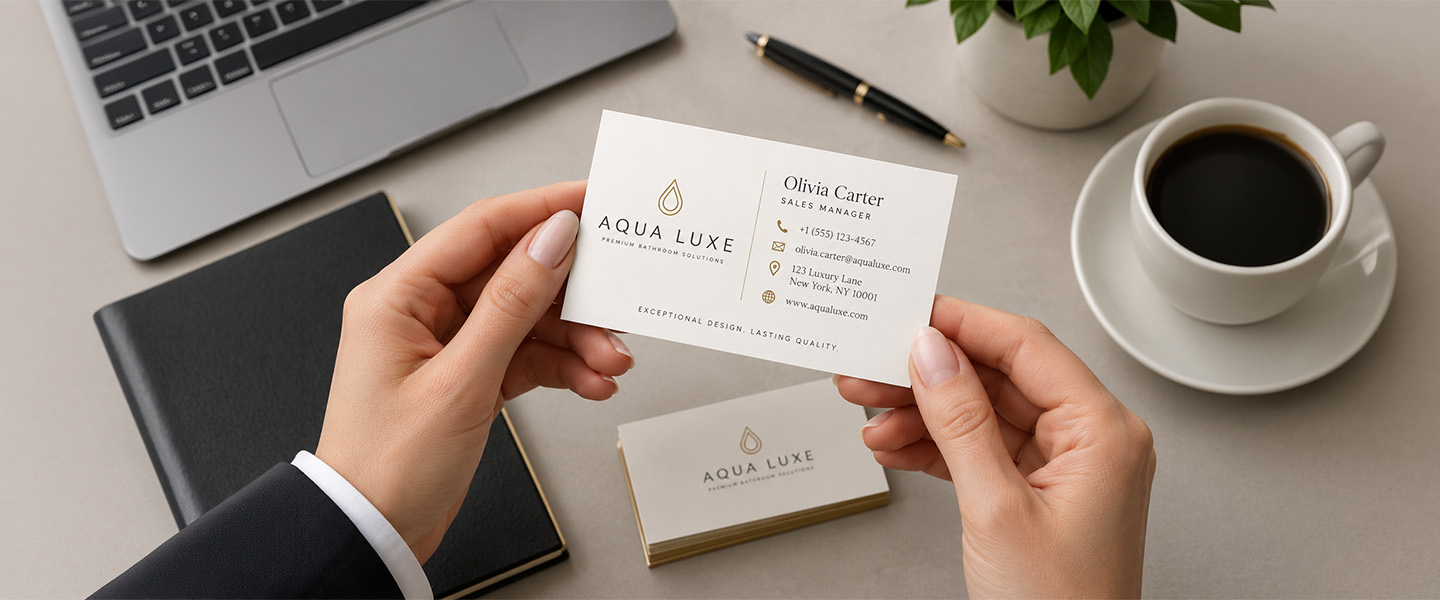
Business cards are often the first printed item a new business considers.
They are particularly useful when you:
- Attend networking events
- Visit clients
- Provide estimates
- Meet potential customers in person
- Participate in trade shows
- Work in sales or consulting
- Rely on referrals
- Want employees to share consistent contact information
A basic business card usually includes:
- Business name
- Logo
- Person’s name
- Job title
- Phone number
- Email address
- Website
- Relevant social media handle
- Optional QR code
Not every business card needs every possible contact method. Include the options customers are most likely to use.
For example, if appointments are booked through a website, a QR code could lead directly to the booking page. If customers typically call, make the phone number easy to find.
Do Online Businesses Need Business Cards?
Not always.
An online shop operating entirely through a website may benefit more from packaging inserts and stickers. However, business cards may still be useful for:
- Wholesale conversations
- Vendor meetings
- Pop-up markets
- Craft fairs
- Media events
- Brand partnerships
If you rarely meet potential customers or partners in person, business cards may not be the first thing you need.
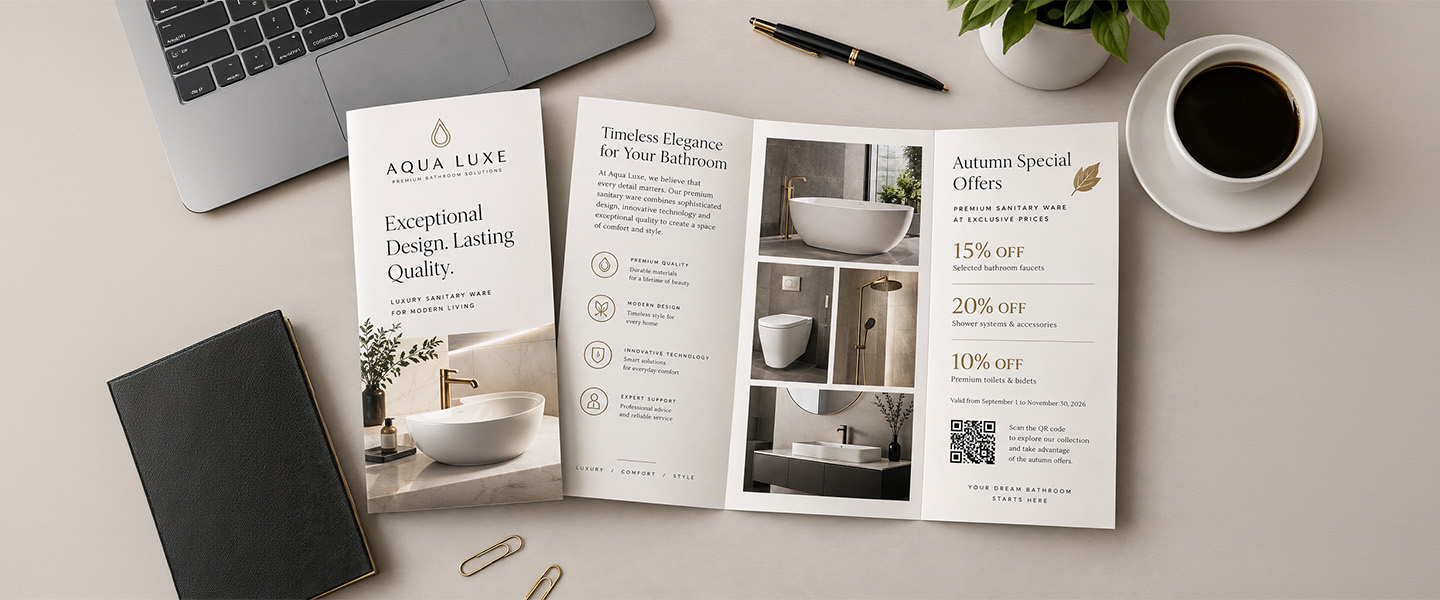
2. Brochures: For Explaining a Business in More Detail
Choose a brochure when customers need more information before deciding.
Brochures work well for businesses with:
- Multiple services
- Detailed processes
- Service packages
- Visual portfolios
- Frequently asked questions
- Higher-consideration purchases
- Information customers may want to review later
A brochure might explain:
- What the company does
- Who the service is for
- Key benefits
- How the process works
- Available packages
- Testimonials
- Frequently asked questions
- Contact information
- The next step
For example, a home remodeling company could use a brochure to show its process, project categories, before-and-after photos, and consultation information.
A dental office might explain its main services, payment options, new-patient process, and appointment details.
A wedding planner could introduce service packages and show examples of previous events.
When Is a Brochure Better Than a Flyer?
Use a brochure when the reader needs a structured explanation.
Use a flyer when the message can be understood quickly.
A brochure might explain an accounting firm’s services. A flyer might promote that firm’s upcoming tax-preparation workshop.
If you’re deciding between fold styles, the guide to Z-fold, tri-fold, and gate-fold brochures explains how each format organizes information differently.
3. Flyers: For One Clear Promotion
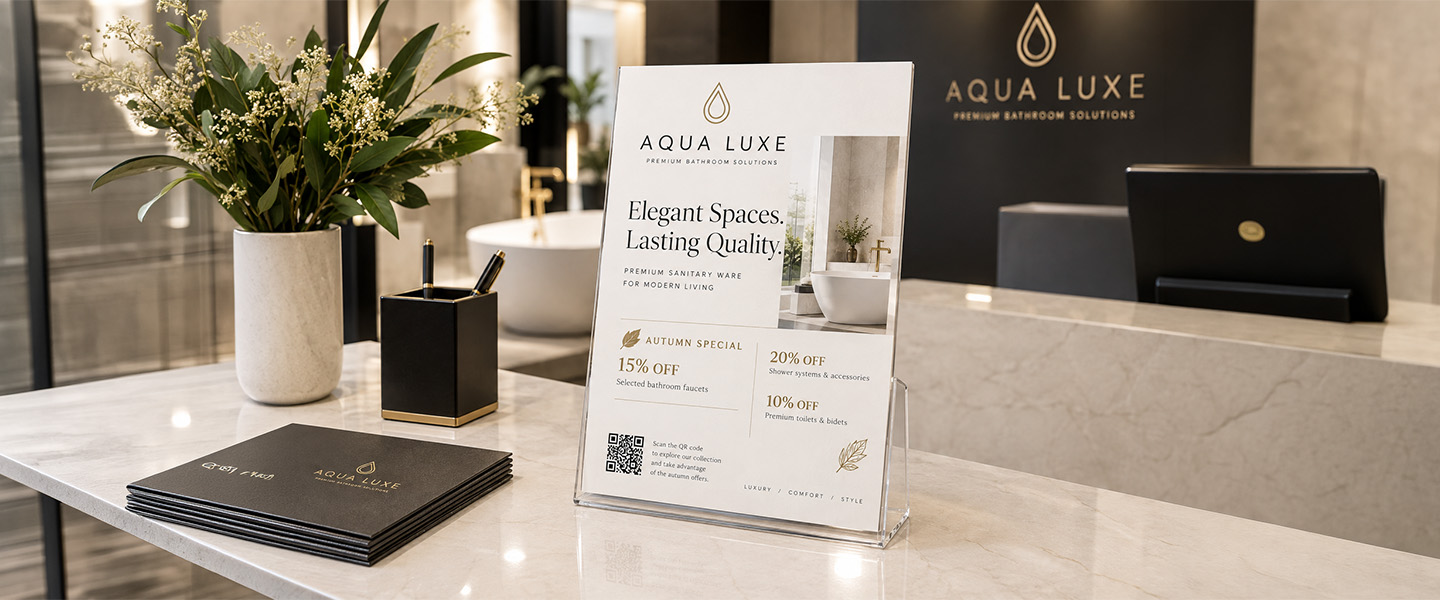
Flyers are useful when a small business has one timely message to distribute.
That message might be:
- Grand opening
- New service
- Seasonal offer
- Workshop
- Store event
- Special menu
- Membership promotion
- Fundraiser
- Open house
- Limited-time sale
A flyer should not try to explain the entire business.
It should answer:
- What is happening?
- Why should someone care?
- When and where is it happening?
- What should the reader do next?
For example:
NOW OPEN IN DOWNTOWN AUSTIN
Fresh bread, pastries, and coffee made daily.
Visit us at 123 Main Street.
Open Monday–Saturday, 7 AM–5 PM
That is clearer than adding the bakery’s full history, complete menu, catering packages, social media accounts, and ten separate offers.
Where Can Small Businesses Use Flyers?
Depending on local rules and permission, businesses may distribute flyers:
- At community events
- Inside customer orders
- At reception desks
- Through local partnerships
- At trade shows
- In waiting areas
- At the business location
- On approved community boards
- Directly to prospective customers
The distribution plan should be decided before the flyer is designed.
A flyer intended for a busy event may need a much bolder headline than one customers will receive during a scheduled consultation.
4. Postcards: For Local Outreach and Customer Follow-Up
Postcards can support both customer acquisition and retention.
Businesses can use them to:
- Introduce a new location
- Reach nearby households
- Promote a seasonal service
- Announce a grand opening
- Send an appointment reminder
- Reconnect with previous customers
- Share a referral offer
- Thank customers
- Advertise a local event
- Promote a new product
- Include a message inside an order
For local outreach, the U.S. Postal Service’s Every Door Direct Mail program allows businesses to select routes and send mail to addresses within chosen neighborhoods. USPS currently describes EDDM Retail as an option for sending between 200 and 5,000 pieces per day per ZIP Code without requiring a special mailing permit. Businesses should check the current USPS EDDM requirements before preparing a campaign.
A postcard campaign works best when it has:
- One audience
- One primary message
- One clear action
- A way to measure responses
For example, a landscaping company could send:
GET YOUR YARD READY FOR FALL
Schedule your seasonal cleanup before October 15.
[QR code]
Request an estimate →
For additional campaign concepts, see these postcard advertising ideas for local businesses.
5. Stickers: For Packaging and Everyday Branding
Custom stickers are especially useful for product-based and e-commerce businesses.
They can be used to:
- Seal tissue paper
- Close product boxes
- Brand plain shopping bags
- Add a logo to shipping packages
- Label products
- Include a thank-you message
- Promote a social media handle
- Highlight product information
- Turn ordinary packaging into branded packaging
- Give customers a small branded extra
A business doesn’t necessarily need fully customized boxes, bags, tissue paper, tape, and labels at launch.
A branded sticker can help create a more consistent presentation while using simpler packaging.
For example, a small bakery could place logo stickers on plain pastry boxes. A candle business could use one sticker on the product and another to seal the tissue paper. A clothing shop could add a thank-you sticker inside each shipping box.
The sticker should still have a clear purpose.
A logo sticker builds recognition. A product label communicates information. A thank-you sticker creates a warmer unboxing experience.
Trying to make one small sticker handle all three jobs can produce a crowded design.
6. Package Inserts: For the Moment After a Sale
Packaging is not only about getting the product to the customer safely. It is also one of the few moments when a business already has the customer’s full attention.
A simple postcard or notecard inside the order can:
- Thank the customer
- Explain product care
- Provide assembly instructions
- Request a review
- Introduce another product
- Offer a future-purchase code
- Encourage referrals
- Share the brand story
- Direct customers to support information
For example:
Thank you for supporting our small business.
Your order was packed by our team in Denver.
Need help with your product? Scan the code for care instructions and support.
[QR code]
A useful insert is often more effective than an insert containing five offers and six calls to action.
Choose the next step that matters most.
7. Rack Cards: For Counters, Lobbies, and Local Partners
Rack cards are designed for places where customers naturally stop and browse information.
They are useful for:
- Hotels
- Visitor centers
- Restaurants
- Attractions
- Tour companies
- Salons and spas
- Medical offices
- Fitness studios
- Real estate offices
- Reception areas
- Local business partnerships
A tour company might place rack cards at nearby hotels. A massage therapist could display them at a yoga studio. A restaurant near a tourist destination might place them at a visitor center.
The format is particularly useful when the business depends on local discovery.
A strong rack card usually includes:
- Clear headline
- Strong visual
- Main benefit
- Short explanation
- Location or service area
- QR code or contact information
- Specific call to action
Rack cards and flyers may look similar, but they behave differently. Flyers are commonly handed directly to people or used for temporary promotions. Rack cards are designed to remain displayed until someone chooses to pick one up.
Our guide to when to use rack cards instead of flyers explores that distinction in more detail.
8. Posters: For Visibility Inside and Around a Business
Posters help communicate with people who are already near a business.
They can promote:
- New products
- Seasonal services
- Store events
- Hours
- Sales
- Menu items
- Loyalty programs
- Safety information
- Directional information
- QR codes
- Upcoming launches
A poster must usually communicate from farther away than a flyer or brochure.
That means the design should prioritize:
- Large headline
- Strong contrast
- One main visual
- Minimal supporting text
- Clear action
A restaurant poster announcing a new lunch special does not need to display the full menu. A salon poster promoting gift cards does not need to explain every available service.
If people have to stand inches away to understand the main message, the poster may contain too much information.
9. Booklets: When a Brochure Isn’t Enough
Some businesses need more than a folded brochure can comfortably hold.
A booklet can be useful for:
- Product catalogs
- Service guides
- Training materials
- Event programs
- Portfolios
- Welcome guides
- Detailed menus
- Real estate presentations
- Annual information
- Instruction manuals
Booklets usually are not the first print purchase a small business needs.
Create one when there is enough useful information to justify multiple pages.
For example, a photographer might eventually create a booklet showing packages, full galleries, preparation tips, and frequently asked questions. At launch, a shorter brochure and online portfolio may be enough.
Avoid creating a booklet simply because the format looks impressive. Every page should have a reason to exist.
10. Bookmarks: For Useful, Long-Lasting Giveaways
Custom bookmarks are not essential for every small business, but they can be useful when the format connects naturally to the audience or campaign.
They work particularly well for:
- Bookstores
- Authors
- Libraries
- Schools
- Tutors
- Publishers
- Literacy programs
- Coffee shops
- Museums
- Educational organizations
Other businesses can use bookmarks as coupons, packaging inserts, event giveaways, or small branded gifts.
For example, a coffee shop near a university could give customers a bookmark featuring:
Front: Branded illustration
Back: Loyalty offer and QR code
A useful printed item may stay with a customer longer than a standard advertisement. However, the connection should make sense. A bookmark is probably not the strongest first investment for an emergency plumbing company.
For dimensions and layout guidance, see the standard bookmark size guide.
11. Notecards and Greeting Cards: For Customer Relationships
Small businesses often focus heavily on finding new customers while overlooking the people who have already purchased.
Printed notecards or greeting cards can support:
- Customer thank-yous
- Referral appreciation
- Holiday messages
- Employee recognition
- Client anniversaries
- Order follow-ups
- Partnership outreach
- Personal notes from the owner
These cards do not need to contain an offer.
A handwritten thank-you can be enough:
Thank you for trusting us with your event. We loved helping bring your ideas together and hope you had a wonderful celebration.
This type of print is most useful when personal relationships are important to the business.
What Printing Does Each Type of Small Business Need?
The following combinations are starting points, not mandatory shopping lists.
| Business Type | Start With | Add When Needed |
| Consultant or freelancer | Business cards and service brochure | Notecards, presentation folders, booklets |
| Home service business | Business cards, flyers, postcards | Stickers, referral cards, leave-behind brochures |
| Local retail store | Flyers, posters, stickers | Postcards, loyalty cards, event materials |
| E-commerce business | Stickers and package inserts | Thank-you cards, promotional postcards, bookmarks |
| Restaurant or café | Menus, flyers, posters | Postcards, stickers, rack cards |
| Salon or spa | Business cards, service brochures, appointment cards | Gift cards, referral postcards, rack cards |
| Real estate professional | Business cards, property flyers, postcards | Brochures, presentation booklets, notecards |
| Tourism business | Brochures and rack cards | Flyers, posters, postcards |
| Nonprofit | Brochures, flyers, event materials | Postcards, notecards, booklets |
| Event professional | Business cards and brochures | Postcards, booklets, thank-you cards |
Example Starter Kits
Starter Kit for a Local Service Business
A cleaning company, landscaper, electrician, or contractor might begin with:
- Business cards for estimates and referrals
- Flyer promoting one primary service
- Postcard for a specific neighborhood campaign
- Branded sticker for folders, estimates, or customer materials
Later, the company could add a brochure explaining service packages or a notecard for customer follow-up.
Starter Kit for an E-Commerce Brand
A small online shop might prioritize:
- Logo stickers
- Thank-you postcard
- Product-care insert
- Return or support information
Business cards and brochures can wait unless the owner attends markets, works with wholesale buyers, or meets business partners in person.
Starter Kit for a Consultant
A consultant could begin with:
- Professional business cards
- Short service brochure
- Branded notecards
- Printed one-page leave-behind for meetings
A detailed booklet may become useful later if the sales process requires case studies, packages, or extensive supporting information.
Starter Kit for a Retail Store
A physical retail location may need:
- Window or in-store posters
- Flyers for events and promotions
- Stickers for bags or packaging
- Postcards for local outreach
- Business cards with store information
The store could later add rack cards for local partnerships or greeting cards for loyal customers.
Starter Kit for a Tourism Business
A tour, attraction, museum, or local experience provider could start with:
- Rack cards for hotels and visitor centers
- Brochures with detailed information
- Flyers for short-term events
- Business cards for partnership conversations
Postcards could be added for direct outreach or sold as branded merchandise when the imagery is strong enough.
What Should You Print First, Later, or Only When Needed?
A simple way to control the budget is to divide materials into three stages.
Print First
Choose materials that support customer interactions already happening.
That might include:
- Business cards
- One flyer or brochure
- Basic packaging sticker
- Thank-you insert
- Essential menu or service information
Print for a Specific Campaign
Wait until the promotion, audience, dates, and distribution plan are confirmed before printing:
- Promotional flyers
- Direct-mail postcards
- Event posters
- Seasonal materials
- Coupons
- Grand-opening pieces
This prevents boxes of outdated materials from sitting unused.
Print After the Business Grows
More detailed or specialized products may become useful later:
- Booklets
- Product catalogs
- Multiple brochure versions
- Premium presentation materials
- Large quantities of branded stationery
- Separate pieces for every service
- Industry-specific giveaways
Growth creates new printing needs. You do not need to predict all of them on the first day.
How Much Should a Small Business Print?
There is no universal starting quantity.
Consider:
- How many customers you currently serve
- How quickly information may change
- How the materials will be distributed
- Whether the design is evergreen or seasonal
- Storage space
- Campaign size
- Budget
- Minimum order requirements
If your phone number, pricing, location, service menu, or branding may change soon, avoid ordering more than you can realistically use.
Evergreen materials such as general business cards may be useful for longer. A flyer promoting a one-week event has a much shorter usable life.
For a first campaign, a smaller test can help reveal problems before a larger reprint.
You may discover that:
- Customers prefer scanning a QR code instead of calling
- A headline is unclear
- An offer needs simpler terms
- One service receives more interest
- The distribution location isn’t working
- Important information is missing
Printing more copies may reduce the cost per piece, but unused materials still cost money.
How to Keep Small Business Printing Consistent
Every printed item does not have to look identical, but customers should be able to recognize that the pieces belong to the same business.
Create a basic brand system that defines:
- Logo versions
- Brand colors
- Fonts
- Photography style
- Illustration style
- Tone of voice
- Contact information format
- QR-code style and destination
For example, a postcard can be bright and promotional while a business card remains simple and professional. They can still share the same colors, typography, and visual identity.
Consistency becomes particularly important when customers encounter several pieces during the same journey.
Someone may receive a postcard, visit the location, pick up a brochure, and leave with a business card. Those pieces should feel connected.
How to Prepare Small Business Files for Printing
A design that looks correct on a screen is not automatically ready to print.
Before submitting artwork, check the printer’s current requirements for:
- Final dimensions
- Bleed
- Trim line
- Safe zone
- Resolution
- Color mode
- File format
- Fonts
- Folds
- Front and back orientation
Use the Correct Size
Create the file for the actual product dimensions.
Do not design a square social media image and stretch it into a horizontal business card or narrow rack card.
Each format needs its own layout.
Include Bleed When Required
If a background, photograph, or color should reach the finished edge, extend it into the required bleed area.
Bleed gives the printer extra artwork to work with during trimming and helps prevent unwanted white edges.
Protect the Safe Zone
Keep important elements away from the cut line, including:
- Text
- Logos
- QR codes
- Phone numbers
- Promotional codes
- Important parts of photographs
Check Image Resolution
Use high-quality source images at their intended physical size.
Enlarging a small internet image does not create the missing detail. It may look acceptable on screen but appear blurry or pixelated in print.
Review Color Settings
Screens create color with light, while commercial printing commonly uses ink-based color processes. This means printed color may not look exactly the same as it does on a bright monitor.
Our guide to CMYK vs. RGB for printing explains the difference and how it affects artwork preparation.
Test QR Codes
Scan every QR code:
- From a printed proof when possible
- At its final intended size
- On more than one phone
- From a normal viewing distance
- Before approving a large order
Also confirm that the destination page works well on mobile devices.
Common Small Business Printing Mistakes
Printing Everything at Once
A new business rarely knows every future need.
Start with the materials that support current customer interactions and add more as the business learns.
Using One Design for Every Format
A postcard, business card, brochure, poster, and rack card have different dimensions and reading environments.
Adapt the hierarchy rather than resizing the same artwork repeatedly.
Adding Too Much Information
More space does not mean every space needs to be filled.
Give each piece one primary purpose.
Ordering Before Confirming the Details
Check:
- Phone number
- Email address
- Website
- Physical address
- Prices
- Dates
- Offer terms
- Social handles
- QR-code destination
One wrong number can make the entire order less useful.
Choosing Products Without a Distribution Plan
Before printing, know where the pieces will go.
“Print 1,000 flyers” is not a distribution plan.
A better plan is:
- 300 at two upcoming events
- 200 inside customer orders
- 250 through three approved local partners
- 250 held for the next promotion
Making Every Piece About the Business
Customers do not always need the company’s full story.
They may need to know:
- What problem you solve
- What they receive
- Why it matters
- Where to find you
- What to do next
Build the message around the customer decision.
Forgetting to Track Campaigns
Use tools such as:
- Campaign-specific promotional codes
- Trackable QR-code links
- Dedicated landing pages
- Coupon redemptions
- Unique phone numbers
- “How did you hear about us?” questions
Tracking makes it easier to decide what should be printed again.
A Simple Small Business Printing Plan
If you’re still unsure where to start, follow this process.
Step 1: List Your Customer Touchpoints
Write down where customers currently encounter the business:
- Networking events
- Store
- Website
- Packages
- Community events
- Partner locations
- Appointments
- Consultations
Step 2: Identify the Missing Information
Ask what customers need at each touchpoint.
Do they need your contact details? A service explanation? An offer? Instructions? A reminder?
Step 3: Choose One Format for Each Important Need
Do not choose three products that all do the same job.
For example:
- Business card for contact
- Brochure for explanation
- Postcard for outreach
- Sticker for packaging
Step 4: Create the Distribution Plan
Decide who will receive each piece, how, where, and when.
Step 5: Print a Practical Quantity
Order an amount you can reasonably distribute before the information becomes outdated.
Step 6: Track What Happens
Monitor calls, scans, redemptions, appointments, store visits, or other relevant actions.
Step 7: Reprint, Revise, or Retire
After the first round:
- Reprint what works
- Improve what is unclear
- Stop ordering what has no useful role
- Add new formats only when a new need appears
Frequently Asked Questions About Small Business Printing
What printing does every small business need?
There is no single printed product every business must have. Most businesses benefit from a contact piece, a sales or information piece, and a customer follow-up or promotional piece.
The exact combination depends on how the business finds, serves, and retains customers.
What should a new small business print first?
Start with the material that supports your most common customer interaction.
If you meet people in person, that may be a business card. If you sell online, it may be a packaging sticker and thank-you insert. If you serve a local area, it may be a postcard or flyer.
Are business cards still necessary for small businesses?
Business cards remain useful for networking, appointments, estimates, trade shows, referrals, and other in-person interactions. However, a fully online business may prioritize packaging inserts, postcards, or stickers instead.
Does a small business need both flyers and brochures?
Not necessarily.
Flyers are generally better for a focused promotion, announcement, or event. Brochures are better when customers need a more detailed explanation of services, packages, benefits, or processes.
A business may use both, but each should have a different purpose.
What are the best marketing materials for a local business?
Common options include flyers, postcards, business cards, brochures, posters, and rack cards.
The best format depends on how it will be distributed. A postcard works well for reaching households, while a rack card may work better in hotels, visitor centers, waiting rooms, and partner locations.
What printing does an online business need?
An online business may benefit from:
- Packaging stickers
- Thank-you cards
- Product-care inserts
- Return instructions
- Promotional postcards
- Referral cards
- Branded bookmarks or other useful inserts
The goal is to improve the package experience and encourage the next customer action.
How much should a small business spend on printing?
There is no universal budget. Base the decision on the number of customers you can realistically reach, the lifespan of the information, the campaign goal, and how the materials will be distributed.
Avoid ordering large quantities simply to reduce the cost per piece if much of the order may remain unused.
How often should printed business materials be updated?
Review them whenever important information changes, including:
- Branding
- Contact details
- Address
- Website
- Prices
- Services
- Team members
- Legal information
- Offer terms
- QR-code destinations
It is also helpful to review evergreen materials at least periodically to make sure the message still reflects the business.
Should small businesses print promotional materials in bulk?
Bulk printing can make sense for evergreen materials or well-planned campaigns with a defined audience and distribution method.
For a new design, changing business, or untested campaign, a smaller initial order may reduce waste and give you an opportunity to improve the piece before printing more.
Can print and digital marketing work together?
Yes. Printed materials can direct customers to digital destinations through QR codes, short URLs, social handles, promotional codes, and booking links.
A postcard might lead to an appointment page, a brochure to a portfolio, or a package insert to product-care instructions.
Build a Printing Kit Around the Business You Have
A new business does not need a warehouse full of printed materials.
It needs a few useful pieces that support real customer interactions.
Start with the places where customers already meet the business. Identify what information or action is missing. Then choose the printed format that fills that gap.
For one company, that may mean business cards and a brochure. For another, it may mean postcards and flyers. An online shop may need nothing more than a packaging sticker and a thoughtful thank-you insert at first.
Print what has a clear job today.
Add the rest when the business gives you a reason.
When you’re ready to create your starter kit, explore small business printing options from Overnight Prints and choose the products that match how your customers discover, understand, and remember your business.