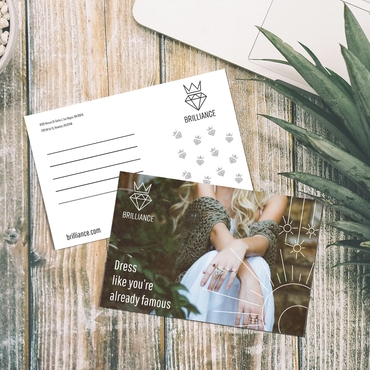
Most postcards don’t fail because people don’t see them. They fail because nothing stands out.
People do look at their mail—they just don’t stop for long.
The right postcard design idea can change that. A bold offer, unexpected layout, strong image, or simple message can give someone a reason to take a second look.
Below, you’ll find 25 postcard design ideas and examples for businesses, including promotional postcards, real estate designs, event postcards, QR code layouts, minimalist designs, and more.
Each example also explains why the design works and how you can adapt it to your own postcard.
Before you start: what makes a postcard work
Every high-performing postcard—no matter the industry—has three things:
A clear message, a strong visual, and a reason to act.
If one of those is missing, the design won’t carry the result.
What Does a Successful Postcard Look Like?
While designs vary by industry, most high-performing postcards follow a similar structure.
A typical postcard includes:
- A strong headline
- One primary image
- A clear offer or message
- Contact information
- A call-to-action
The most effective postcards guide the reader’s attention naturally from the visual to the offer and then to the next step.
If your design requires too much effort to understand, response rates usually suffer.
25 Postcard Design Ideas and Examples
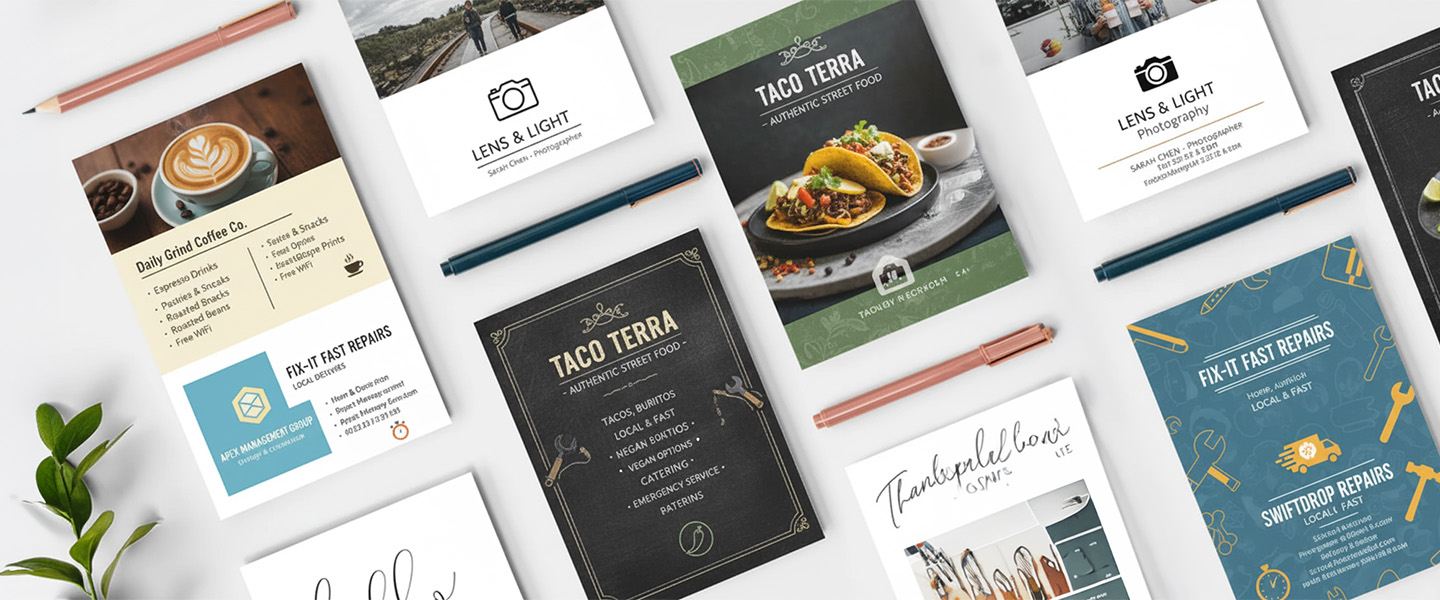
Looking for postcard inspiration? These postcard design examples show different ways businesses can combine headlines, visuals, offers, and calls to action to create a message that gets noticed.
1. One Bold Offer Postcard
Keep the design focused on one promotion so the reader immediately knows what you’re offering.
Example:
20% Off Your First Cleaning Service
Book by September 30
Scan to Schedule → [QR Code]
Best for: Cleaning companies, salons, restaurants, retailers, and local service businesses.
Why it works: There are no competing messages. The offer and next step are immediately clear.
2. Before-and-After Postcard
Let the results tell the story by placing before-and-after images side by side.
Example:
See What a Difference One Day Can Make
[Before Photo] → [After Photo]
Ready to transform your space?
Get Your Free Estimate → [QR Code]
Best for: Landscapers, cleaners, contractors, painters, beauty businesses, and home improvement companies.
Why it works: Visual proof can communicate the value of a service faster than a long explanation.
3. Limited-Time Promotion Postcard
Make the deadline prominent so recipients have a reason to act now rather than putting the postcard aside.
Example:
15% Off Through September 30
Don’t miss our end-of-season offer.
Shop Today → [Website/QR Code]
Best for: Retail stores, restaurants, salons, gyms, and seasonal businesses.
Why it works: A clear deadline adds urgency while keeping the promotion easy to understand.
4. Oversized Postcard
Use the additional space for one large visual and a short, bold message rather than filling every inch with information.
Example:
[Large Product Image]
Something BIG Just Arrived
Discover our newest collection.
See What’s New → [QR Code]
Best for: Product launches, grand openings, real estate, retail, and major promotions.
Why it works: A larger format gives your headline and imagery more room to stand out.
5. Local and Personal Postcard
Make the message feel relevant by referencing the recipient’s neighborhood, city, or community.
Example:
Hey, Downtown Austin!
We’re helping homeowners in your neighborhood get their yards ready for fall.
Schedule Your Service → [QR Code]
Best for: Realtors, restaurants, home services, healthcare practices, and other local businesses.
Why it works: Local references can make mass mail feel more relevant to the person receiving it.
6. Minimalist Postcard
Use plenty of white space, one strong image, and very little copy.
Example:
[Product Image]
Simple. Fresh. Made for You.
Explore the new collection.
Shop Now →
Best for: Premium brands, photographers, designers, beauty businesses, boutiques, and luxury services.
Why it works: Removing unnecessary elements helps the main message and visual receive more attention.
7. Handwritten-Style Postcard
Combine a handwritten-style headline with a simple message to give the design a more personal feel.
Example:
We miss you!
It’s been a while since your last visit.
Come see what’s new.
Visit Us This Week →
Best for: Salons, restaurants, boutiques, customer reactivation campaigns, and small businesses.
Why it works: A handwritten look can make the postcard feel more like a personal note than a traditional advertisement.
8. Top 3 Benefits Postcard
Instead of listing every feature, give recipients three reasons to choose your business.
Example:
Why Homeowners Choose Us
✓ Same-week appointments
✓ Upfront estimates
✓ Local service
Request an Estimate → [QR Code]
Best for: Contractors, professional services, healthcare, home services, and B2B companies.
Why it works: A short list makes important benefits easy to scan and remember.
9. Image-First Postcard
Let a strong photograph dominate the front and keep supporting copy minimal.
Example:
[Large Restaurant Dish Photo]
Dinner Looks Good Tonight.
See what’s on the menu.
View Menu → [QR Code]
Best for: Restaurants, travel companies, real estate agents, photographers, retailers, and event businesses.
Why it works: The image communicates the experience before the recipient reads the details.
10. QR Code Postcard
Use a QR code to connect your printed postcard directly to an online action.
Example:
Your Free Estimate Is One Scan Away
[QR Code]
Scan to choose a time that works for you.
Best for: Appointment-based businesses, restaurants, real estate, events, e-commerce, and service companies.
Why it works: Recipients can move from the postcard to a landing page, booking form, menu, or offer without typing a URL.
11. Testimonial Postcard
Put a short customer quote at the center of the design and support it with a clear CTA.
Example:
“They made the entire process incredibly easy.”
★★★★★
— Sarah M.
Ready to get started?
Request Your Estimate → [QR Code]
Best for: Home services, real estate, healthcare, professional services, and businesses where trust plays an important role.
Why it works: A specific customer experience gives prospects another reason to feel confident about taking the next step.
12. Problem-Solution Postcard
Lead with a problem your audience recognizes and immediately introduce the solution.
Example:
Tired of Looking at That Leaky Faucet?
We’ll take care of it.
Book Your Repair → [Phone Number/QR Code]
Best for: Plumbers, HVAC companies, cleaners, repair services, consultants, and other problem-solving businesses.
Why it works: The postcard starts with something the reader already cares about.
13. Event Invitation Postcard
Make the essential event details impossible to miss.
Example:
You’re Invited!
GRAND OPENING
Saturday, October 10 • 11 AM–4 PM
Food • Giveaways • Special Offers
Get Directions → [QR Code]
Best for: Grand openings, community events, fundraisers, product launches, open houses, and customer appreciation events.
Why it works: Recipients can quickly see what is happening, when it is happening, and why they should attend.
14. Real Estate Postcard
Combine strong property photography with hyperlocal information and a simple next step.
Example:
JUST SOLD IN BROOKSIDE
[Property Photo]
Sold for $485,000
Wondering what your home could be worth?
Get Your Free Home Value Estimate → [QR Code]
Best for: Realtors, real estate teams, brokers, and property management companies.
Why it works: Specific neighborhood information makes the postcard relevant while demonstrating recent activity.
15. Seasonal Promotion Postcard
Connect your promotion to something customers are already thinking about.
Example:
Get Your Home Ready for Fall
Book your seasonal maintenance before October 15.
Schedule Today → [QR Code]
Best for: Home services, retailers, restaurants, salons, landscapers, and seasonal businesses.
Why it works: Timely messaging gives the recipient a natural reason to consider the offer now.
16. Bold Typography Postcard
Turn the headline itself into the main visual.
Example:
WE’RE OPEN!
Same team.
Fresh new space.
Come Visit Us →
Best for: Store openings, announcements, restaurants, retailers, events, and simple promotional campaigns.
Why it works: Large typography can communicate the main message even before someone reads the smaller details.
17. Front-and-Back Postcard
Give each side a specific job: use the front to grab attention and the back to explain what happens next.
Example:
Front:
YOUR NEXT PROJECT STARTS HERE
[Large Finished-Project Image]
Back:
Tell us what you’re planning.
✓ Free consultation
✓ Custom quote
✓ Flexible scheduling
Request a Quote → [QR Code]
Best for: Contractors, designers, professional services, real estate, and businesses with offers that need a little more explanation.
Why it works: Separating the attention-grabbing message from the supporting information keeps the design from feeling overcrowded.
18. How-It-Works Postcard
Turn your process into three simple steps.
Example:
Getting Started Is Easy
- Scan the code
2. Choose your service
3. Pick your appointment
[QR Code]
Book Today
Best for: Service businesses, subscription services, healthcare practices, repair companies, and appointment-based businesses.
Why it works: Showing a simple process can make the next step feel easier.
19. Premium-Feel Postcard
Pair a clean design with quality paper and finishing choices to create a more polished presentation.
Example:
[Elegant Product Photo]
An Invitation to Something Special
Discover our private fall collection.
Explore the Collection →
Best for: Luxury services, real estate, premium retailers, hospitality, events, and high-end brands.
Why it works: The design and physical feel of the postcard work together to reinforce the brand’s positioning.
20. Discount + Value Postcard
Don’t make the discount the entire message. Explain what the customer gets from the offer.
Example:
Save $25 on Your First Service
Get your home professionally cleaned without giving up your Saturday.
Claim Your Offer → [QR Code]
Best for: Home services, salons, fitness businesses, restaurants, retailers, and subscription services.
Why it works: The recipient sees both the savings and the benefit behind the promotion.
21. “Did You Know?” Postcard
Open with an interesting question or useful piece of information.
Example:
Did You Know Your Gutters Should Be Checked Before Fall?
A quick inspection can help you spot potential problems before the rainy season.
Schedule an Inspection → [QR Code]
Best for: Home services, healthcare, financial services, educational businesses, and professional services.
Why it works: Educational content gives the reader a reason to continue reading before introducing the CTA.
22. Comparison Postcard
Use a simple side-by-side format to help customers understand what makes your offer different.
Example:
Which Plan Works for You?
Basic
✓ Monthly service
✓ Email support
Premium
✓ Weekly service
✓ Priority support
✓ Additional features
Compare Plans → [QR Code]
Best for: Subscription services, memberships, service packages, B2B companies, and businesses with multiple options.
Why it works: A visual comparison can simplify a decision that might otherwise require a lot of explanation.
23. Referral Postcard
Give existing customers a clear reason to recommend your business.
Example:
Know Someone Who’d Love Us Too?
Refer a friend and you’ll both receive $10 toward your next visit.
Share the Offer → [QR Code]
Best for: Salons, gyms, restaurants, home services, subscription businesses, and customer loyalty campaigns.
Why it works: The postcard turns satisfied customers into potential sources of new business.
24. Quick-Win Postcard
Offer something useful that requires very little commitment.
Example:
Find Out What Your Home Is Worth
Get your free neighborhood home value report.
[QR Code]
Get Your Report
Best for: Realtors, consultants, financial services, home services, and lead-generation campaigns.
Why it works: A low-commitment offer gives interested prospects an easy first step.
25. Brand-Focused Postcard
Not every postcard needs a discount. Sometimes the goal is simply to remind customers who you are and what you do.
Example:
Still Here. Still Local. Still Happy to Help.
Serving the Downtown community since 2008.
[Brand Image]
Come See Us →
Best for: Established local businesses, restaurants, professional services, retailers, and brand-awareness campaigns.
Why it works: Consistent brand exposure can keep your business familiar even when the recipient isn’t ready to buy immediately.
Business Postcard Examples by Industry
The best business postcard ideas depend on what you’re promoting and who you want to reach. A real estate postcard, for example, needs a very different message from a restaurant promotion or salon offer.
Here are business postcard examples you can adapt to different industries.
Real Estate Postcard Example
Real estate postcards work best when they’re specific to the neighborhood and give homeowners a reason to pay attention.
Example:
JUST SOLD IN [NEIGHBORHOOD]
Another home sold for $485,000.
Thinking about selling? Find out what your home could be worth.
CTA: Scan for a free home value estimate.
Design tip: Make the property photo the main visual and keep the neighborhood name, sale price, and CTA easy to spot.
Restaurant Postcard Example
Use restaurant postcards to promote a special offer, new menu, seasonal item, or reason to come back.
Example:
Dinner Plans? We’ve Got You Covered.
Get 15% off your next dinner order through September 30.
CTA: Bring this postcard or scan to order.
Design tip: Let a high-quality photo of the food do most of the visual work. Avoid overcrowding the postcard with your entire menu.
Home Services Postcard Example
Focus on a problem homeowners may already be thinking about and make scheduling the service simple.
Example:
Is Your AC Ready for Summer?
Book your seasonal inspection before the temperatures rise.
CTA: Scan to schedule your appointment.
Design tip: Use a clear headline, one relevant image, and a prominent phone number or QR code.
Retail Postcard Example
Give customers a specific reason to visit your store rather than simply announcing that you sell products.
Example:
Something New Just Arrived
Discover our newest collection and get 15% off your purchase through October 15.
CTA: Bring this postcard when you visit.
Design tip: Feature one standout product or collection instead of trying to show everything you sell.
Healthcare Postcard Example
Healthcare postcards should feel clear, reassuring, and easy to understand.
Example:
Time for Your Annual Checkup?
Appointments are now available for new and returning patients.
CTA: Scan to request an appointment.
Design tip: Prioritize readability and essential information such as the practice name, contact details, location, and next step.
Professional Services Postcard Example
For accountants, consultants, attorneys, financial professionals, and other service providers, focus on a specific need rather than describing every service you offer.
Example:
Starting a New Business?
Get the guidance you need to start with confidence.
Schedule an introductory consultation.
CTA: Scan to request a consultation.
Design tip: Keep the layout professional and simple, with one clear service or benefit as the focus.
Salon & Beauty Postcard Example
Beauty postcards are highly visual, so use strong imagery alongside an offer that gives customers a reason to book.
Example:
Ready for a Fresh Look?
Get 15% off your first appointment with us.
CTA: Scan to book your appointment.
Design tip: Use high-quality photography, minimal text, and make the booking information easy to find.
No matter the industry, strong business postcards have one thing in common: they make the message easy to understand and the next step easy to take. Start with one goal, build the design around it, and remove anything that distracts from that action.
Popular Postcard Layout Ideas
Great postcard design isn’t just about visuals. Layout plays a major role in readability.
Some of the most effective layouts include:
Hero Image Layout
Large image with minimal text.
Split Layout
Image on one side, offer on the other.
Headline-First Layout
Bold headline at the top with supporting details underneath.
Grid Layout
Multiple products, services, or promotions organized into sections.
Choosing the right layout depends on how much information you need to communicate.
Why these ideas work (and most postcards don’t)
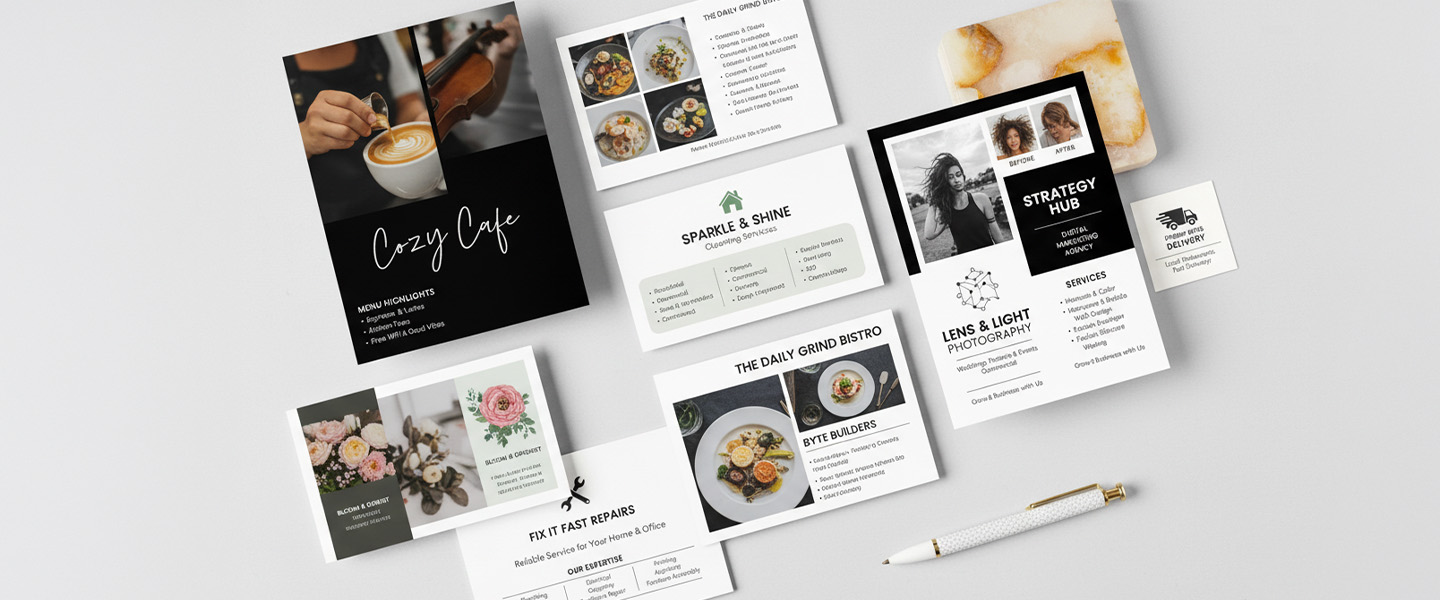
If you look closely, these ideas aren’t random.
They follow patterns.
They either:
- make something easier to understand
- create urgency
- feel more personal
- or stand out visually
Most postcards fail because they try to do too much at once.
Too many messages.
Too much text.
No clear action.
If you simplify the structure, the results improve.
If you want to go deeper into performance, this guide on postcard marketing what actually works shows how these ideas translate into real results.
The biggest design mistakes to avoid
Most issues come from execution, not ideas.
The most common mistakes are:
- unclear messaging
- weak or missing call to action
- overcrowded layouts
- choosing cheap printing that reduces impact
If your postcard feels disposable, it will be treated that way.
For a deeper look at design fundamentals, this guide on how to design print materials that actually get read breaks down what actually matters.
Before you print your postcards
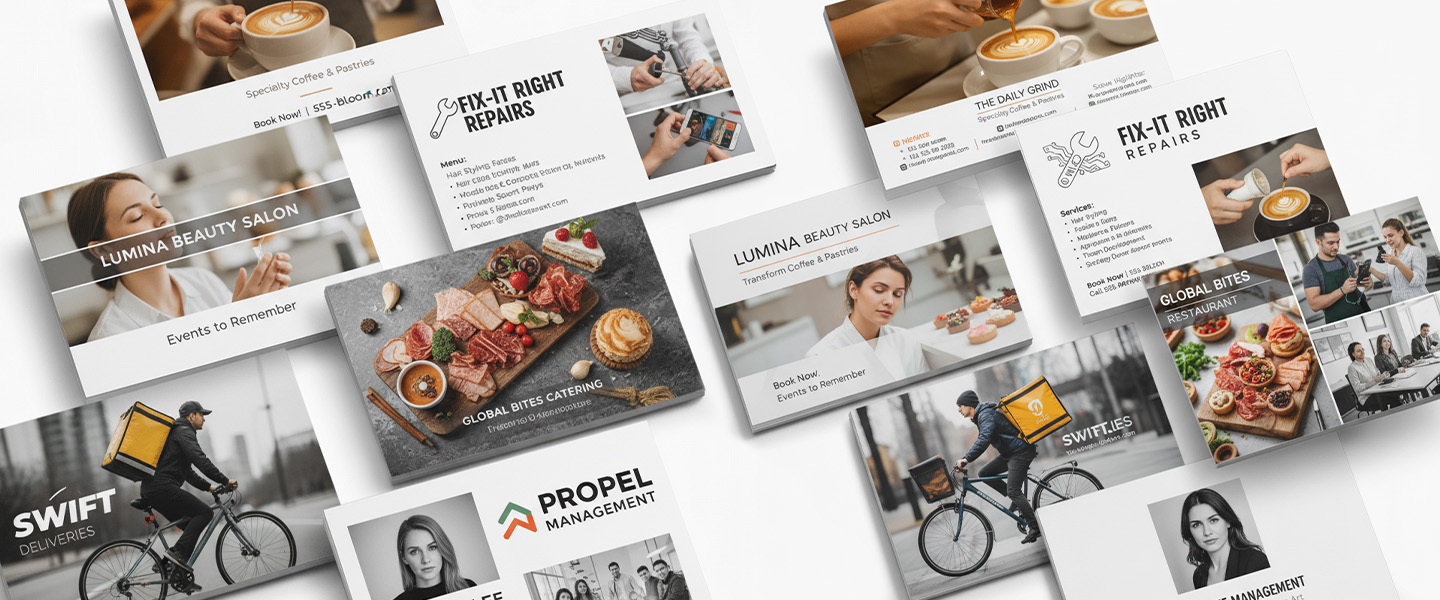
Once you choose your idea, make sure everything is aligned.
Your message, layout, and call to action should all support the same goal.
If one part is off, the whole piece underperforms.
Ready to turn your idea into a printed postcard?
If you already have a design direction, you can customize your postcard size, paper, and finish here:
This is where your idea becomes something people actually hold—and respond to.
Final takeaway
Good postcard design isn’t about creativity alone.
It’s about clarity, intention, and execution.
Because the best-performing postcards don’t try to impress everyone.
They make the right person stop—and take action.
Frequently Asked Questions About Postcard Design
What makes a postcard design effective?
An effective postcard combines a clear headline, strong visual, focused message, and obvious call to action. Recipients should be able to understand what you’re offering and what to do next within a few seconds.
What should be included in a business postcard?
A business postcard should typically include your business name or logo, a clear headline, the main offer or message, a relevant visual, contact information, and a call to action. You can also include a QR code that directs recipients to a landing page, booking form, menu, or special offer.
What is the best layout for a marketing postcard?
The best layout depends on your message, but simple layouts usually make postcards easier to scan. Popular options include a large hero image with a short headline, a split layout with an image and offer, or a headline-first design with supporting details underneath.
What should go on the front of a postcard?
The front of a marketing postcard should focus on getting attention. Use a strong headline, an eye-catching image, your main offer or message, and recognizable branding. Avoid filling the front with too many details.
What should go on the back of a postcard?
Use the back for supporting information such as offer details, contact information, your website, a QR code, and a clear call to action. If the postcard will be mailed, make sure the design also leaves the necessary space for addressing and mailing information.
How much text should be on a postcard?
Keep postcard copy short enough to scan quickly. Focus on one main message, a few supporting details, and one clear call to action rather than trying to explain everything about your business.
What size postcard is best for marketing?
There isn’t one postcard size that works best for every campaign. Standard sizes can work well for simple promotions, while larger postcards provide more room for images, offers, and information and may be easier to notice. Choose a size based on your design, message, mailing requirements, and budget.
Should I use both sides of a postcard?
Yes. Using both sides gives you more room without overcrowding the design. The front can grab attention with a headline or image, while the back provides additional details, contact information, and the next step you want the recipient to take.
Should I include a QR code on my postcard?
A QR code can be useful when you want recipients to move from print to a digital action. It can link to a landing page, online store, appointment scheduler, menu, event registration page, or special offer. Always test the QR code before printing.
What colors work best for postcard designs?
Choose colors that fit your brand while creating enough contrast between the background, text, and important design elements. Your headline and call to action should be easy to read at a glance. Avoid combinations that make small text difficult to see.
What resolution should images be for postcard printing?
For high-quality printing, images are generally best prepared at 300 DPI at their final printed size. Using high-resolution images helps prevent photos, logos, and other graphics from appearing blurry or pixelated after printing.
How big should text be on a postcard?
Text should be large enough to read comfortably at the postcard’s final printed size. Headlines should be noticeably larger than supporting copy, and important information such as an offer, URL, or call to action should never require the reader to strain. Always review your design at actual size before sending it to print.