
To write a postcard, put your message in the designated message area, the recipient’s mailing address on the address side, and the correct postage in the upper-right area before mailing it.
It sounds simple—and usually it is.
But once you’re holding a blank postcard, a few questions tend to come up.
Where exactly does the address go? Do you need a return address? What should you actually write? Can you use the entire back? And what changes if you’re sending postcards for your business instead of writing to a friend?
Whether you’re sending one postcard from vacation or hundreds as part of a marketing campaign, here’s how to get the message, layout, and mailing details right.
How to Write a Postcard in 5 Steps
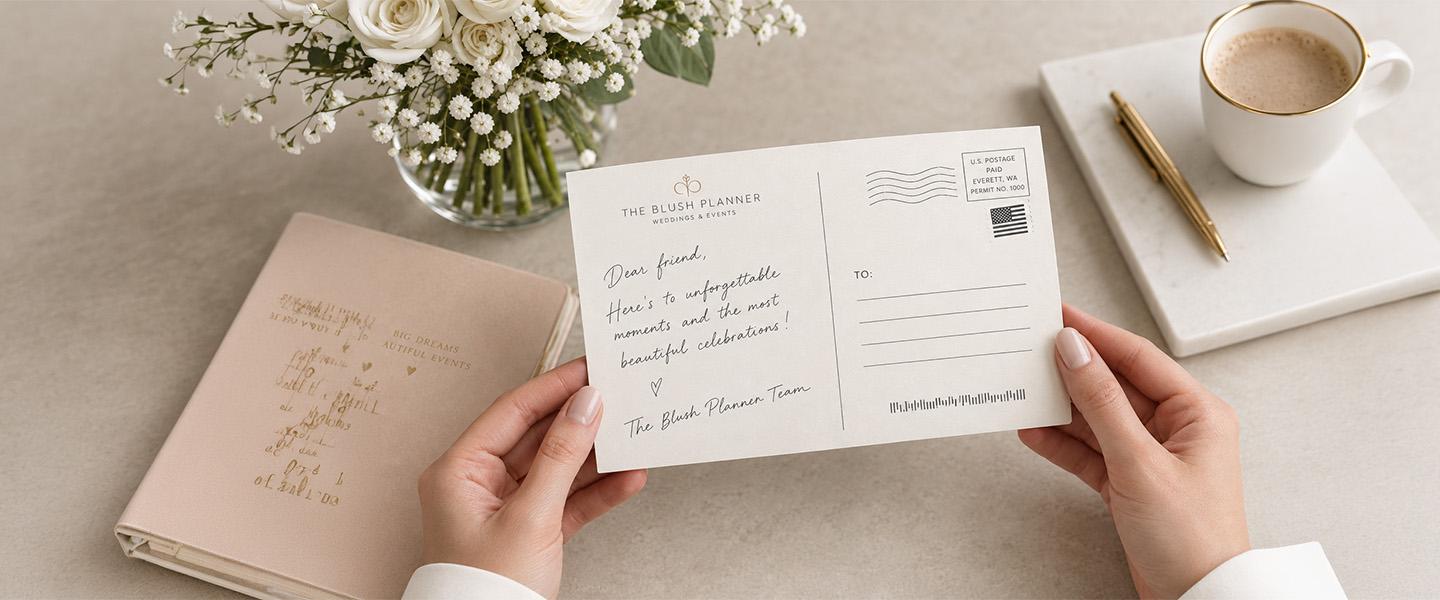
If you just need the basics, follow these five steps:
- Turn the postcard to the address side.
- Write your message in the designated message area.
- Add the recipient’s name and mailing address in the address area.
- Add a return address if appropriate.
- Place the correct postage in the upper-right area and mail the postcard.
Before sending it, double-check that the recipient’s address is complete and easy to read.
Now let’s look at where everything goes.
Where Do You Write on a Postcard?
A traditional postcard has two sides with different jobs.
Front: Usually contains the photograph, illustration, artwork, or primary marketing design.
Back/address side: Usually contains the message, recipient’s address, and postage.
Many personal postcards divide the back vertically.
A typical layout looks something like this:
| Left Side | Right Side |
| Your message | Postage |
| Your message | Recipient name |
| Your message | Street address |
| Your message | City, State, ZIP Code |
Not every postcard uses exactly the same printed layout, so use the areas provided by the postcard when available.
USPS requires the delivery address to be visible and legible on the same side of the mailpiece as the postage.
For postcards, address orientation also matters: the address should run parallel to the postcard’s longer dimension.
Where Does the Address Go on a Postcard?
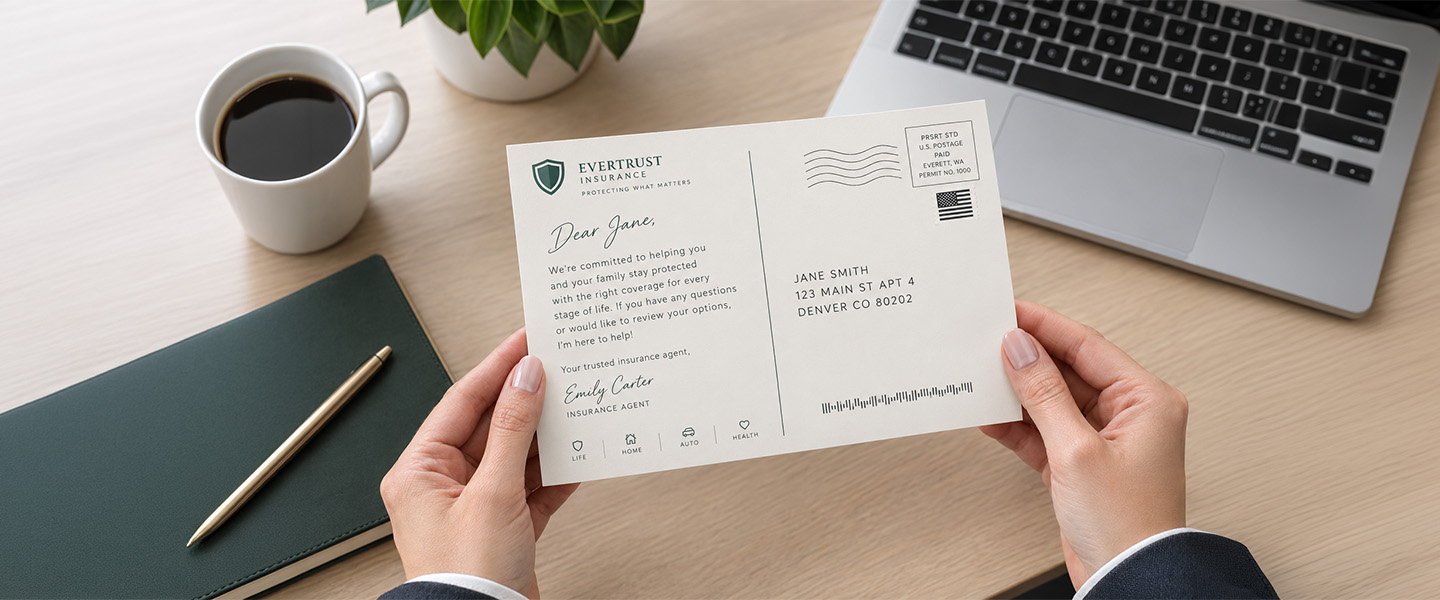
The recipient’s address goes on the address side of the postcard, typically toward the right side or in the designated address area.
Write the address clearly enough for both postal equipment and people to read.
For a U.S. address, the basic format is:
JANE SMITH
123 MAIN ST APT 4
DENVER CO 80202
Include:
- Recipient’s full name
- Street address
- Apartment or suite number, when applicable
- City
- State
- ZIP Code
USPS recommends printing addresses clearly, using uppercase letters, and avoiding punctuation.
Most importantly, make sure the address itself is correct.
A beautiful postcard can’t reach the customer if the mailing information is wrong.
For current addressing requirements, check the USPS addressing guidelines.
Where Does the Stamp Go on a Postcard?
Postage normally goes in the upper-right area on the address side of a postcard.
Many postcards already include a small box or the word POSTAGE to show where it belongs.
Keep this area clear when designing a postcard that will be mailed.
Don’t place essential text, logos, promotional codes, or other information where the postage needs to go.
Businesses preparing larger postcard mailings may use other approved postage methods rather than applying individual stamps.
The correct postage depends on factors such as:
- Postcard dimensions
- Thickness
- Mailing class
- Destination
- Mailing method
Check current USPS prices and mailing information before sending a campaign.
Do You Put a Return Address on a Postcard?
A return address isn’t required for every type of postcard mailing, but including one can help identify the sender and, where applicable, allows undeliverable mail to be returned.
If you use a return address, keep it separate from the recipient’s delivery address so there is no confusion about where the postcard should go.
USPS guidance places a return address in the upper-left area on the address side of a mailpiece.
A business return address might look like:
SUNRISE COFFEE
45 OAK ST
AUSTIN TX 78701
For marketing postcards, your business name and return address can also reassure recipients that the mail is coming from a recognizable sender.
What Should You Write on a Postcard?
What you write depends entirely on why you’re sending it.
A postcard to a friend should feel personal.
A Save-the-Date should communicate essential event information.
A business postcard needs a clear reason for the recipient to pay attention and act.
Here are some examples.
What to Write on a Personal Postcard
You don’t have much room, so don’t try to turn a postcard into a letter.
Focus on one or two moments worth sharing.
For example:
Hi Maya!
We’re having such a great time in Chicago. We finally tried deep-dish pizza yesterday and spent the afternoon exploring the city. Wish you were here!
See you soon,
Anna
A simple personal postcard can include:
- A greeting
- Where you are
- Something you did
- Something that reminded you of the recipient
- A short personal thought
- A sign-off
You don’t need to describe the entire trip.
Pick one detail that makes the message feel personal.
What to Write on a Vacation Postcard
Vacation postcards are probably the format most people associate with postcard writing.
Try this simple formula:
Greeting + what you’re doing + memorable detail + personal sign-off
For example:
Hi Dad!
Greetings from San Diego! We’ve had perfect weather and spent this morning walking along the waterfront. You would love the seafood here.
See you next week!
Chris
Or keep it even shorter:
Greetings from Miami!
Sun, great food, and way too much walking. Having an amazing time and thinking of you!
Love,
Sam
The message doesn’t have to be clever.
A specific detail will usually make it feel more genuine than a generic “Having a great time.”
What to Write on a Business Postcard
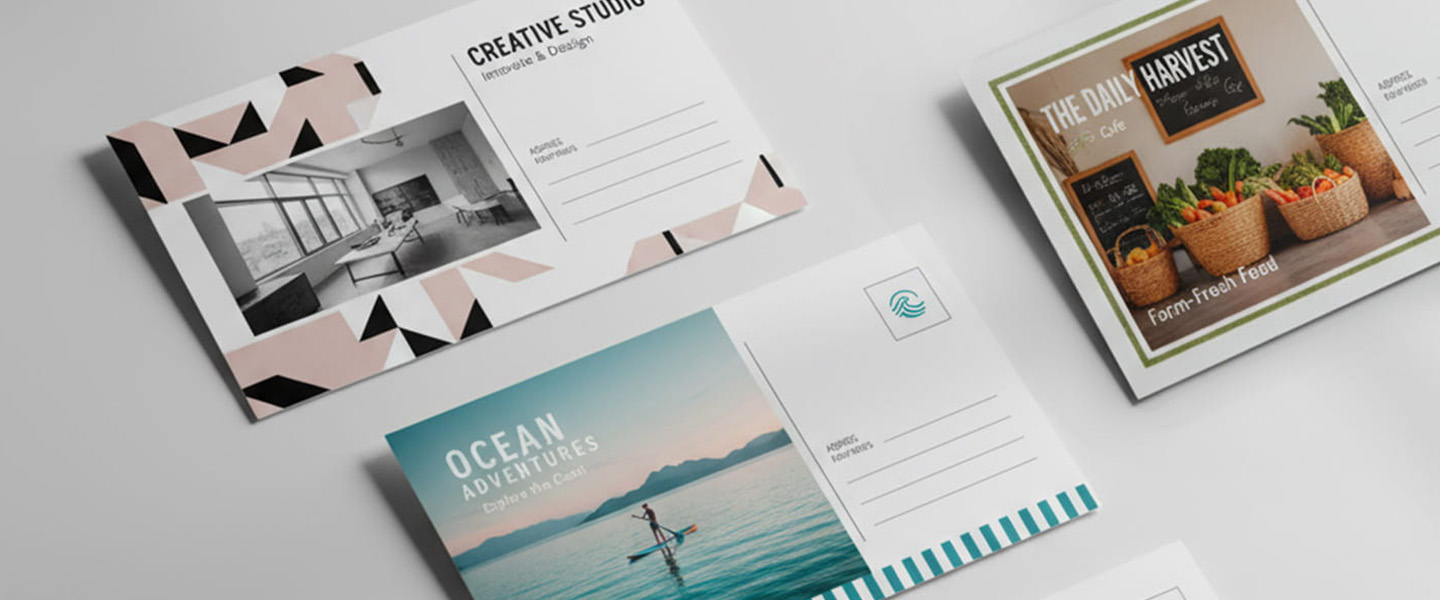
A business postcard has a very different job.
You’re not simply sharing a message.
You’re asking someone to notice something and take action.
A marketing postcard should usually answer four questions:
- What is this about?
- Why should I care?
- What do you want me to do?
- How do I do it?
For example:
YOUR NEW NEIGHBORHOOD CAFÉ IS OPEN
Stop by Sunrise Coffee for locally roasted coffee, breakfast, and fresh pastries.
Visit us this week at 45 Oak Street.
Or:
TIME FOR YOUR NEXT CLEANING?
Keep your home ready for the season with professional local cleaning.
Book your appointment at example.com.
Notice what these examples don’t include:
Long company histories.
Several competing offers.
Five different calls to action.
A postcard has limited space. Give the reader one clear reason to keep reading.
How to Write a Marketing Postcard That Gets Read
A strong marketing postcard usually needs more than good copy.
The information also needs a clear hierarchy.
Start With One Main Message
Decide what the postcard is actually about before writing anything.
Maybe it’s:
- A grand opening
- A new service
- A seasonal promotion
- An event
- A new product
- An appointment reminder
- A customer thank-you
- A limited-time offer
Don’t try to fit all of those into one postcard.
One postcard should generally have one primary purpose.
Write a Headline People Can Understand Immediately
Instead of:
EXCITING NEWS FROM ABC COMPANY
try:
NOW OPEN IN DOWNTOWN AUSTIN
Instead of:
DON’T MISS THIS AMAZING OPPORTUNITY
try:
SAVE 20% ON YOUR NEXT SERVICE
Specific language helps readers understand why the postcard matters.
Explain the Benefit
The next piece of copy should answer:
Why should the recipient care?
Keep it brief.
For example:
Get your lawn ready for spring without giving up your weekend.
Or:
Join us Saturday for local food, music, and family activities.
Add One Clear Call to Action
Tell the reader exactly what to do next.
For example:
Book your appointment.
Visit us this Saturday.
Scan to see the menu.
Bring this card in by October 31.
Shop the new collection.
Avoid several equally prominent calls to action.
If you’re designing a promotional postcard, our guide to what to put on a postcard goes deeper into the elements worth including.
Where Should Everything Go on a Marketing Postcard?
Marketing postcards give you more design flexibility than handwritten vacation postcards, but mailing requirements still matter.
A simple approach is:
Front
Use the front for the message that needs to grab attention.
That might include:
- Main image
- Headline
- Offer
- Business name
- Key benefit
Back
Use the back for supporting information and mailing elements.
That might include:
- Short supporting copy
- Call to action
- Website
- QR code
- Contact details
- Return address
- Recipient address
- Postage
You don’t necessarily need to squeeze every marketing detail onto the postcard.
Your goal is to give the recipient enough information to take the next step.
For additional design inspiration, see our postcard design ideas that get results.
How Much Should You Write on a Postcard?
Usually, less than you think.
A postcard isn’t a brochure.
If you’re writing personally, you have limited physical space.
If you’re writing for marketing, you’re competing for limited attention.
In both cases, editing matters.
For a personal postcard:
Focus on one or two memorable details.
For a marketing postcard:
Focus on one message, one benefit, and one primary action.
If you’re struggling to fit everything, don’t immediately make the font smaller.
Remove information that isn’t essential.
This is particularly important for marketing materials. Our guide to effective print design that gets read explains why hierarchy and simplicity matter in printed communication.
Can You Write on Both Sides of a Postcard?
You can use both sides creatively, but if the postcard is being mailed without an envelope, you must preserve the necessary space for mailing information.
The delivery address must appear on the same side as the postage, and USPS requires clear space for postal information.
For a traditional personal postcard, that usually means:
Image on the front
Message + address + postage on the back
For a professionally designed marketing postcard, the front and back can both contain marketing content as long as the address side remains compliant with the mailing method you’re using.
If you’re planning a bulk or commercial mailing, confirm the design specifications with your mailing provider before printing thousands of cards.
What Size Should a Postcard Be?
Postcards come in several sizes, but not every printed postcard automatically qualifies for USPS postcard pricing.
For First-Class Mail postcard pricing, USPS currently specifies a rectangular card that is:
- At least 5 inches long
- At least 3 1/2 inches high
- At least 0.007 inch thick
- No more than 6 inches long
- No more than 4 1/4 inches high
- No more than 0.016 inch thick
A larger postcard may still be mailable, but it can fall into a different postal pricing category.
That’s an important distinction:
Printed postcard size and USPS postcard-rate eligibility are not necessarily the same thing.
For a deeper breakdown of formats, read our postcard sizes explained.
You can also review the latest requirements directly in the USPS postcard size standards.
How to Address a Postcard Correctly
Before mailing, check the recipient information carefully.
For a domestic U.S. postcard, include:
RECIPIENT NAME
STREET ADDRESS
APARTMENT OR SUITE, IF NEEDED
CITY STATE ZIP CODE
For example:
MICHAEL DAVIS
250 MARKET ST APT 8
PHILADELPHIA PA 19106
USPS recommends:
- Writing or printing clearly
- Using uppercase letters
- Leaving out unnecessary punctuation
- Including the correct ZIP Code
- Keeping the delivery address legible
- Orienting the address parallel to the longest side of the postcard
If you’re handwriting the address, use a pen or permanent marker that creates good contrast against the background.
How Do You Address an International Postcard?
International postcards require a little more information.
The destination country’s name should appear on the final line of the address and should be written in English.
For example:
MR THOMAS CLARK
117 RUSSELL DRIVE
LONDON W1P 6HQ
UNITED KINGDOM
International address formats vary by country, so don’t assume every country follows the U.S. city-state-ZIP format.
USPS recommends following the destination country’s addressing format and writing the destination country clearly on the final line.
Check the current USPS international postcard and letter guidance before sending internationally.
Personal vs. Marketing Postcards: What Changes?
The physical format may be similar, but the writing strategy is different.
| Personal Postcard | Marketing Postcard |
| Written to one person | Written for a target audience |
| Personal greeting | Attention-grabbing headline |
| Shares an experience | Communicates an offer or message |
| Conversational | Concise and persuasive |
| Personal sign-off | Clear call to action |
| Usually handwritten | Often professionally designed and printed |
| Goal: connection | Goal: response or awareness |
Both benefit from simplicity.
The reader should understand the point without working for it.
Postcard Writing Examples
Here are a few complete examples for different situations.
Vacation Postcard Example
Hi Emma!
Greetings from New York! We walked through Central Park this morning and somehow ended up eating pizza twice today. Having a wonderful time and wish you were here!
Love,
Mia
Thank-You Postcard Example
Hi Daniel,
Thank you so much for helping us move last weekend. We couldn’t have done it without you. Dinner is on us next time!
Thanks again,
Laura & Ben
Small Business Postcard Example
WE’RE NOW OPEN
Your new neighborhood bakery is here.
Stop by for fresh bread, pastries, and coffee baked and brewed daily.
Visit us at 123 Main Street.
Customer Appreciation Postcard Example
THANKS FOR SUPPORTING LOCAL
We’re grateful you’ve chosen us.
Bring this postcard on your next visit and enjoy your customer thank-you reward.
See you soon.
Appointment Reminder Postcard Example
IT’S TIME FOR YOUR NEXT VISIT
Your next appointment is coming up.
Tuesday, October 20 at 10:30 AM
Need to reschedule?
Call us at (555) 123-4567.
Common Postcard Writing Mistakes
Before mailing, check for these common problems.
Writing Too Much
If your handwriting barely fits or your marketing copy needs an extremely small font, you’ve probably included too much.
Forgetting the ZIP Code
Double-check the full mailing address before sending.
Putting Important Information in the Mailing Area
Don’t let marketing copy interfere with the address, postage, or postal markings.
Making the Address Difficult to Read
Decorative typography might look attractive, but the mailing address needs clarity.
Using Too Many Calls to Action
This applies especially to marketing postcards.
Visit our website. Follow us. Call us. Scan this. Visit our store. Sign up.
That’s a lot to ask from one small card.
Pick the action that matters most.
Forgetting to Proofread
Check:
- Names
- Addresses
- Dates
- URLs
- Phone numbers
- Promotional codes
- Offer expiration dates
For professionally printed pieces, proofread before submitting the final artwork. Our guide to preparing files for printing covers other checks to make before production.
Turn a Small Postcard Into a Clear Message
A postcard doesn’t give you unlimited space—and that’s part of what makes it effective.
For a personal postcard, choose one memorable detail and write it as if you were talking directly to the recipient.
For a business postcard, focus on one audience, one message, and one action.
Then make sure the practical pieces are where they belong:
Message → designated message area
Recipient address → address side
Return address → upper-left area, when used
Postage → upper-right area
And if you’re creating postcards for a business campaign, start with a format that gives your message enough room without sacrificing readability. Overnight Prints offers custom postcard printing in multiple sizes and paper options for promotions, direct mail, announcements, and other business uses.
You can also explore our postcard marketing guide for ideas on turning the finished postcard into a more focused campaign.
The best postcard doesn’t say everything.
It says the right thing clearly enough that the recipient knows what to do with it.
Frequently Asked Questions About Writing a Postcard
How do you write a postcard?
Write a short message in the designated message area, add the recipient’s complete mailing address on the address side, add a return address when appropriate, place the correct postage in the upper-right area, and mail it.
What do you write on a postcard?
For a personal postcard, write a greeting, one or two interesting details, a personal thought, and a sign-off. For a marketing postcard, include a clear headline, benefit, essential details, and one primary call to action.
Where do you write the address on a postcard?
Write the recipient’s delivery address on the address side of the postcard in the designated address area. The delivery address must appear on the same side as the postage.
Where does the stamp go on a postcard?
Postage generally goes in the upper-right area of the address side of the postcard.
Do you need a return address on a postcard?
Not every postcard mailing requires a return address, but including one can identify the sender and can allow certain undeliverable mailpieces to be returned. Follow USPS requirements for your specific mailing type.
What side of a postcard do you write on?
On a traditional postcard, the image or artwork is on one side and the message, recipient address, and postage are placed on the other. Professionally designed marketing postcards may use both sides for content as long as required mailing areas remain properly formatted.
Can you write on the front of a postcard?
Yes, you can incorporate text into the front design. Personal postcards commonly reserve the front for an image, while marketing postcards frequently use the front for a headline, offer, and imagery.
How long should a postcard message be?
Keep it short enough to remain comfortable to read. A personal postcard may contain a few sentences, while a marketing postcard should generally focus on one message, one main benefit, and one primary call to action.
How do you address a postcard in the USA?
Include the recipient’s full name, street address, apartment or suite number when applicable, and city, state, and ZIP Code. Write or print the address clearly on the address side of the postcard.
How do you write a postcard for a business?
Lead with the main message or offer, explain why it matters to the recipient, provide only the essential supporting information, and finish with a clear call to action. Keep the mailing address and postage areas unobstructed.