Spot UV is a premium finishing technique that applies a clear glossy coating to selected areas of a printed design. Instead of making the entire piece shiny, the coating can highlight specific elements such as a logo, business name, pattern, image, icon, or important text.
The result is subtle but noticeable.
Against a matte surface, glossy areas reflect light differently and create both visual and tactile contrast.
That makes Spot UV especially appealing for businesses looking to make Premium Business Cards and other printed marketing materials feel more distinctive without completely redesigning them.
But premium finishing usually comes with an additional cost.
So the important question is:
Is Spot UV actually worth it?
The answer depends on what you are printing, how the material will be used, your brand positioning, and what you want customers to notice.
Here is how Spot UV works and when paying for the additional finish makes sense.
Key Takeaways
- Spot UV is a premium print finish that applies a clear glossy coating to selected areas of a design rather than the entire surface.
- It creates contrast between coated and uncoated areas, helping elements such as logos, names, patterns, or graphics stand out.
- Spot UV differs from full UV coating because it is applied selectively rather than across the entire printed piece.
- The effect works particularly well when glossy Spot UV is contrasted with a matte background.
- Spot UV can make simple designs feel more distinctive without requiring additional colors or complicated graphics.
- The additional cost makes the most sense when presentation, brand perception, and first impressions are important.
What Is Spot UV Printing?
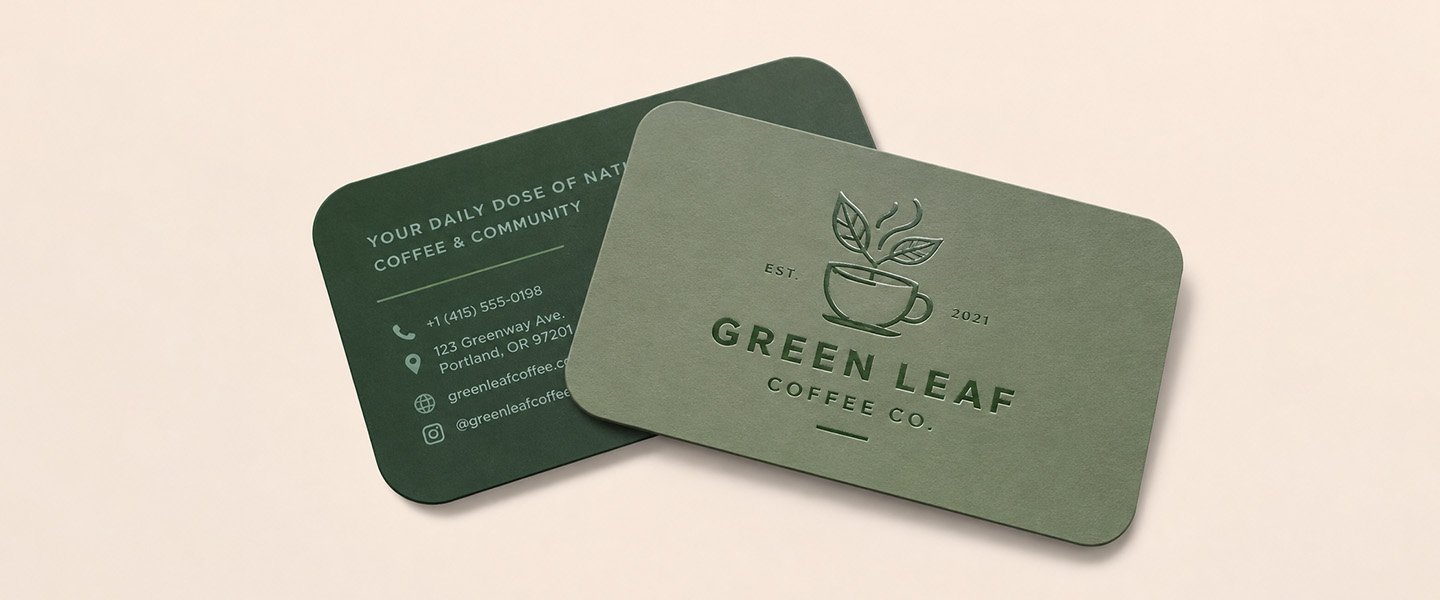
Spot UV is a finishing process in which a clear glossy coating is applied to specific areas of a printed piece.
The word “spot” refers to the fact that the coating is placed only in selected locations.
For example, you could apply Spot UV to:
- a company logo,
- your business name,
- a geometric pattern,
- an image,
- icons,
- a headline,
- or another important design element.
The rest of the surface remains uncoated or uses a contrasting base finish.
This is different from applying UV coating across the entire printed surface.
With full UV coating, the whole piece receives a glossy treatment.
With Spot UV, the designer decides exactly which areas receive the gloss.
Imagine a business card with a dark satin-matte background and a black logo.
Without Spot UV, the logo might intentionally blend into the minimalist design.
Add glossy Spot UV over that logo, however, and it becomes visible as the card moves under the light.
The design has not gained another color.
It has gained another surface effect.
That is what makes Spot UV particularly useful for understated, premium designs.
How Does Spot UV Printing Work?
The technical production process can be complex, but the basic idea is easy to understand.
Step 1: The Main Design Is Printed
First, the normal artwork is printed.
This contains the colors, text, images, logos, and other visual elements that will appear on the finished piece.
Step 2: Spot UV Areas Are Identified
A separate layer or file identifies exactly where the glossy coating should appear.
At Overnight Prints, for example, Spot UV artwork is prepared as a separate black-and-white bitmap file.
The black areas tell the printer where the gloss should be applied, while the remaining areas stay in the underlying finish.
Step 3: The Clear Coating Is Applied
A clear UV coating is placed over the selected portions of the design.
Because the coating is transparent, the original design remains visible underneath it.
Step 4: UV Light Cures the Coating
Ultraviolet light is used to cure and harden the coating.
This happens quickly, creating the glossy finished surface.
Step 5: The Contrast Becomes Visible
Once finished, the coated areas reflect light differently from the surrounding surface.
The effect can be particularly noticeable when Spot UV is paired with a low-shine base finish.
Instead of changing the actual content of the design, Spot UV changes how selected areas interact with light.
What Are the Benefits of Spot UV?
Spot UV is primarily a visual and tactile enhancement.
Its value comes from what it adds to the experience of the printed piece.
Creates Visual Contrast
One of the strongest uses of Spot UV is creating contrast.
Glossy elements naturally interact with light differently from matte areas.
This allows designers to create contrast without introducing additional colors.
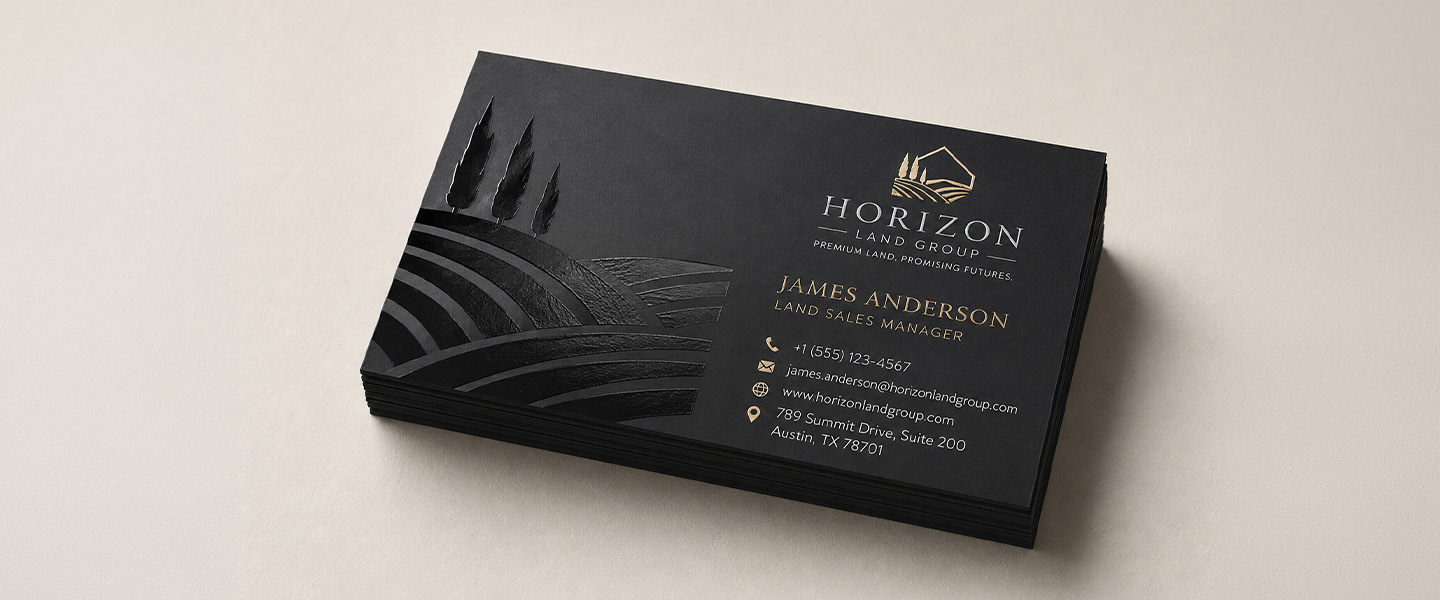
For example, a black logo with Spot UV over a black matte background can become visible primarily through the difference in surface finish.
That creates a subtle effect that changes depending on the viewing angle.
Adds a Premium Look and Feel
Print is physical.
People do not simply see a business card or marketing piece. They pick it up, turn it over, and feel its surface.
Spot UV adds another dimension to that interaction.
The transition between glossy and matte areas can make a printed piece feel more intentionally designed and visually refined.
That can be particularly valuable for businesses where presentation is part of the brand experience.
Draws Attention to Important Design Elements
Not every element deserves equal attention.
Spot UV can help establish visual hierarchy by highlighting specific parts of the design.
Common choices include:
Logos – to reinforce brand recognition.
Business names – to make the company identity more prominent.
Patterns – to add subtle background detail.
Icons – to highlight important visual elements.
Key text – to draw attention to a short headline or name.
Used carefully, Spot UV guides attention without requiring the design to become louder.
Makes Simple Designs More Memorable
Minimalist designs can benefit significantly from premium finishing.
A simple card with only a logo, name, and contact information may not need additional graphics.
Adding Spot UV to one carefully selected element can provide visual interest while preserving the simplicity of the design.
This is particularly useful when the goal is to create a sophisticated rather than highly decorative appearance.
Reinforces Premium Brand Positioning
Physical materials can communicate positioning.
If a brand wants to appear refined, creative, high-end, or detail-oriented, the paper and finishing choices should support that image.
Spot UV can complement brands in areas such as:
- luxury services,
- real estate,
- photography,
- consulting,
- hospitality,
- beauty and wellness,
- architecture,
- and creative services.
It should not be viewed as an automatic shortcut to premium branding.
But when the design, paper, typography, and finish work together, Spot UV can reinforce an already strong visual identity.
For a deeper look at how physical quality changes customer perception, read Cheap Business Cards vs. Premium Ones: What Clients Actually Notice.
Spot UV vs. Other Print Finishes
Spot UV is only one way to change the appearance and feel of printed materials.
The best finish depends on what you want the design to accomplish.
| Finish | Appearance | Texture | Best For |
| Spot UV | Glossy highlights on selected areas | Smooth contrast between surfaces | Highlighting logos, patterns and selected elements |
| Gloss | Overall shiny appearance | Smooth | Bright colors, graphics and photography |
| Matte | Low-shine appearance | Smooth | Clean and professional designs |
| Soft Touch | Elegant, low-shine appearance | Soft, velvet-like feel | Premium and luxury branding |
| Foil | Metallic or reflective accents | Distinctive surface effect | Luxury and high-impact designs |
Spot UV vs. Gloss
The main difference is where the shine appears.
A full gloss finish creates shine across the overall surface.
Spot UV creates shine only in predetermined areas.
Choose gloss when you want the entire design to appear vibrant and reflective.
Choose Spot UV when the contrast itself is part of the design.
Spot UV vs. Matte
Matte provides a lower-shine appearance across the surface.
Spot UV is frequently effective when contrasted against a matte background because the difference between glossy and non-glossy areas becomes easier to notice.
Spot UV vs. Soft Touch
Soft-touch finishes focus heavily on tactile experience, producing a softer, velvet-like surface.
Spot UV focuses more on selective visual contrast.
Both can contribute to a premium impression, but they accomplish it differently.
Spot UV vs. Foil
Foil introduces a metallic or reflective material to selected design elements, while Spot UV uses a transparent glossy coating.
Foil tends to make the highlighted area more immediately visible because it introduces a different metallic appearance.
Spot UV can be subtler because it works primarily through changes in reflection and surface finish.
If you’re comparing finishes for your next card, read What’s the Best Business Card Finish for Your Brand?.
Which Print Products Work Best With Spot UV?
Spot UV can be used across different types of printed materials, although availability depends on the printer, stock, product, and quantity.
At Overnight Prints, Spot UV is available on qualifying products printed on 15pt card stock, including Premium Business Cards, most Postcard sizes, Bookmarks, Rack Cards, and certain other products.
Premium Business Cards
Premium Business Cards are one of the most natural applications for Spot UV.
A business card is viewed from close range and physically handled, which means subtle finishing details are more likely to be noticed.
Spot UV can be used to highlight:
- logos,
- names,
- monograms,
- patterns,
- illustrations,
- icons,
- or selected typography.
It can be particularly effective on minimalist cards where one or two elements are given extra emphasis.
Postcards
Spot UV can also be used on qualifying Postcards.
This can work well for:
- premium promotions,
- direct mail,
- announcements,
- invitations,
- product launches,
- and high-value customer campaigns.
For example, a postcard could use Spot UV on the brand logo or primary visual element while leaving the rest of the surface more understated.
Bookmarks
Bookmarks are handled repeatedly, making them an interesting format for tactile design.
A selective glossy pattern, logo, illustration, or brand element can make a bookmark more visually distinctive without covering the entire design in gloss.
Rack Cards
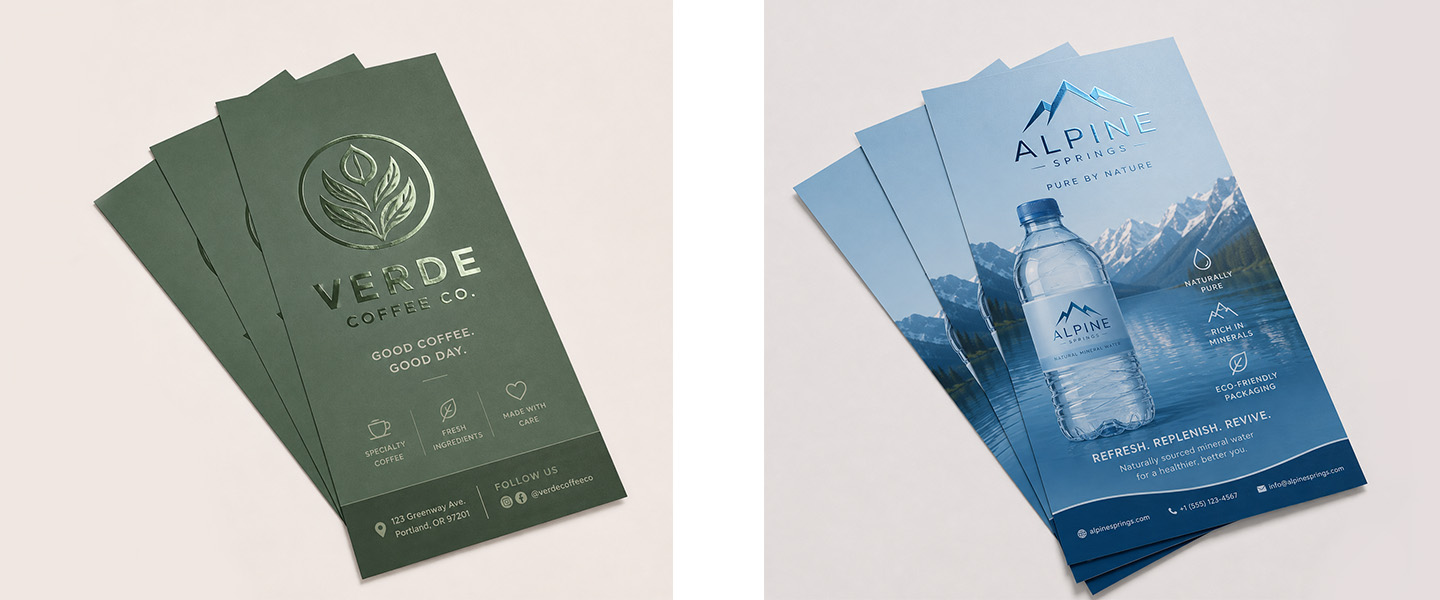
Rack Cards compete for attention in physical displays.
Selective Spot UV can help a logo, image, or other important visual element stand out as someone approaches or handles the card.
This can be particularly useful for hospitality, tourism, events, attractions, and service businesses.
Availability matters: Spot UV is not available on every Overnight Prints product or stock. Always check the specifications of the individual product before building your design around the effect.
When Is Spot UV Worth the Extra Cost?
This is where the decision becomes less technical and more strategic.
Spot UV is usually an additional finishing expense, so ask whether the effect contributes meaningfully to what the printed piece needs to accomplish.
It may be worth considering when:
First Impressions Are Especially Important
If your printed material is often used during an initial client interaction, additional attention to presentation may make sense.
Business cards are a good example.
A consultant, real estate agent, photographer, or agency owner may hand over relatively few cards compared with a large retail promotion.
Each individual card therefore has a more important role.
Your Brand Has Premium Positioning
Luxury and premium businesses often depend heavily on small presentation details.
A carefully selected Spot UV treatment can complement a brand identity built around craftsmanship, exclusivity, sophistication, or attention to detail.
Your Design Is Simple
Spot UV often works particularly well with minimalist designs.
If your card contains a clean background, restrained typography, and a strong logo, the glossy contrast has room to become noticeable.
You Meet Clients Face-to-Face
The tactile benefits of Spot UV matter most when people physically interact with the material.
That makes it particularly relevant for professionals in industries such as:
- real estate,
- consulting,
- photography,
- hospitality,
- beauty and wellness,
- luxury services,
- and creative agencies.
Your Materials Need to Stand Out
At conferences, networking events, trade shows, or sales meetings, customers may receive several printed materials in a short period.
An unusual finish can make yours easier to distinguish from otherwise similar pieces.
The Material Will Be Kept
Spending more on finishing makes more sense when the printed piece is likely to remain with the customer.
A premium business card that stays in someone’s wallet or a bookmark used for months has more opportunities to create an impression than a short-lived handout.
When Might You Not Need Spot UV?
Premium does not automatically mean necessary.
There are plenty of situations where standard printing makes more sense.
You’re Printing Large Quantities on a Tight Budget
If you’re distributing thousands of pieces, even a relatively small additional finishing cost can become significant.
Prioritize the fundamentals first:
- clear design,
- readable typography,
- appropriate paper,
- strong branding,
- and quality printing.
The Material Is Short-Term
A temporary promotional piece that will only be used for a few days may not need a premium finish.
The additional investment is easier to justify when the material has a longer useful life.
Your Design Is Already Complex
Spot UV introduces another visual effect.
If the design already contains numerous colors, photographs, patterns, gradients, and competing elements, adding selective gloss may create even more visual competition.
Sometimes the stronger decision is to leave the design alone.
Matte or Gloss Already Achieves the Desired Effect
Not every project needs selective contrast.
If your goal is simply vibrant color and shine, a full gloss finish may be enough.
If you want a restrained professional appearance, matte may already accomplish exactly what you need.
The Piece Is Purely Functional
Some print products primarily need to communicate information quickly.
If customers are unlikely to keep or closely inspect the piece, investing in premium finishing may provide limited additional value.
How to Design for Spot UV
The best Spot UV designs usually use the finish selectively.
Highlight One or Two Important Elements
Ask yourself:
What should the customer notice first?
That is often where Spot UV belongs.
A logo or business name is usually more effective than coating numerous unrelated elements.
Use Contrast Intentionally
Think about both the underlying artwork and the base finish.
Glossy Spot UV becomes particularly noticeable when the surrounding surface has significantly less shine.
The contrast is part of the design.
Keep the Overall Design Clean
Give the effect room to work.
A simple layout allows changes in texture and reflection to become meaningful design elements rather than additional visual noise.
Use High-Quality Artwork
Premium finishing cannot fix low-resolution graphics or weak design.
Start with high-quality artwork and follow the printer’s resolution, bleed, safe-zone, and file-format requirements.
Prepare the Spot UV File Correctly
Special finishes require additional production information.
For Overnight Prints, the Spot UV layer is submitted as a separate 1-bit black-and-white TIFF at 300 dpi, with black identifying the areas that should receive gloss.
The Spot UV file needs to align accurately with the main artwork.
Always check current file specifications before submitting your order because production requirements can vary by printer and product.
Common Spot UV Mistakes to Avoid
Applying Spot UV Everywhere
The value of Spot UV comes from contrast.
If nearly every element receives the treatment, there is less visual distinction between what should and should not attract attention.
Use it selectively.
Adding It to an Already Busy Design
A complicated design does not necessarily become more premium when another effect is added.
Sometimes simplifying the artwork first produces a stronger result.
Using Extremely Fine Details
Very small or intricate elements can create production challenges and may not produce the same visual impact as larger, clearly defined areas.
Follow your printer’s minimum-size and artwork requirements.
Ignoring the Base Finish
Spot UV does not exist in isolation.
Its appearance depends heavily on the surrounding surface.
Consider how glossy areas will contrast with the underlying stock and finish.
Assuming It Looks Identical on Every Stock
Paper, coatings, colors, and surrounding finishes can influence the final appearance.
Always evaluate Spot UV as part of the entire print specification rather than as an independent effect.
Preparing the Artwork Incorrectly
Spot UV requires precise placement.
If the Spot UV file does not align with the main artwork, the glossy coating may not appear exactly where intended.
Follow the printer’s artwork instructions carefully and review files before submitting them.
Why Choose Overnight Prints for Premium Printing?
Overnight Prints offers several options for businesses looking to move beyond a basic business card.
Premium Business Cards are available with finishes including Satin Matte, Soft Touch Laminate, Full Gloss, and Spot UV, allowing businesses to choose a finish that supports their visual identity.
Overnight Prints also provides customizable templates and artwork-upload options, making it possible to start with an existing design or create a custom card.
Spot UV is also available on other qualifying 15pt products, including most Postcard sizes, Bookmarks, and Rack Cards at qualifying quantities.
Rather than choosing a premium finish simply because it is available, consider how it supports the design and the impression you want the finished piece to create.
Frequently Asked Questions
What is Spot UV printing?
Spot UV is a print finishing technique that applies a clear glossy coating to selected areas of a design. The coating is cured using ultraviolet light, creating contrast between glossy areas and the surrounding surface.
Is Spot UV the same as UV coating?
Not exactly.
Both involve a UV-cured coating, but full UV coating is applied broadly across the printed surface, while Spot UV is selectively applied to specific areas such as logos, text, patterns, or graphics.
Is Spot UV worth the extra cost?
It can be when the printed material plays an important role in brand presentation or first impressions.
Premium business cards, high-value marketing materials, and pieces customers are likely to keep can benefit more from the effect than temporary, high-volume materials.
Does Spot UV make business cards look more professional?
Spot UV can make a well-designed business card feel more refined and distinctive, but the finish alone does not determine professionalism.
Typography, layout, branding, paper quality, print quality, and the information on the card remain equally important.
What is the difference between Spot UV and foil?
Spot UV uses a clear glossy coating to create selective shine and surface contrast. Foil introduces a metallic or reflective material to selected parts of a design.
Foil tends to create a more obvious decorative accent, while Spot UV can create a subtler effect.
Can you combine Spot UV with a matte finish?
Yes, and the contrast between glossy Spot UV and a lower-shine matte surface is one of the reasons the technique is popular.
Exact finish combinations depend on the printer and product specifications.
What designs work best with Spot UV?
Simple designs with clear focal points often benefit most.
Logos, business names, patterns, icons, monograms, and larger graphic elements can all work well when the finish is applied strategically.
Is Spot UV more expensive than standard printing?
Usually, yes.
Spot UV requires an additional finishing process and specific artwork preparation, so it generally costs more than standard printing without the effect.
The exact price depends on the printer, product, quantity, stock, and other specifications.
Conclusion
Spot UV is a relatively simple concept with a distinctive visual result.
Instead of covering the entire printed surface with gloss, it applies a clear coating only to selected areas.
That contrast can make a logo, name, pattern, or other important design element stand out through light and texture rather than additional color.
But Spot UV is not necessary for every project.
For high-volume, temporary, or purely functional materials, a standard matte or gloss finish may make more financial and practical sense.
Spot UV becomes particularly valuable when presentation matters, customers will physically handle the piece, and the finish reinforces the way your brand wants to be perceived.
And usually, less is more.
The strongest Spot UV designs do not cover everything. They choose one or two elements worth noticing and allow the contrast to do the work.
Explore Premium Business Cards and other custom Business Card options from Overnight Prints to compare paper stocks and finishes for your next design.
Resources
- PRINTING United Alliance – Printing industry information, terminology, education, and resources covering commercial print production and finishing.
- Adobe – Preparing Documents for Color Separation – Technical guidance for preparing professional print artwork and special separations.
- AIGA – The Professional Association for Design – Professional resources covering graphic design, visual communication, and design practices.