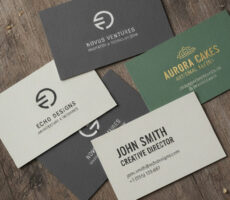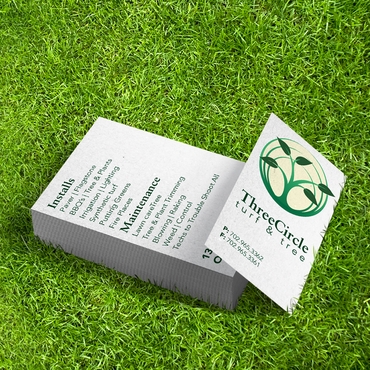

Pick up two business cards with the same dimensions and completely different paper stocks, and you can usually feel the difference immediately.
One may feel light and flexible. The other may feel firm, substantial, and noticeably heavier in your hand.
That difference is business card thickness, and it can influence how people experience your card before they have even read your name.
The confusing part is understanding how thickness is measured.
Terms such as GSM, PT, card stock, paper weight, 14pt, 16pt, and 32pt often appear when ordering business cards, but they do not all describe exactly the same thing.
So what do they actually mean?
This guide explains business card paper thickness, the difference between GSM and PT, how standard and premium cards compare, and how to choose the right card stock for your business.
Key Takeaways
- Business card thickness describes how substantial and rigid a card feels, but it is not the same as paper weight.
- GSM measures paper weight per square meter, while PT refers to physical thickness in thousandths of an inch.
- Standard business cards offer a practical balance of quality and cost, while thicker stocks can create a more substantial feel.
- Thickness can affect durability, handling, and the impression a card makes when someone receives it.
- The best card stock depends on your brand, industry, budget, finish, and how the cards will be used.
What Is Business Card Paper Thickness?
Business card paper thickness describes the physical thickness of the stock used to produce the card.
Generally, a thicker card feels more rigid and substantial, while thinner stock is more flexible.
However, paper thickness and paper weight are not the same measurement.
Paper can vary in density, fiber composition, coatings, and manufacturing process. Two stocks with a similar weight may therefore have slightly different physical thicknesses.
This distinction explains why business card specifications can initially seem confusing.
In the printing industry, you may encounter terms including:
- PT (point): used to describe physical thickness.
- GSM (grams per square meter): measures paper weight.
- Card stock: a general term for heavier, more durable paper.
- Paper weight: the mass of the paper rather than its exact thickness.
- Bulk: a printing term associated with the thickness of paper relative to its weight.
Understanding these measurements makes comparing business card options much easier.
Why Business Card Thickness Matters
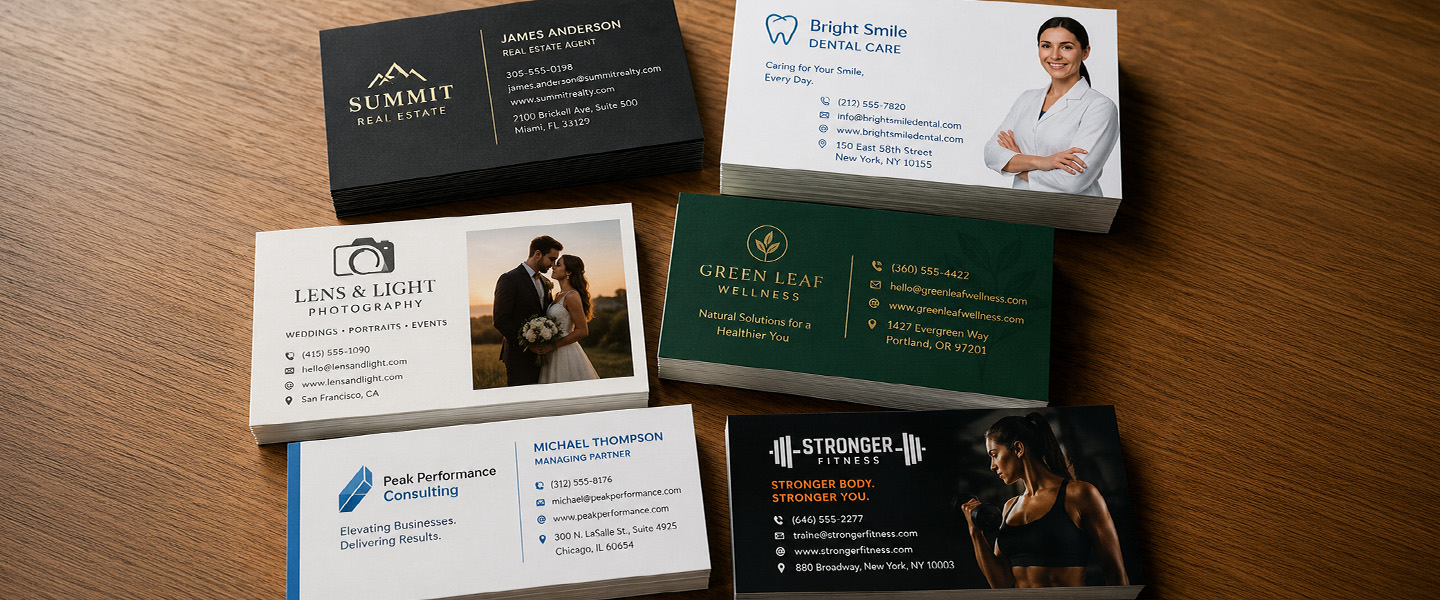
Thickness may seem like a small detail, but business cards are physical marketing tools.
People do not simply look at them.
They hold them.
That tactile experience can influence the overall impression of your card and, by extension, your brand.
It Can Create a Stronger First Impression
When someone receives a business card, its weight and rigidity are immediately noticeable.
A substantial card can communicate attention to detail before the recipient even starts reading.
That does not mean every company needs the thickest stock available. It simply means paper choice becomes part of the overall presentation.
It Improves Durability
Business cards spend time in pockets, wallets, bags, desk drawers, and card holders.
A sturdier stock is generally better equipped to maintain its shape during normal handling than very lightweight paper.
For professionals who distribute cards frequently at meetings, networking events, conferences, or appointments, durability can be an important consideration.
It Supports Your Brand Image
The right paper stock should reinforce the personality of the business.
A straightforward professional services company may prefer a traditional card with a clean matte finish.
A luxury brand may want something more substantial.
A designer or creative professional might choose an unusual stock or finish to make the physical card part of the creative experience.
Paper thickness is therefore not only a technical printing decision. It can also be a branding decision.
It Influences Perceived Quality
Small physical details can influence how people evaluate printed materials.
Thickness, texture, finish, color reproduction, typography, and overall design work together to create the finished impression.
A thicker card cannot rescue a poor design, but an appropriate paper stock can make a strong design feel more complete.
Read Cheap Business Cards vs Premium Ones: What Clients Actually Notice for a closer look at how these details influence perception.
Understanding GSM vs. PT
GSM and PT are two terms you are likely to encounter while comparing business card stocks.
They measure different things, so they should not be treated as interchangeable.
What Is GSM?
GSM stands for grams per square meter.
It measures how much one square meter of a particular paper weighs.
For example, 350 GSM means that one square meter of that paper weighs approximately 350 grams.
GSM is widely used internationally and makes it easier to compare paper weights because the measurement does not depend on the dimensions of an individual sheet.
A higher GSM generally indicates a heavier stock.
However, heavier does not always mean proportionally thicker because paper composition, coatings, density, and manufacturing methods can affect the finished stock.
What Is PT?
PT stands for point.
In printing, one point represents one-thousandth of an inch of thickness.
That means:
- 14pt = approximately 0.014 inches thick
- 16pt = approximately 0.016 inches thick
- 32pt = approximately 0.032 inches thick
Unlike GSM, PT describes physical thickness rather than weight.
This is why PT is particularly useful when comparing how substantial different business cards may feel.
GSM vs. PT Comparison Table
There is no universal exact conversion between PT and GSM because different papers have different densities and compositions.
However, approximate comparisons can make the terminology easier to understand.
| PT | Approx. GSM | Typical Use |
| 14 PT | ~300 GSM | Standard professional business cards |
| 16 PT | ~350 GSM | Thicker everyday business cards |
| 18 PT | ~400 GSM | Premium card stock |
| 32 PT+ | Varies by construction | Extra-thick or layered business cards |
Important: These GSM equivalents are approximate. Paper coatings, fibers, density, and layered construction can change the relationship between paper weight and actual thickness.
When comparing products, use the printer’s individual paper specifications rather than relying exclusively on a PT-to-GSM conversion.
Standard vs. Premium Business Card Thickness
There is no single business card thickness that works for every company.
The right choice depends on what the card needs to accomplish.
Standard Business Cards
A standard card stock is a practical choice for everyday business use.
It generally provides a good balance between:
- affordability,
- durability,
- professional appearance,
- and easy handling.
At Overnight Prints, Business Cards are available with options including 14pt and 16pt card stock.
Standard stocks work particularly well when you distribute cards frequently and need larger quantities without making the card unnecessarily heavy.
Best for: everyday networking, small businesses, startups, sales teams, events, and high-volume distribution.
Premium Business Cards
Premium cards focus more heavily on the tactile experience.
A thicker or more distinctive stock can make the card feel more substantial and can complement brands that place greater emphasis on presentation.
Premium Business Cards can be particularly useful when the card is part of an important first impression.
Best for: consultants, executives, agencies, designers, real estate professionals, boutique businesses, and client-facing professionals.
Ultra-Thick Business Cards
Ultra-thick cards take the tactile experience further.
Instead of feeling like ordinary card stock, they have significantly more rigidity and presence.
For businesses that want this effect, Thick Business Cards offer a substantially heavier alternative to conventional 14–16pt cards.
These cards are especially useful when the physical business card itself is intended to become part of the brand experience.
Best for: luxury brands, high-end services, creative professionals, designers, consultants, and businesses that distribute fewer cards but want each one to make a stronger impression.
Quick Business Card Thickness Comparison
| Type | Feel | Durability | Cost | Best For |
| Standard | Familiar and professional | Good | Lower | Everyday networking |
| Thicker Standard | More substantial | Very good | Moderate | Client-facing professionals |
| Premium | Refined and distinctive | Very good | Higher | Stronger brand presentation |
| Ultra-Thick | Very rigid and substantial | Excellent | Higher | Luxury and high-impact branding |
The most expensive or thickest card is not automatically the best one.
The goal is to choose a stock that makes sense for the way your business actually uses business cards.
How to Choose the Right Business Card Thickness

Instead of choosing paper based solely on specifications, consider your audience and the impression your business needs to create.
Small Businesses
For many small businesses, a standard or moderately thick card provides the best balance of professionalism and affordability.
If you regularly hand out large quantities, spending significantly more on ultra-thick stock may not be necessary.
A well-designed Business Card on quality card stock can already create a polished impression.
Corporate Professionals
Corporate professionals generally benefit from a clean, substantial card that fits comfortably into standard wallets and card holders.
A traditional format with a slightly heavier stock and restrained finish can communicate professionalism without becoming distracting.
Real Estate Agents
Real estate is highly relationship-driven, which means business cards often accompany meetings, property tours, open houses, and referrals.
A more substantial card can work particularly well when paired with professional photography, clear contact information, and consistent personal branding.
Creative Professionals
Designers, photographers, architects, artists, and other creative professionals have more freedom to experiment.
Paper stock, thickness, shape, finish, typography, and even the edges of the card can become part of the design.
For these professionals, a thicker or less conventional card can demonstrate creativity before a portfolio is even opened.
Luxury Brands
Luxury businesses often benefit most from premium or ultra-thick cards because tactile details can reinforce a high-end positioning.
A thicker card paired with minimal typography and an appropriate finish can create a sophisticated result without requiring an overly complicated design.
Startups
Startups should consider how frequently cards will be distributed and where they fit within the marketing budget.
If you are attending multiple events or rapidly growing your network, a quality standard stock may provide better value.
As the company becomes more established, premium cards can be introduced for executives, investors, high-value prospects, or important meetings.
Don’t Forget About the Finish
Thickness is only one part of how a business card feels.
The finish can change the visual and tactile experience just as significantly.
Common options include:
Matte: Smooth and understated, often chosen for a clean professional appearance.
Glossy: Reflective and vibrant, useful for designs featuring strong colors or photography.
UV coating: Adds a glossy protective surface.
Spot UV: Adds gloss selectively to particular design elements, creating contrast between surfaces.
A thinner card with the right finish may fit a brand better than a very thick card with the wrong finish.
For a complete comparison, read What’s the Best Business Card Finish for Your Brand? Matte, Glossy or Soft Touch.
Common Business Card Thickness Mistakes to Avoid
Choosing Based Only on Price
Price matters, particularly when ordering large quantities.
But the cheapest option is not automatically the best value if it does not match how the cards will be used.
Consider cost alongside durability, quantity, audience, and brand positioning.
Assuming Thicker Is Always Better
A thicker card can feel premium, but there is a point where additional thickness may not provide meaningful value for every business.
If you distribute hundreds of cards at events, a practical standard stock may make more sense than an ultra-thick card.
Confusing GSM With PT
Remember:
GSM measures weight.
PT measures thickness.
They are related, but they are not the same.
Avoid treating GSM-to-PT conversions as exact measurements.
Ignoring the Finish
Thickness does not determine the entire tactile experience.
Matte, gloss, coatings, textures, and other finishes can dramatically change how the same card stock looks and feels.
Choosing a Stock That Doesn’t Match Your Brand
An ultra-thick luxury card may feel unnecessary for a casual, high-volume service business.
Likewise, an extremely lightweight card may not support the image a premium consultant or luxury brand wants to create.
The best choice is the one that feels intentional.
Thickness Is Only One Part of a Great Business Card
Paper matters, but it cannot compensate for missing information or poor design.
A professional business card also needs:
- clear typography,
- enough white space,
- accurate contact information,
- consistent branding,
- appropriate dimensions,
- and a logical visual hierarchy.
Before ordering, make sure the design itself works.
If you’re still deciding what information belongs on your card, read What Information Should You Actually Put on a Business Card?.
You can also review the Business Card Size Guide to compare standard, Euro, square, and other card formats.
Why Choose Overnight Prints for Business Cards?
Overnight Prints offers multiple business card options for different budgets, industries, and branding needs.
Depending on the product, customers can choose from standard and thicker card stocks, different sizes, and finishes such as matte, glossy, UV, and Spot UV.
Businesses looking for an everyday option can explore Business Cards, while brands that want a more distinctive presentation can compare Premium Business Cards, Thick Business Cards, Sandwich Business Cards, and Ultra Thick Business Cards.
Rather than simply choosing the thickest available option, compare the stock, finish, design, quantity, and intended use to find the combination that best represents your business.
Frequently Asked Questions About Business Card Thickness
-
What is the standard thickness of a business card?
Standard business cards commonly use 14pt or 16pt cardstock. A 14pt card measures approximately 0.014 inches thick, while a 16pt card measures 0.016 inches. Both are suitable for everyday business use, although 16pt feels slightly more substantial.
-
How thick is 14pt paper?
14pt cardstock is approximately 0.014 inches (0.356 mm) thick. It is a common choice for standard business cards because it provides a professional appearance while remaining flexible and practical for everyday networking.
-
What does 16pt paper mean?
16pt means the paper is approximately 0.016 inches (0.406 mm) thick. The PT measurement describes physical thickness, not paper weight. Compared with 14pt cardstock, 16pt cards generally feel firmer and more substantial.
-
Is 14pt or 16pt cardstock better for business cards?
Both are good options. Choose 14pt for affordable, everyday business cards distributed in larger quantities. Choose 16pt if you prefer a slightly thicker, sturdier card. The best choice depends on your budget, brand, and how frequently you distribute cards.
-
What is 16pt cardstock in GSM?
16pt cardstock is often compared with approximately 350 GSM paper, but there is no exact universal conversion. PT measures thickness, while GSM measures weight. Paper density, coatings, and manufacturing methods can affect the relationship between the two measurements.
-
What is the best GSM for business cards?
Around 300–350 GSM is a common range for standard business cards, while heavier stocks may be used for premium designs. The best paper weight depends on the desired rigidity, finish, durability, and brand presentation.
-
What is the difference between GSM and PT in business cards?
GSM stands for grams per square meter and measures paper weight. PT stands for points and measures paper thickness in thousandths of an inch. For example, 16pt cardstock is approximately 0.016 inches thick, but its GSM depends on the paper’s composition and density.
-
Are thicker business cards more professional?
Thicker business cards can create a more substantial, premium feel, but thickness alone does not determine professionalism. A well-designed 14pt or 16pt card can look professional, while ultra-thick cards may be better suited to luxury brands and businesses that want a distinctive tactile experience.
Conclusion
Business card thickness influences more than durability.
It affects how the card feels in someone’s hand and can contribute to the overall impression your brand creates.
But there is no one-size-fits-all answer.
A small business distributing hundreds of cards may prioritize a practical standard stock. A consultant may prefer something more substantial. A luxury brand may decide that an ultra-thick card better reflects its positioning.
Understanding the difference between GSM and PT makes those decisions much easier.
Remember that GSM measures paper weight, while PT describes physical thickness. And because different stocks have different compositions, there is no perfect universal conversion between the two.
The best business card combines the right thickness, finish, design, size, and paper stock for the way your brand wants to be remembered.
Explore Business Cards and Premium Business Cards from Overnight Prints to compare options and find a card stock that fits your business.
Resources
- PRINTING United Alliance – Printing Industry Glossary – Industry terminology and definitions for paper, printing, grammage, and related production concepts.
- AIGA – The Professional Association for Design – Professional resources covering graphic design, visual communication, typography, and design practices.
- U.S. Small Business Administration – Business Guide – Resources for starting, managing, marketing, and growing a small business.